
- Print Business Cards in Sugar Land – Same Day Service
- Copying Services
- Document Printing, Finishing & Lamination in Sugar Land
- Flyers
- Print Banner in Sugar Land | Same-Day Banner Printing Near Me
- Graphic Design
- Photo Printing
- Postcard Printing
- Document Printing
- EDDM Full Service Postcards
- FotoZoomer Large Format Printing



Businessmailboutique
11645 S. Hwy 6
Sugar land, Texas 77498 United States (US)
Email: info@businessmailboutique.com
Route
You’re handed a power of attorney, a school form, a real estate packet, or a travel consent letter. The signer points to a blank line and asks, “Do I need a stamp here, a seal, or both?” That’s the moment when notary rules stop feeling theoretical.
Individuals often overlook a notary stamp and seal until a deadline is close and the document has to be accepted the first time. If the mark is blurry, in the wrong place, or the wrong type for that state, the paperwork can come right back. That’s frustrating for the signer and risky for the notary.
Notary seals have a long history. The practice goes back to ancient Egypt around 2750 BC, where scribes authenticated official documents, and it later developed in ancient Rome, where a notarius used wax seals to show authenticity and trust, according to this history of the notary seal. The tools have changed, but the purpose hasn’t. A notary’s mark still tells other people, “This act was performed by an authorized official.”
Today, the confusion usually isn’t about history. It’s about practical compliance. Which tool is allowed in your state? What happens if the document will be scanned? Does remote online notarization change the rule? And what should a notary do with an old seal after a commission ends?
Table of Contents
- Your Introduction to Notary Stamps and Seals
- Notary Stamp vs Seal What Is the Difference
- Essential Elements of a Compliant Notary Tool
- Navigating State by State Notary Seal Rules
- Proper Use and Common Notarization Mistakes to Avoid
- Maintaining Securing and Replacing Your Notary Tools
Your Introduction to Notary Stamps and Seals
A simple example shows why this topic matters. A customer brings in a signed affidavit that needs notarization before it can be sent with a larger application packet. The notary completes the certificate, applies the official mark, and the customer leaves thinking the job is done. Later, the receiving office rejects the document because the impression isn’t readable on a scan.
That problem usually starts with a misunderstanding of what the official mark is supposed to do. A notary stamp and seal isn’t decoration. It’s the visual proof that a commissioned notary completed a notarial act and attached the required identifying information in a form others can trust.
Why people mix up the terms
In everyday conversation, people often say “stamp” and “seal” as if they mean the same thing. Sometimes they do. In some places, “seal” refers broadly to the notary’s official marking tool, whether it leaves ink on paper or creates a raised impression. In other settings, “stamp” means the inked device and “seal” means the metal embosser.
That overlap is where confusion begins.
A good rule for beginners is this. Ask what kind of impression the tool leaves on the document, not just what someone calls it.
What matters in real life
If you’re a signer, you want your paperwork accepted without delays. If you’re a notary, you want a tool that matches your state’s rules and produces a clear result every time. If you run a business center or office that supports notarization, you also need to think about scanning, storage, replacement, and workflow.
Those modern details matter just as much as the official mark itself. The rest of this guide keeps the focus there.
Notary Stamp vs Seal What Is the Difference
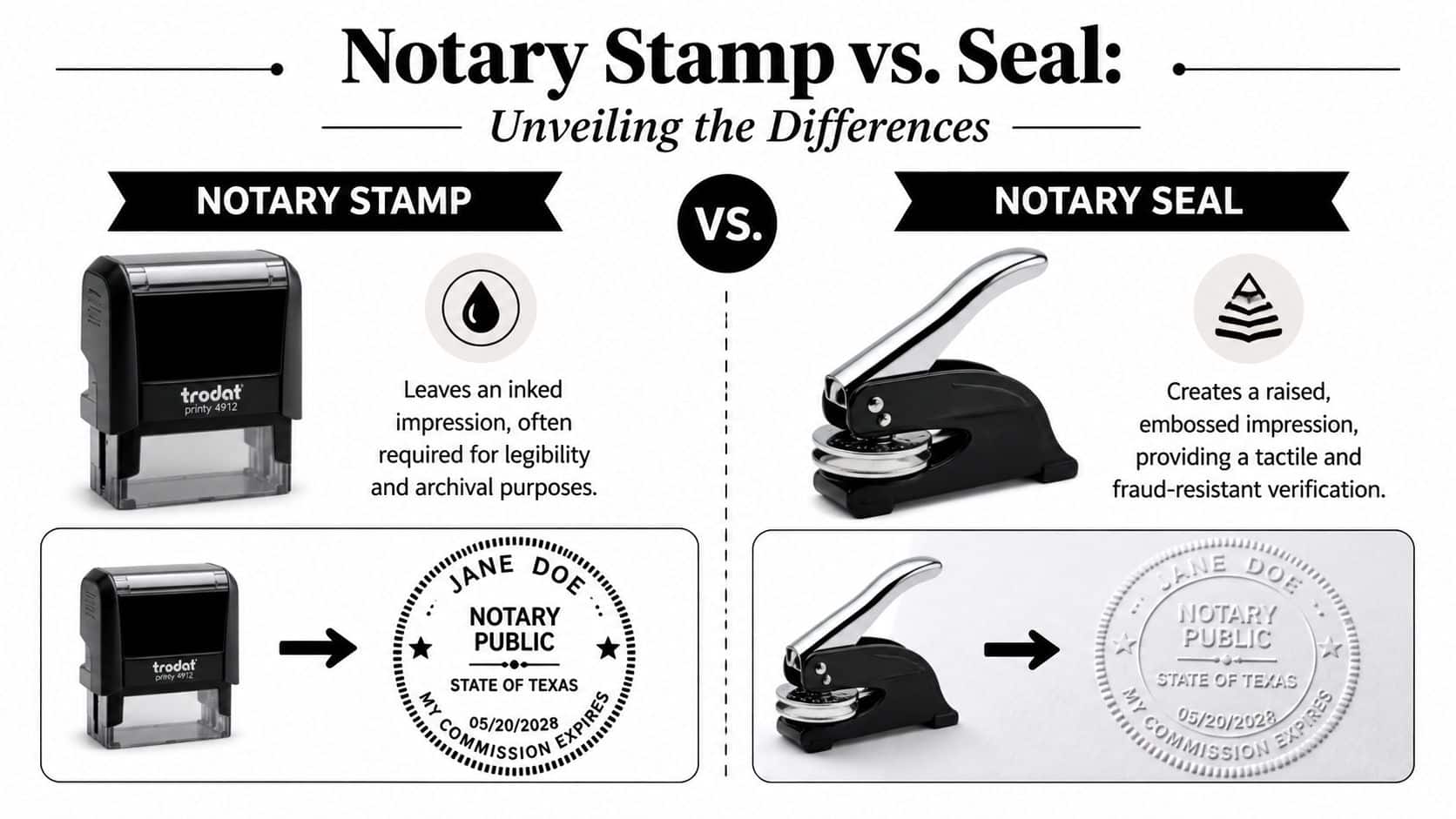
The easiest way to separate the two is this. A stamp is like a printed signature. A seal is like a fingerprint. One is built for readable information. The other adds a physical mark that’s harder to imitate casually.
What a notary stamp does
A notary stamp usually means an ink stamp. That might be self-inking or pre-inked. Its main job is legibility. It leaves the notary’s official information on the page in a format that other people can read quickly.
That’s why ink stamps are so common in current practice. The receiving party often needs to inspect the notary’s name, title, jurisdiction details, or expiration information without guessing at a faint impression.
Common advantages of an ink stamp include:
- Clear reading: The text is meant to be visible at a glance.
- Fast repeat use: It’s practical for offices handling multiple documents.
- Better copying results: Ink usually shows up more reliably on scans and photocopies.
What a notary seal does
A notary seal often means an embossing seal made from metal. Instead of ink, it presses a raised impression into the paper. People sometimes prefer it because it feels formal and visibly official.
That raised mark can add a layer of physical authentication. But it can also create problems if the document will be copied, scanned, or uploaded, because a plain embossment may not show clearly in a flat image.
Practical rule: If the document will travel through scanners, email, or digital intake systems, readability matters more than tradition.
Why some people use both
In some jurisdictions, a notary may need an ink stamp, an embosser, or a combination of both. That’s why it’s risky to buy a tool based only on what looks professional or what another notary uses in a different state.
Here’s a quick side by side comparison:
| Tool | How it marks paper | Main strength | Common concern |
|---|---|---|---|
| Ink stamp | Leaves an ink impression | Easy to read | Can smudge if poorly applied |
| Embosser seal | Creates a raised impression | Tactile authenticity | May not copy or scan clearly |
The real takeaway
When people ask which one is “better,” the practical answer is that compliance decides. The right tool is the one your state accepts and the receiving institution can process without delay. If a lender, court, school, or agency can’t verify the mark easily, the paperwork may stall even if the notary meant well.
Essential Elements of a Compliant Notary Tool
A compliant tool does two jobs at once. It identifies the notary, and it produces an impression that other people can use. If either part fails, the notarization can become harder to accept.

What information must be readable
Specific wording varies by jurisdiction, but a compliant notary tool typically includes the notary’s identifying details exactly as required by that state. The key point isn’t just that the information exists. It has to be legible on the final document.
If you’re checking a newly received stamp, look closely at:
- Name format: It should match the commissioned notary’s name as required by the jurisdiction.
- Official title: The tool should clearly indicate the notarial office.
- Jurisdiction details: The state or commissioning authority must appear in the required way.
- Expiration information: If the jurisdiction requires a commission expiration date on the stamp or seal, it must print clearly.
Why photographic reproducibility matters
One of the most important legal standards is that the notary seal must be photographically reproducible. That means the impression must be clear enough to be copied or scanned legibly. If it’s faint or smudged, courts, lenders, and government agencies may reject the document, as explained by this overview of photographically reproducible notary seals.
That requirement explains a lot of modern notary practice. It’s also why many notaries prefer tools that produce a crisp, repeatable impression instead of an inconsistent one.
A simple compliance check
Before using a new tool on a customer document, test it on plain paper and inspect it like a document reviewer would. Don’t just ask, “Can I kind of read it?” Ask, “Would a stranger scanning this into a file system read every required element without effort?”
Use this checklist:
- Stamp once on white paper. Avoid textured paper for the test.
- Check all text lines. Look for letters filling in, fading, or dropping out.
- Photocopy or scan it. Weak tools often fail during this process.
- Review spacing and borders. Crowded text can become unreadable fast.
If your test impression looks borderline in person, it usually looks worse after copying.
Choosing a practical tool
For many offices, self-inking and pre-inked tools are popular because they tend to produce consistent impressions. If you’re comparing options, focus on legibility first, then convenience. Fancy styling doesn’t help if the mark doesn’t reproduce well.
If you need a state-compliant custom impression tool for related office use, options like custom rubber stamps can help you compare formats and readability before ordering. Just remember that a notary’s official tool must match the notary laws and commissioning rules that apply to that notary.
Navigating State by State Notary Seal Rules
Many people often get tripped up, assuming notary rules are mostly the same everywhere. They aren’t.
A tool that works perfectly in one state can be wrong in another. The biggest differences usually involve ink color, stamp shape, and whether an embosser is required, optional, or not enough by itself.
Why one size doesn’t fit all
Some jurisdictions are very specific about the appearance of the official mark. State notary stamp requirement summaries note that Utah and Idaho require purple ink, while many other states require blue or black ink. The same source also notes that the District of Columbia requires an embosser exclusively, and that some jurisdictions require embossing in addition to an ink stamp.
That means a notary can’t safely borrow assumptions from a friend in another state, a national office handbook, or a generic online supply listing.
The wrong ink color or the wrong seal type isn’t a cosmetic error. It can affect whether the notarization is accepted at all.
Sample State Notary Seal Requirements
| State | Required Ink Color(s) | Embosser Requirement |
|---|---|---|
| Utah | Purple | Check current jurisdiction rules |
| Idaho | Purple | Check current jurisdiction rules |
| District of Columbia | Check current jurisdiction rules | Embosser exclusively |
| Florida | Check current jurisdiction rules | Embosser required with ink stamp |
| U.S. Virgin Islands | Check current jurisdiction rules | Embosser required with ink stamp |
The table is only a sample. It shows why notaries and office staff should verify current state rules before relying on a single tool for every transaction.
A practical example from mixed workflows
A signer in Texas may need a notarized document for use elsewhere. Another customer may have paperwork prepared by an out of state lawyer but signed locally. In those situations, people often ask whether the destination state’s formatting controls the seal choice. Usually, the starting point is still the notary’s own commissioning rules, but document recipients may have separate acceptance standards that create added friction.
That’s one reason service desks often pause to double check before stamping anything.
For in-person support with routine document notarization questions, some local customers use notary services in Sugar Land to confirm what type of appointment and document handling they need before the signature step begins.
Why offices need procedures, not guesses
A single-notary setup can sometimes manage by memory. A multi-service office can’t. If several staff members schedule notarizations, prepare packets, scan documents, or route customers to remote options, the office needs a written process for:
- State matching: Verify the notary’s commissioning state requirements before use.
- Tool separation: Keep different tools clearly labeled if more than one configuration is used.
- Final review: Inspect the completed certificate before the client leaves.
- Escalation: Pause when a document format or recipient requirement looks unusual.
That’s less glamorous than talking about seals, but it prevents preventable errors.
Proper Use and Common Notarization Mistakes to Avoid
A proper notary mark has to be more than valid in theory. It has to be applied in a way that leaves the document readable, complete, and ready for the next reviewer.

Basic placement mistakes
Most physical document errors are simple. The stamp lands over text. The impression is half off the page. The notary presses too lightly. Ink pools at one edge. Or the mark is placed where a clerk can’t easily connect it to the notarial certificate.
A clean process helps:
- Find the certificate first: Apply the stamp where it belongs with the notarial wording, not in a random blank space.
- Leave margins visible: Don’t cover signatures, dates, or printed language.
- Press evenly: Uneven pressure can make one side crisp and the other side unreadable.
- Inspect before releasing the document: A two-second review saves resubmission later.
When embossers cause modern problems
A major compliance gap appears in states that authorize embossers. This discussion of stamp and seal issues for hybrid workflows notes that embossers often struggle to satisfy the photographically reproducible standard needed for digital scanning. It also points out that guidance rarely explains how to handle Remote Online Notarization, or RON, when a traditional embossed seal is the prescribed tool.
That’s where people get stuck. A raised impression may satisfy an older paper habit, but the document may still need to be uploaded to a portal, emailed to counsel, or scanned into a lender’s system.
Hybrid workflow questions people ask
The most common questions sound like this:
-
If the state allows an embosser, is the embosser enough for a scanned file?
Not always. A raised impression may be hard to read on a flat image. -
If the document starts on paper but ends in a digital system, what matters most?
The final image still needs to communicate the notary’s official information clearly. -
Does RON eliminate paper-tool problems?
It can simplify some issues because the notarization takes place within an approved digital process, but notaries still need to follow the rules tied to their commission and platform.
In hybrid workflows, the safest habit is to think about the document’s final destination before the notarial act begins.
A short visual walkthrough can help if you’re new to the process:
A practical way to avoid rejections
Treat every notarized document as if it will be scanned, copied, and reviewed by someone who has no context. That means the stamp should be dark enough, complete enough, and placed cleanly enough to survive that trip.
If you use an embosser in a state that permits it, think carefully before relying on the raised impression alone in a digital or mixed environment. That’s one of the most common points of confusion in modern notarization.
Maintaining Securing and Replacing Your Notary Tools
A notary tool doesn’t stop being a compliance issue after purchase. Storage, wear, replacement, and disposal all matter. If the tool is lost, misused, or left intact after it should be retired, the risk doesn’t end with the commission term.

Day to day security
The first rule is simple. Keep the stamp or seal under the notary’s control. Don’t leave it on a shared front desk, in an unsecured drawer, or inside a general office supply cabinet.
A practical storage routine includes:
- Restricted access: Only the commissioned notary should control the official tool.
- Clean storage: Dust, heat, and pressure can affect impression quality over time.
- Routine testing: A quick test impression helps catch fading or distortion before a live appointment.
Replacement creates hidden risk
The awkward moment comes when a commission expires, a name changes, or a seal goes missing. Guidance on stamp and seal replacement requirements states that when a notary commission ends, the old stamp or seal must be thoroughly destroyed to prevent fraud. The same discussion also highlights a gap. There’s often very little practical guidance about documentation, transition timing, or liability during the replacement process.
That leaves real questions unanswered. If the new tool is delayed, can the notary keep working? Should the office maintain written proof of disposal? What if a multi-notary location discovers an old seal in storage months later?
Office insight: Treat seal destruction like a controlled records task, not like throwing away an old pen.
A careful disposal habit
Even where detailed disposal procedures aren’t spelled out, the safest approach is to create an internal record for your own protection. That can include the date the tool was retired, why it was replaced, and how it was destroyed or defaced.
If your notarization work includes digital appointments, it also helps to understand how your physical tool rules connect with electronic processes such as remote online notary services. Replacement planning is easier when your office knows which services depend on physical tools and which rely on approved digital workflows.
A secure, documented replacement habit won’t eliminate every gray area, but it does reduce the chance that an outdated notary stamp and seal creates trouble later.
If you need practical help with notarization, document prep, printing, shipping, mailbox services, or questions about in-person and remote document workflows, Business Mail Boutique LLC in Sugar Land offers those services in one location. For customers dealing with time-sensitive forms, that kind of one-stop support can make it easier to get documents handled correctly on the first visit.

Related posts

How Does a Virtual Address Work? A Clear Guide
How Does a Virtual Address Work
You're probably dealing with one of these problems right now. Your business is new, so your home add...

Custom Engraved Coffee Mugs and Etched Mugs: A Guide
Custom Engraved Coffee Mugs and Etched Mugs: A Guide
You need a mug fast. Maybe it's a retirement gift for someone who's been drinki...
PrintScan Authorized Fingerprinting Service Center Guide
You've probably got a form in one hand and a deadline in the other. A new job wants a background check. A licensing board needs prints....