
- Print Business Cards in Sugar Land – Same Day Service
- Copying Services
- Document Printing, Finishing & Lamination in Sugar Land
- Flyers
- Print Banner in Sugar Land | Same-Day Banner Printing Near Me
- Graphic Design
- Photo Printing
- Postcard Printing
- Document Printing
- EDDM Full Service Postcards
- FotoZoomer Large Format Printing


Direct Mail Response Rates: A 2026 Guide for SMBs
Businessmailboutique
11645 S. Hwy 6
Sugar land, Texas 77498 United States (US)
Email: info@businessmailboutique.com
Route
A lot of small business owners still treat mail like an old channel. The data says otherwise. According to the 2025 ANA/DMA Response Rate Report summary, direct mail averages a 4.4% response rate, compared with 0.12% for email, which is about 36 times higher.
That changes how you should think about local marketing in Sugar Land. Direct mail isn’t a nostalgia play. It’s a measurable way to put a real offer in front of the right households, track action, and build campaigns that don’t disappear in a crowded inbox. If you’re already working on how to improve conversion rates, mail deserves a place in that conversation because response quality starts with attention, relevance, and a clear next step.
For local businesses, execution matters just as much as strategy. The design has to print cleanly, the list has to match the audience, and the final piece has to arrive looking professional. That’s why the production side matters too, especially when you’re coordinating campaigns with marketing material printing services close to home instead of trying to manage everything through scattered vendors.
Table of Contents
- Understanding Direct Mail Response Rates in 2026
- Direct Mail Benchmarks and What to Expect
- The 5 Levers That Control Your Response Rate
- Measuring Your Campaign Success Beyond Responses
- Smart Testing to Boost Your Direct Mail Results
- Your Local Partner for High-Response Mail Campaigns
Understanding Direct Mail Response Rates in 2026
Direct mail still earns attention because a printed piece reaches people in a format they physically handle. Response rates in 2026 are less about the channel by itself and more about whether the campaign matches the audience, the offer, and the buying habits of the area you serve.
A response rate is the share of recipients who take the action you asked for. That action could be a phone call, a QR scan, a landing page visit, a coupon redemption, or an appointment request. Set that goal before anything goes to print. If the action is vague, the result will be hard to measure and harder to improve.
For Sugar Land businesses, local context matters more than broad marketing talk. A dental office mailing to nearby families needs trust and clarity. A roofer mailing after a storm needs speed and a strong call to action. A restaurant needs timing, a clear offer, and an easy reason to visit this week, not someday.
Why local execution matters
National benchmarks help set expectations, but they do not choose your list, your format, or your offer. Those decisions happen at the local level, and they affect performance more than many owners expect. I see the difference every week between mail that was sent because a business needed to “do some marketing” and mail that was built for a specific neighborhood, season, and customer type.
Production matters too. Paper stock, size, finish, readability, and the way the piece feels in hand all shape response. A well-planned postcard or self-mailer often pulls better than a generic template because it looks intentional and gives the recipient one clear next step. Businesses that invest in marketing material printing for direct mail campaigns usually get cleaner execution and better tracking discipline from the start.
This is the point where many campaigns either gain momentum or waste budget. The businesses that treat direct mail like a real system tend to learn faster and improve faster.
What good response rate thinking looks like
Good campaigns start with a few clear decisions:
- A defined audience: current customers, lapsed customers, nearby households, or a targeted prospect segment
- One primary action: call, scan, visit, redeem, register, or book
- A measurable response path: a unique phone number, campaign landing page, QR code, or offer code
- A format that fits the sale: postcard, letter, menu mailer, coupon piece, or neighborhood announcement
There is another trade-off worth stating plainly. A mail piece can get responses and still disappoint if the landing page, front desk, or sales follow-up is weak. That is why business owners who want better mail performance should also understand how to improve conversion rates, because the campaign only works when the response path is easy to complete.
Direct mail is still practical. Unfocused campaigns are what underperform.
Direct Mail Benchmarks and What to Expect
A business mailing 1,000 pieces should not expect 500 replies. A realistic benchmark is much tighter than that, and the difference between a healthy result and a disappointing one usually comes down to list quality, offer strength, and how easy you make the response.
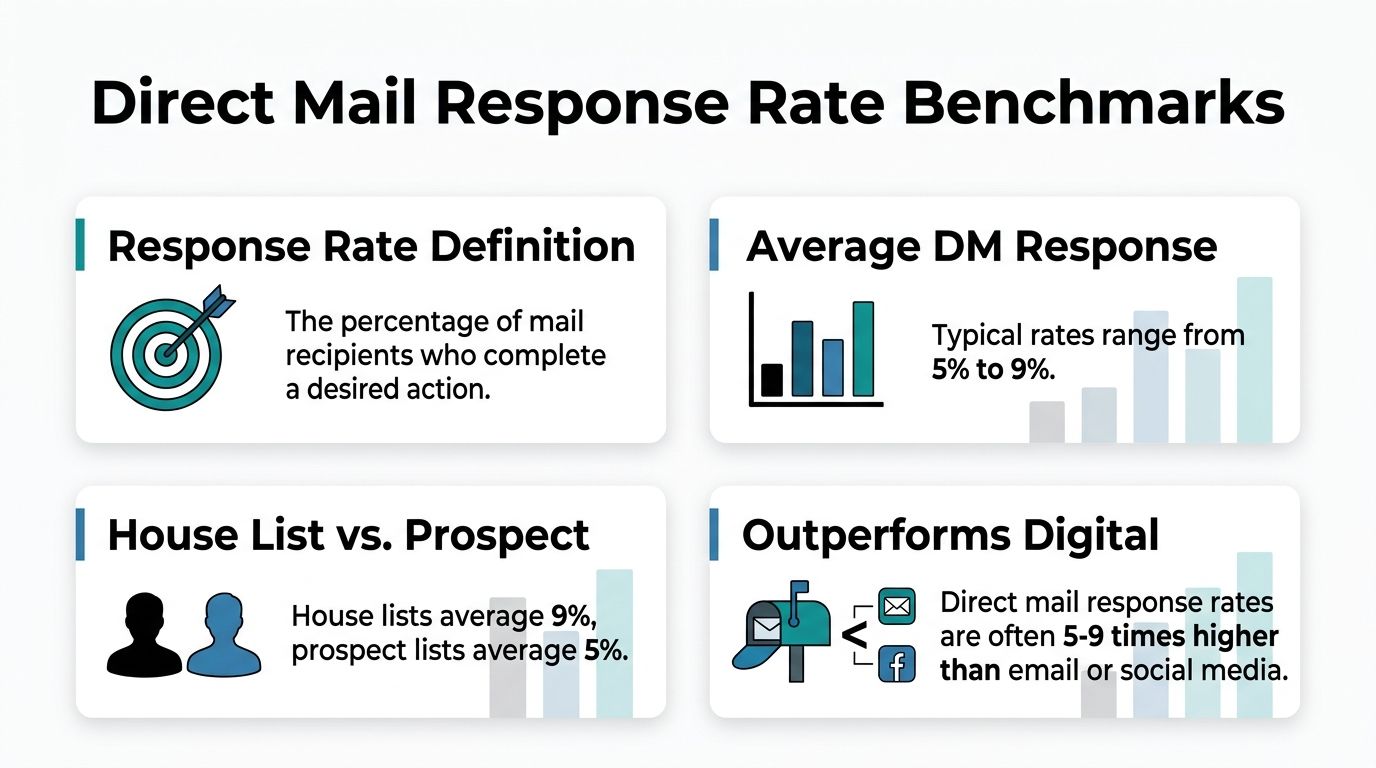
For Sugar Land businesses, benchmarks are useful because they keep planning grounded. A neighborhood service company mailing past customers should judge results differently than a retailer prospecting cold households across a wider area. I see business owners get frustrated when they compare two campaigns that were built for completely different audiences.
What response rate actually means
Response rate is the percentage of recipients who take the action your mail piece asks for. The formula is simple:
| Term | Meaning |
|---|---|
| Responses | The number of people who took the action you asked for |
| Total mailed | The number of pieces sent |
| Response rate | Responses divided by total mailed, then multiplied by 100 |
The hard part is not the math. The hard part is tracking every response path consistently.
Calls, QR scans, coupon redemptions, online form fills, and walk-ins all count if they came from the campaign. If your front desk does not ask, or your landing page is shared with other promotions, the response rate you calculate will be lower quality than the campaign itself. That is one reason local execution matters. A shop working with Business Mail Boutique can set up the piece, offer, and tracking method together instead of treating mailing and measurement as separate jobs.
The benchmark numbers that matter
According to the 2025 ANA/DMA Response Rate Report summary, the average direct mail response rate is 4.4%, while email marketing averages 0.12%. For planning purposes, that gives small businesses a reasonable starting point: direct mail can still produce measurable action when the campaign is built well.
That same summary reports a clearer range by audience type:
- House lists: 5% to 9%
- Prospect lists: 2.0% to 4.4%
Those ranges are more useful than a single average. If a Sugar Land gym mails a win-back offer to former members, it should expect different behavior than a new home services company mailing nearby homeowners who have never heard the name before.
Format also affects what “good” looks like. A simple postcard can work well for reminders, local offers, and neighborhood awareness, especially when the message is tight and the call to action is obvious. Many small businesses start with custom 4×6 direct mail cards for small business campaigns because they are affordable to test, easy to deploy locally, and fast to read.
Why house lists usually win
House lists perform better because the recipient already knows who you are. That prior contact changes the starting point. You are not asking a stranger to trust you from scratch.
A house list can include past buyers, current customers, leads, subscribers, or people who requested information. Prospect lists are still useful, especially for route-based service businesses and local expansion, but they need more from the offer and creative to earn attention.
That is the trade-off. House-list campaigns usually produce stronger response rates. Prospect campaigns usually help you reach new revenue.
For many small businesses, the smartest first move is to mail the customer file before scaling into broader prospecting. It is often the faster way to learn what offer, format, and message perform well in your local market.
The 5 Levers That Control Your Response Rate
You can’t control whether every recipient is ready to buy today. You can control the campaign mechanics that make response more likely. In practice, five levers drive most direct mail outcomes.
A useful way to think about them is this: if one lever is weak, the others have to work harder.
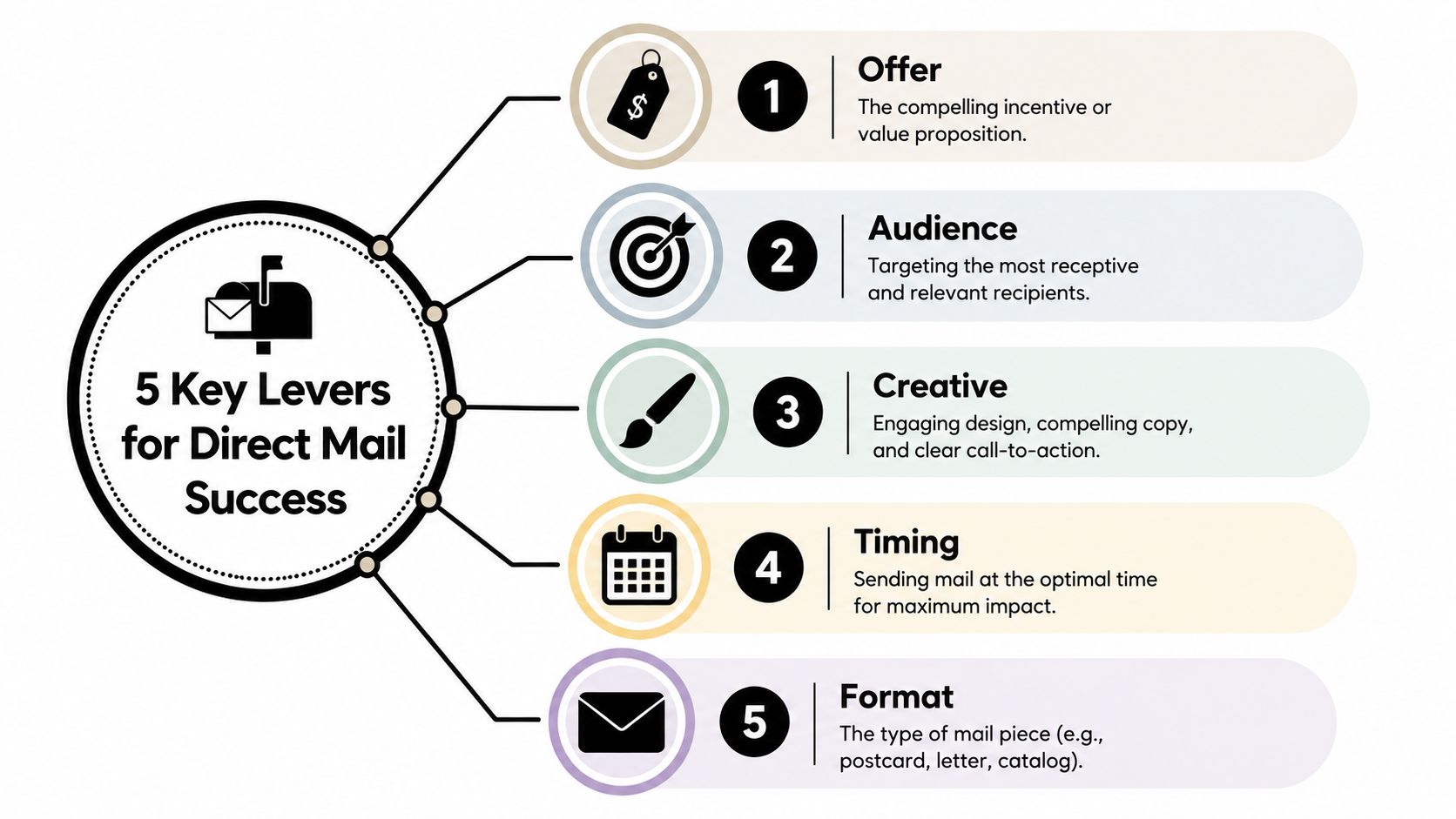
The list comes first
The list is the foundation. If the wrong people get the piece, even strong design won’t rescue the campaign.
For local businesses, this usually means one of three approaches:
- Customer file mailings: Best when you have a usable list of current or former customers.
- Geographic targeting: Useful for local service areas, route density, and neighborhood awareness.
- Segmented prospecting: Better than broad “every door” thinking when your offer suits a specific type of buyer.
House lists generally outperform prospect lists because the relationship is already there. That’s why list hygiene matters so much. Remove bad addresses. Suppress people who shouldn’t receive the offer. Segment by behavior if you can.
Offer beats clever design
Many businesses spend too much time choosing colors and too little time strengthening the offer. People don’t respond because a postcard looks nice. They respond because the value is clear.
A strong offer usually answers three questions fast:
- Why should I care?
- Why should I act now?
- What do I do next?
That doesn’t always mean a discount. It could be a consultation, a free checkup, an upgrade, a limited service package, early access, or a customer-only invitation. The key is relevance. A weak offer printed beautifully is still a weak campaign.
Creative has one job
Creative should guide attention, not show off. The best mail pieces are easy to scan and impossible to misunderstand.
Use creative to support these basics:
- Headline first: State the benefit immediately.
- Visual hierarchy: Make the offer, proof, and CTA easy to find.
- Readable copy: Short sentences win. Dense paragraphs lose.
- One primary CTA: Don’t split attention across five actions.
If you’re mailing postcards, sharp production matters because every square inch is working. A business that wants a compact mail format can learn a lot from a practical 4×6 card printing guide for small businesses, especially when deciding how much information the piece can realistically carry.
A quick visual walkthrough can help if you’re evaluating formats and layout choices before you print:
Format changes the outcome
Format is not cosmetic. It directly affects attention, perceived value, and response behavior.
According to Focus Digital’s summary of direct mail benchmarks, the average direct mail response rate is 3.63%, but performance varies sharply by format. Dimensional mailers achieve 12.19%, catalogs reach 10.30%, and untargeted postcard blasts yield 2.79%.
That tells you two important things:
| Format type | Practical takeaway |
|---|---|
| Dimensional mailers | Best for high-value targets where standing out matters most |
| Catalogs | Useful when product variety helps sell |
| Untargeted postcards | Easy to mail, but weak when the audience is too broad |
The lesson isn’t that postcards don’t work. It’s that untargeted postcards often don’t work well.
Personalization and timing finish the job
Personalization can be simple. Use the right neighborhood reference, relevant service language, or customer status. Timing can be simple too. Mail when the offer makes sense in the customer’s decision cycle.
The businesses that get steady results from mail usually don’t rely on one heroic campaign. They match the message to the moment and repeat what works.
A local dental office might mail hygiene reminders. A tax preparer might mail before filing urgency rises. A landscaping company might mail ahead of seasonal demand. Timing doesn’t need to be fancy. It needs to fit buyer behavior.
Measuring Your Campaign Success Beyond Responses
A 5% response rate can still lose money.
That happens more often than small business owners expect, especially when the mailing gets attention but the wrong households respond, the average job value is too low, or follow-up breaks down after the first inquiry. In Sugar Land, I see the strongest mail campaigns judged on what they produce in actual booked work, not just how many people called or scanned.
Start with response rate because it gives you a clean read on initial interest.
Response Rate = (Responses / Total Pieces Mailed) x 100
If 50 people respond from 1,000 mailed pieces, your response rate is 5%. Simple math. The hard part is deciding before the drop what counts as a response. A phone call, QR scan, form fill, redeemed coupon, and in-store visit are not equal unless you track them separately and tie them back to the same campaign.
Use tracking methods that fit how customers buy:
- Campaign-specific phone numbers: Best when calls are the main path to a sale.
- QR codes and landing pages: Good for booking, quote requests, and offer redemption.
- Offer codes or coupons: Useful for retail, restaurants, and service specials.
- Front-desk or sales staff attribution: Ask every lead how they heard about you, then record it consistently.
- Dedicated contact pages with high-converting lead forms: Helpful when the mail piece is meant to start an online inquiry.
Then measure what happened after the response. That is where many campaigns are won or lost.
A practical ROI check looks like this:
- Total the campaign cost. Include design, printing, postage, list acquisition or cleanup, and any finishing.
- Total the revenue tied to that campaign.
- Subtract cost from revenue, then compare the profit to what you spent.
- Review close rate, average sale, and repeat purchase potential.
That last step matters. A campaign that produces fewer leads can still be the better campaign if those leads close at a higher rate or turn into repeat customers. For a local HVAC company, one maintenance client may be worth far more over time than a batch of low-intent coupon calls. For a dental office, reactivation mail to former patients may outperform a broader prospecting campaign because the follow-up economics are better.
Small businesses also miss operational costs after the response comes in. If your campaign includes reply mail, returned pieces, warranty cards, or customer correspondence, details like return label printing for SMB workflows affect how quickly your team can process responses without errors or delays.
A few mistakes show up repeatedly in underperforming campaigns:
- Counting inquiries but not sales: Leads are only the first checkpoint.
- Ignoring full campaign cost: Postage, list work, and handling change the math.
- Skipping customer lifetime value: First-sale revenue can understate what the campaign produced.
- Using weak attribution: If every response gets labeled “heard about you somewhere,” the results are hard to trust.
- Waiting too long to review performance: Early tracking often exposes follow-up problems while the campaign is still active.
The best mail programs are accountable from print to payment. That is one reason local execution matters. A Sugar Land business working with a nearby mail partner like Business Mail Boutique can usually track response channels, mail timing, and operational follow-through more closely than a business buying print and mail from separate vendors in different markets.
Smart Testing to Boost Your Direct Mail Results
Most disappointing mail campaigns have one thing in common. The business sends one version, waits for results, and guesses why it worked or failed. That approach makes improvement slow.
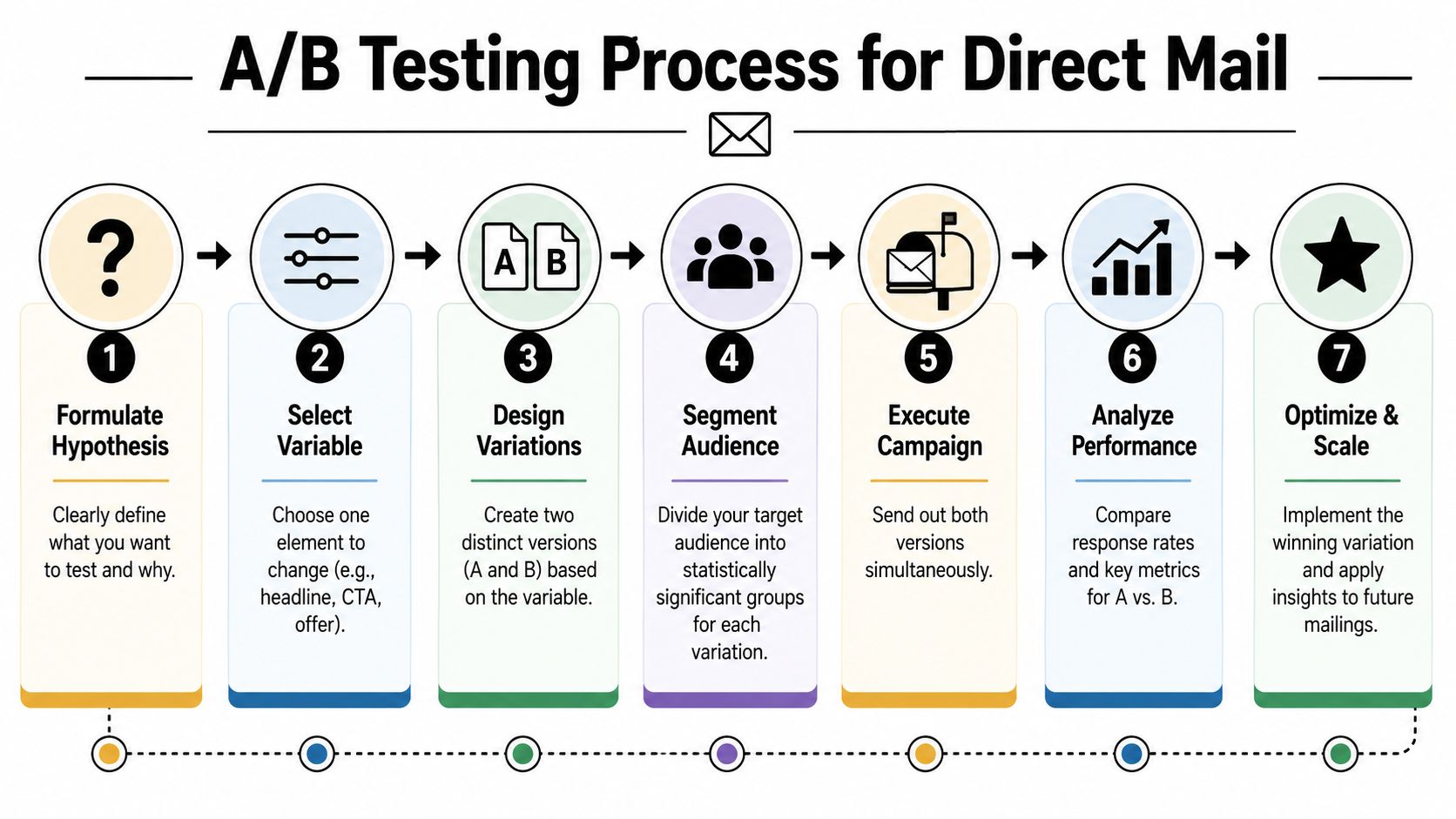
Testing gives you a better way to learn. It turns direct mail from a one-shot tactic into an optimization process.
Test one variable at a time
A clean A/B test changes one meaningful element while keeping the rest of the campaign stable. That way, when one version performs better, you know what likely caused the difference.
Good direct mail variables to isolate include:
- Headline: Benefit-driven wording versus problem-driven wording
- Offer: Free consultation versus limited-time package
- Call to action: Call now versus scan to book
- Format: Postcard versus letter
- Outer presentation: Plain envelope versus teaser copy on the envelope
Keep the audience comparable. Mail both versions to similar segments. Use the same timing. Track the same action.
What to test first
Start with the elements closest to buyer motivation, not tiny cosmetic details.
A practical testing order looks like this:
- Offer
- Audience segment
- Format
- Headline
- CTA mechanics
That order usually produces better learning because it reflects how people decide. The offer and audience do most of the heavy lifting. Buttoned-up creative refinements come later.
Build a response path that is easy to complete
A mail piece can earn attention and still lose the lead if the next step is clumsy. Here, many campaigns underperform. The printed piece may be solid, but the landing page, form, or intake process creates friction.
If the campaign pushes people online, study examples of high-converting lead forms so the handoff from mailbox to screen stays simple. Short forms, clear benefit language, and one obvious action usually outperform busy pages with too many fields and mixed messages.
Other response boosters are straightforward:
- Use QR codes carefully: Send people to a page built for mobile, not your generic homepage.
- Match the message: The landing page should repeat the same offer and language from the mailer.
- Keep staff aligned: If people call, whoever answers should know the campaign and the offer.
- Create urgency: Give a genuine reason to act soon, but don’t rely on gimmicks.
When a business tests regularly, poor campaigns become data instead of dead ends.
One more important point. Don’t test everything at once because you’re eager to improve fast. That usually creates confusion, not insight. Small businesses get the most value by making fewer changes, tracking them carefully, and carrying the winning elements into the next drop.
Your Local Partner for High-Response Mail Campaigns
For Sugar Land businesses, the biggest advantage in direct mail isn’t just knowing national benchmarks. It’s applying them locally with better execution. That means cleaner print, smarter format choices, more reliable mailing prep, and tighter coordination between creative, production, and delivery.
The practical takeaway is simple. Mail performs best when you treat it like a system. You define the audience. You choose a format that suits the offer. You track responses clearly. You measure ROI. Then you test and improve.
For a local business, having one nearby partner who understands printing, mailing, finishing, and business operations can remove a lot of friction. It’s easier to review stock, compare formats, catch production issues early, and move quickly when the vendor is part of your local market instead of a distant platform with no context for your audience.
That local context matters. A Sugar Land restaurant, clinic, contractor, law office, or boutique retailer doesn’t need generic advice. It needs mail that fits the neighborhood, the service area, and the customer base. The strongest campaigns usually don’t look flashy. They look relevant, clear, and credible.
If you want better direct mail response rates, start with disciplined basics. Build a real list. Make the offer worth acting on. Print something people will notice. Then measure what came back and improve the next round.
Business Mail Boutique LLC helps Sugar Land businesses turn those basics into finished campaigns with printing, mailing, and business support under one roof. If you need a local team for postcards, marketing materials, mailing prep, shipping support, or day-to-day business services, visit Business Mail Boutique LLC.

Related posts

Custom Memorial Glasses Engraved in Three Hours in Sugar Land
When a customer needed eight personalized glasses for a memorial, Business Mail Boutique completed the engraving or...

Custom Martini Glass Engraving in Sugar Land, TX
Custom Logo Engraving on Martini Glasses in Sugar Land, Texas.
Business Mail Boutique recently completed a beautiful custom engravin...

Custom Engraved Wine Glasses for a Golf Club Event in Sugar Land, TX
Custom Engraved Wine Glasses for a Golf Club Event in Sugar Land.
Custom wine glass engraving in Sugar Land, TX at Business Mail Bouti...