
- Print Business Cards in Sugar Land – Same Day Service
- Copying Services
- Document Printing, Finishing & Lamination in Sugar Land
- Flyers
- Print Banner in Sugar Land | Same-Day Banner Printing Near Me
- Graphic Design
- Photo Printing
- Postcard Printing
- Document Printing
- EDDM Full Service Postcards
- FotoZoomer Large Format Printing


Engraved Glasses for Wedding: A Practical Guide
Businessmailboutique
11645 S. Hwy 6
Sugar land, Texas 77498 United States (US)
Email: info@businessmailboutique.com
Route
You are likely compiling a list at this moment. Toasting flutes for the head table. Gifts for parents. Perhaps a set for the wedding party. Then the practical questions begin to emerge quickly: what style of glass works, what design will engrave cleanly, how many do you need, and how do you get fragile items packed and delivered without adding another headache to the week of the wedding?
That’s where engraved glasses for wedding planning can either stay simple or turn into a mess. The glass itself matters. The engraving method matters. Packaging matters more than most couples expect. If part of your order needs to go home with you and part needs to ship to out-of-town attendants, the process works better when design, production, packing, and carrier handoff are handled together instead of split across several vendors.
Table of Contents
- The Timeless Appeal of Personalized Wedding Glasses
- Choosing the Right Glass for Your Celebration
- Creating a Beautiful and Engravable Design
- Comparing Engraving Methods for the Perfect Finish
- Budgeting and Ordering for Your Wedding
- The Advantage of Local Engraving and Shipping
The Timeless Appeal of Personalized Wedding Glasses
Two weeks before the wedding, a couple often realizes the toast glasses are still not handled. The online option looks fine until they notice the delivery window is tight, the artwork proof is generic, and no one is answering practical questions about packing, breakage, or where the rest of the gift order will ship. Personalized wedding glasses keep their appeal because they solve more than one job at once. They are used during the celebration, kept afterward, and, if the order is handled by one local shop that engraves and ships, they remove a surprising amount of last-minute risk.
That staying power is not new. Engraved glass has been associated with ceremonial and gift use for centuries, and the same basic idea still holds up today. A well-made piece feels personal because it is tied to a date, a name, and a specific moment, but it also has a practical use once the wedding is over.
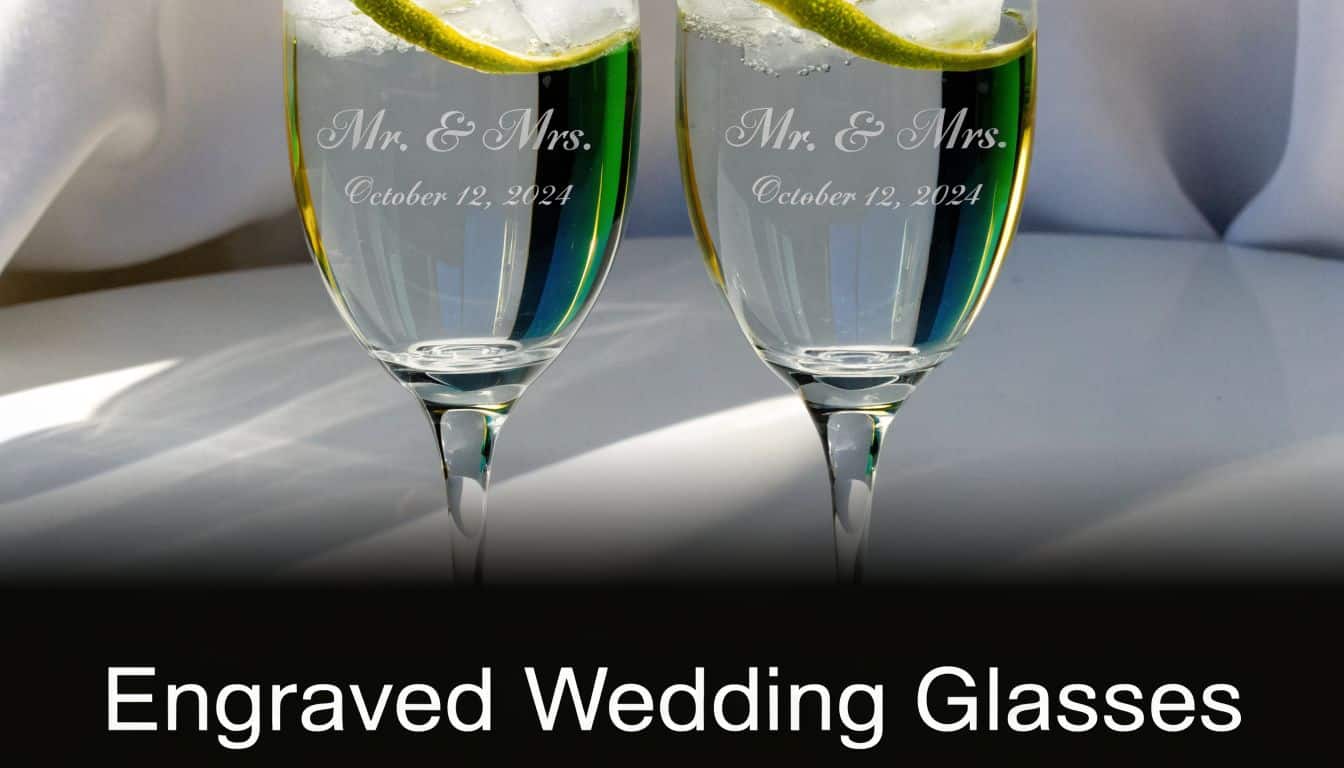
Keepsake first, drinkware second
The best orders are planned around who will use each piece after the event. A pair of engraved flutes usually stays with the couple. A few extra glasses can become parent gifts. Tumblers or shot glasses often make more sense for attendants because they are easier to pack, easier to ship, and less likely to sit in a cabinet unused.
That is the trade-off couples should pay attention to. The more decorative the glass, the stronger it may look in photos. The more practical the shape, the more often it tends to be used later. Good engraving does not fix a poor product choice.
Price matters too. Personalized glassware stays popular because it can scale up or down without forcing the whole gift budget in one direction. A couple can keep the head-table pieces more formal and choose simpler items for the wider wedding party. That kind of split order is much easier to manage when design, engraving, packing, and shipping are handled in one place instead of across multiple vendors.
Practical rule: Choose glassware people will reach for again. Reuse is what turns a custom piece into a keepsake.
Why these pieces work so well for weddings
Wedding glasses sit in a useful middle ground. They are more personal than standard decor and more functional than many favors. They also work across different parts of the event, from the toast itself to parent gifts, welcome boxes, and thank-you packages sent after the wedding.
From the production side, they also fit wedding timelines well if the process is managed properly. Names, initials, and dates are straightforward to proof. Matching sets can be grouped for the couple, family, and attendants. Professional packing can be done at the same shop that engraved them, which reduces handoff errors and helps keep fragile items from getting damaged in transit. Online-only sellers rarely help much with that part.
For related gift ideas beyond glassware, customized items like laser engraved groomsmen flasks fit the same planning approach: practical pieces, personalized cleanly, used during the event, and kept afterward.
Choosing the Right Glass for Your Celebration
A week before the wedding is a bad time to learn that the glasses look great in a mockup but feel awkward in hand, hold too much for a quick toast, or cost far more to pack safely than expected. Glass choice affects all of that before the engraving file is even approved.
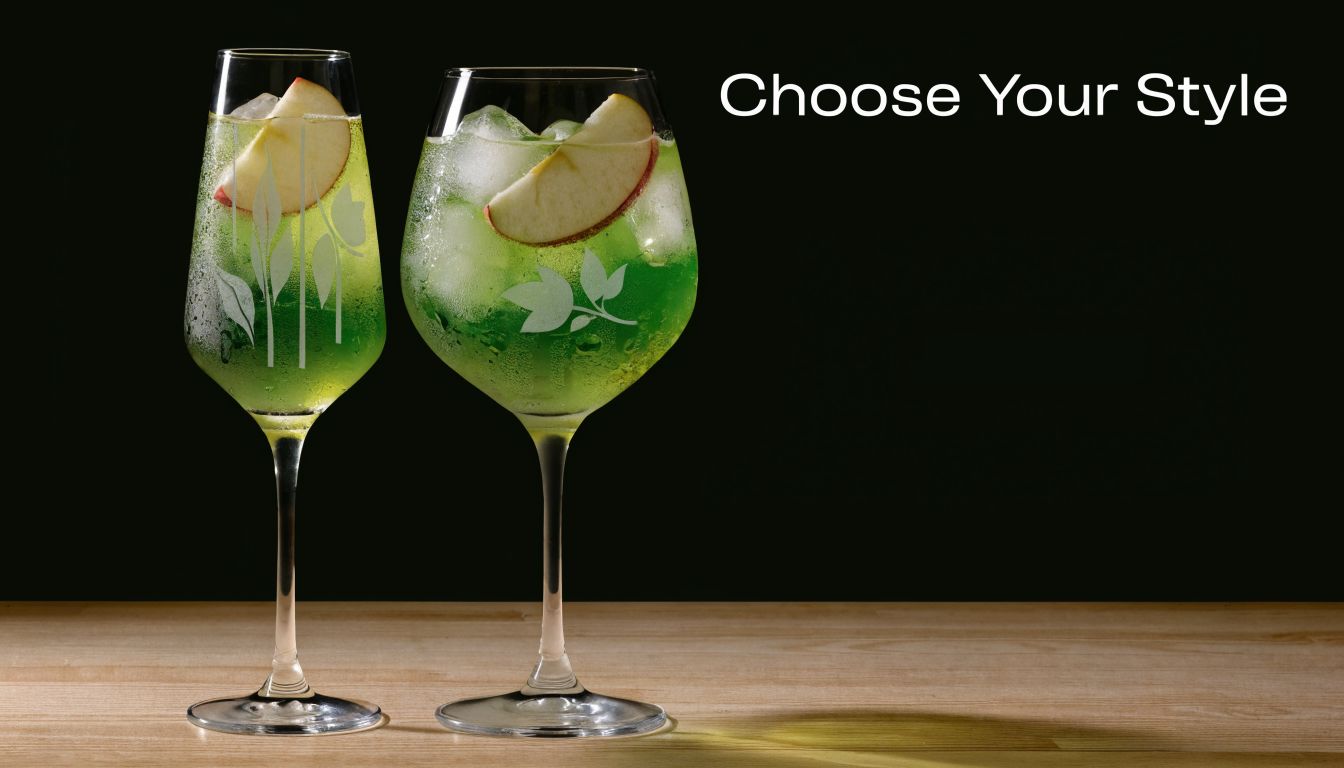
Start with the role each glass will play
Choose the glass based on how it will be used, not just how it looks on a product page. A couple’s toasting set has different needs than favors for 75 guests or thank-you gifts that need to survive shipping after the wedding.
Each style solves a different problem:
- Flutes suit a formal toast and keep the couple’s set traditional.
- Wine glasses give more room for names, dates, and monograms, which helps if the design needs to stay readable from across a table.
- Tumblers are easier to hold, easier to pack, and usually safer for wedding-party gifts or hotel welcome boxes.
- Shot glasses keep costs down for larger favor counts and work well when the engraving is simple.
Capacity matters too. A standard 75cl bottle of prosecco or champagne usually pours about 6 generous glasses or up to 8 smaller toast servings. That affects the order size. If only the couple, parents, and head table are using engraved pieces, flutes may make sense. If the engraved glasses are part of a wider group toast, many couples switch to a more practical shape or limit engraving to key participants.
Order the glassware and plan the pour at the same time. That prevents overbuying one and underestimating the other.
Match the glass to the engraving area
Some shapes are easier to engrave cleanly than others. Tall, narrow bowls look elegant, but they leave less forgiving space for long names or detailed artwork. Wider bowls and straight-sided tumblers usually give better results when the design includes two names, a date, or a monogram with flourishes.
This is one of the most common trade-offs I see at the counter. Couples pick a slim flute for the look, then need to shorten the wording to make it fit properly. That is usually the right call. A shorter layout on the right glass looks better than a crowded design on an expensive piece.
Glass or crystal
Material affects appearance, price, and how much risk you take on during handling and shipping.
Standard glass is often the practical choice for larger wedding orders. It keeps replacement costs lower if a piece breaks, and it usually makes more sense for favors, mixed sets, or wedding-party gifts that need to be packed in volume.
Crystal gives a brighter, more formal presentation and works well for a keepsake pair or parent gift. It also needs more careful handling. In real orders, that means more protective packing, more box space, and less margin for error if pieces are being shipped to another city or split across multiple addresses.
| Material | Best fit | Trade-off |
|---|---|---|
| Standard glass | Favors, wedding-party gifts, larger mixed orders | Less formal look than crystal |
| Crystal | Toasting pairs, parent gifts, keepsake sets | More delicate and usually more expensive to pack and ship |
For couples working on a deadline, a local shop has an advantage over an online-only seller. You can compare shapes in person, approve the engraving on the actual glass style, and have the same team pack and ship the finished order. That reduces the handoffs where breakage, delays, and packing mistakes usually happen.
Creating a Beautiful and Engravable Design
The design that looks best on a phone screen isn’t always the design that engraves best on a curved glass wall. The cleanest wedding pieces usually come from restraint: short wording, balanced spacing, and artwork simple enough to stay readable after it’s etched.
What translates well onto glass
Names, initials, wedding dates, short phrases, and simple monograms are usually the safest choices. Light line art can also work if it’s clean and not overloaded with tiny interior details. Think rings, floral outlines, a minimal crest, or a single branch motif.
What tends to fail is overcrowding. Long quotes wrap poorly. Thin script with lots of swashes can blur visually. Highly detailed photos or shaded artwork usually lose their character when reduced to an engraving area on a flute or tumbler.
A good review process is simple:
- Read the text at small size.
- Check whether the artwork still makes sense without color.
- Ask whether the design still works on a curved surface, not just a flat mockup.
Small adjustments before production matter more than fancy artwork. A shorter line of text often engraves better than a more ambitious layout.
File setup that saves time
If you already have artwork, vector files are the cleanest starting point. Formats such as .ai, .eps, and .svg scale better for engraving than pixel-based files like .jpg or .png, especially when the engraver needs to resize the design for different glass shapes.
For text-only pieces, legibility matters more than style. Script can work, but only if the letterforms stay open. Simple serif and sans serif fonts often produce the cleanest result on glass because the strokes remain distinct after etching.
A few design habits make orders smoother:
- Keep wording short so names and dates don’t have to be compressed.
- Use strong contrast in the artwork. Fine gray details from a photo file don’t convert well.
- Match the layout to the glass. A tall flute favors vertical balance. A wide tumbler handles broader layouts better.
- Approve one final proof before production starts. That’s where spelling, date format, and placement errors get caught.
When couples bring in a design with too much going on, the fix is usually subtraction, not redesign from scratch. Remove a line. Simplify the crest. Switch fonts. The final piece almost always looks stronger.
Comparing Engraving Methods for the Perfect Finish
The engraving method determines how the glass feels, not just how it looks. That’s the main trade-off couples should understand before ordering. Some finishes are fast and clean. Others are deeper and more tactile. Others are chosen because the craft itself is part of the appeal.
Laser engraving
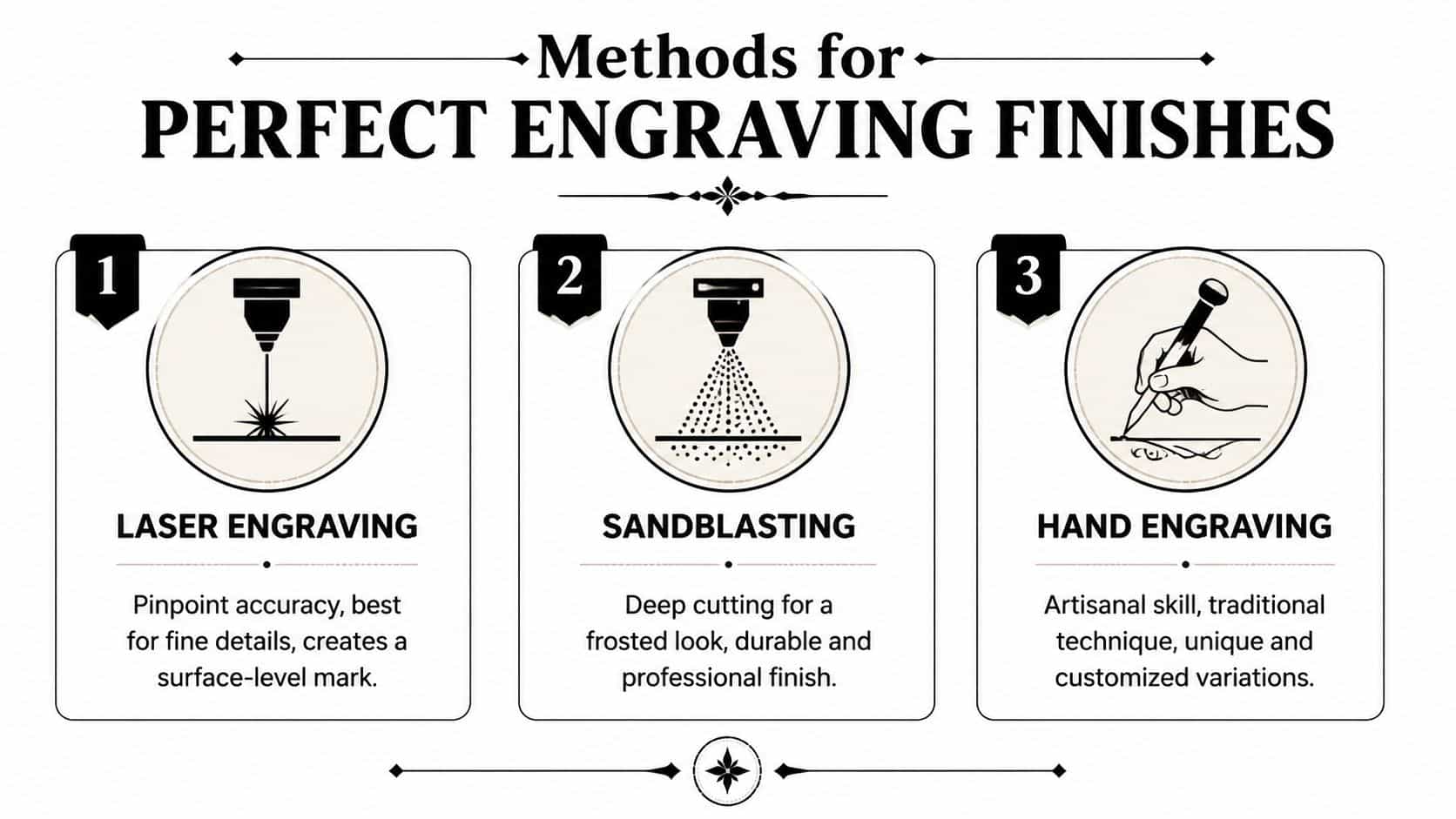
Laser engraving is a practical choice when turnaround matters and the artwork needs precision. It’s especially useful for names, dates, monograms, and repeatable designs across multiple pieces. On glass, the mark is usually surface-level and clean.
That precision is why laser works well for wedding orders with text-heavy layouts or mixed personalization where each piece needs a different name. It also suits local same-day or short-deadline jobs better than more labor-intensive methods in many shops.
For couples comparing service types, personalized engraving on glass is one example of a local service format where glassware can be customized for gifts and event use.
Sandblasting
Sandblasting gives a different result. It cuts deeper and leaves a frosted texture that people can feel with their fingertips. According to this glass engraving process explanation, sandblasting creates a 0.5-1.5mm etch, compared with laser engraving’s typical 0.1-0.3mm depth, produces a frosted look with 98% permanence, and can withstand over 1,000 dishwasher cycles.
That combination makes it attractive for wedding glassware that’s meant to feel substantial rather than lightly marked. It’s a strong fit for logo-style designs, bold monograms, and larger sets where a consistent frosted finish matters.
Sandblasting usually wins when the question is feel. Laser usually wins when the question is speed and fine text.
The trade-off is setup. Stencils, alignment, and masking take work, especially on curved pieces like flutes. For one-off rush orders with variable names, that can make laser the more practical route even if the etched depth is shallower.
Copper wheel engraving
Copper wheel engraving sits in a different category. It’s an old-school, artisan method associated with premium work and a carved appearance that machine methods don’t quite replicate. It’s beautiful when the order is centered on a keepsake pair or a small set where craft matters as much as utility.
It’s not usually the first recommendation for larger wedding favor runs or compressed timelines. The method is slower, more specialized, and best suited to buyers who want hand-crafted character rather than production efficiency.
A quick side-by-side view
| Method | Best for | Main strength | Main limitation |
|---|---|---|---|
| Laser | Names, dates, short runs, rush jobs | Precision and speed | Lighter surface mark |
| Sandblasting | Bold frosted finish, tactile etch, larger consistent runs | Deeper feel | More setup on curved glass |
| Copper wheel | Premium keepsake pieces | Hand-crafted carved look | Slower and less practical for bulk |
If the goal is a pair of wedding flutes that feel formal and substantial, sandblasting or hand work often makes more sense. If the order includes many personalized names or a tighter timeline, laser is usually the method that keeps the project moving.
Budgeting and Ordering for Your Wedding
Most pricing surprises happen because couples order by item type instead of by use case. Start with who needs a glass, then sort those people into groups: the couple, the wedding party, parents, and guests. That gives you a cleaner quantity plan and avoids buying too many of the wrong shape.
Build the order around use cases
A wedding order often works better when it’s split into small categories instead of treated as one large custom purchase.
- For the couple choose the most important pair first. Many people spend a little more attention on shape, finish, and presentation at this stage.
- For parents or attendants keep the design consistent, but don’t assume every item needs the same wording or same glass style.
- For favors or group gifts choose the easiest piece to produce, pack, and replace if needed.
Always leave room for real-world changes. Names get added. One glass breaks during setup. A planner decides a table needs matching pieces after the main order is already done. Ordering a few extras is usually easier than trying to match a discontinued blank later.
Where pricing usually changes
The biggest shift in price usually comes from quantity, not from tiny design changes. Wedding forums regularly show confusion around bulk ordering, and industry marketplace guidance on engraved wedding glasses indicates that tiered pricing is common, with per-unit costs dropping significantly for orders of 10-50+ units compared with single pieces.
That matters for budgeting because a pair of custom flutes and a set of party gifts behave like two different jobs. One is a small custom keepsake order. The other is closer to a batch production run.
A straightforward approach to consider:
| Order type | What usually drives cost |
|---|---|
| Single pair or small gift set | Setup time, artwork handling, glass quality |
| Mid-size group order | Repetition efficiency and personalization labor |
| Bulk favors | Unit economics, packaging, and consistency |
One practical local option for event-related custom glassware is engraving on wine glass and perfume bottles in Sugar Land, where the service format is geared toward personalized items rather than generic off-the-shelf inventory.
Order timing affects cost too. Rush work isn’t only about engraving time. Packing, proof approval, replacement blanks, and carrier cutoffs all sit in the same schedule.
If any part of the order needs shipping, build the timeline around final approval and dispatch, not just production. Fragile custom goods don’t benefit from last-minute planning.
The Advantage of Local Engraving and Shipping
A wedding glass order often changes after the first proof is approved. One name needs a correction. Two parent gifts need to ship to another state. The couple wants the head-table flutes held for pickup, but favors need to go out by carrier. Local service handles those changes faster because the engraving, packing, and shipping stay under one roof.
That one-stop setup solves a practical problem that online-only sellers usually leave to the customer. If engraving happens in one place and shipping happens somewhere else, the order gets touched more times, repacked more often, and checked against more than one list. Each extra handoff creates another chance for a chipped rim, a mislabeled box, or a package going to the wrong recipient.
Why local service changes the process
Location-focused searches for custom wedding items are common, and couples under a deadline often prefer a nearby shop they can call or visit. The reason is straightforward. They want to approve a sample, confirm the glass style, and know who is packing the finished order before it goes out.
A local engraving and shipping counter gives you options mail-order alone does not handle as well:
- Review the actual glass before the full run starts, especially if clarity, weight, or rim shape matters.
- Divide the order by destination so local pieces stay for pickup and gift items ship directly to family or attendants.
- Correct mistakes without restarting the whole process if a date, monogram, or recipient list changes.
- Keep packing consistent with the approved proof because the same team checks the engraving and the label details.
Packing and shipping details that protect the order
Fragile glassware does not usually fail during engraving. It fails during transfer, repacking, and rushed distribution. I see the same pattern with wedding orders. A couple receives a batch from one vendor, then spends an evening sorting names, wrapping stems, and building shipping labels at home. That is where preventable breakage and mix-ups tend to happen.
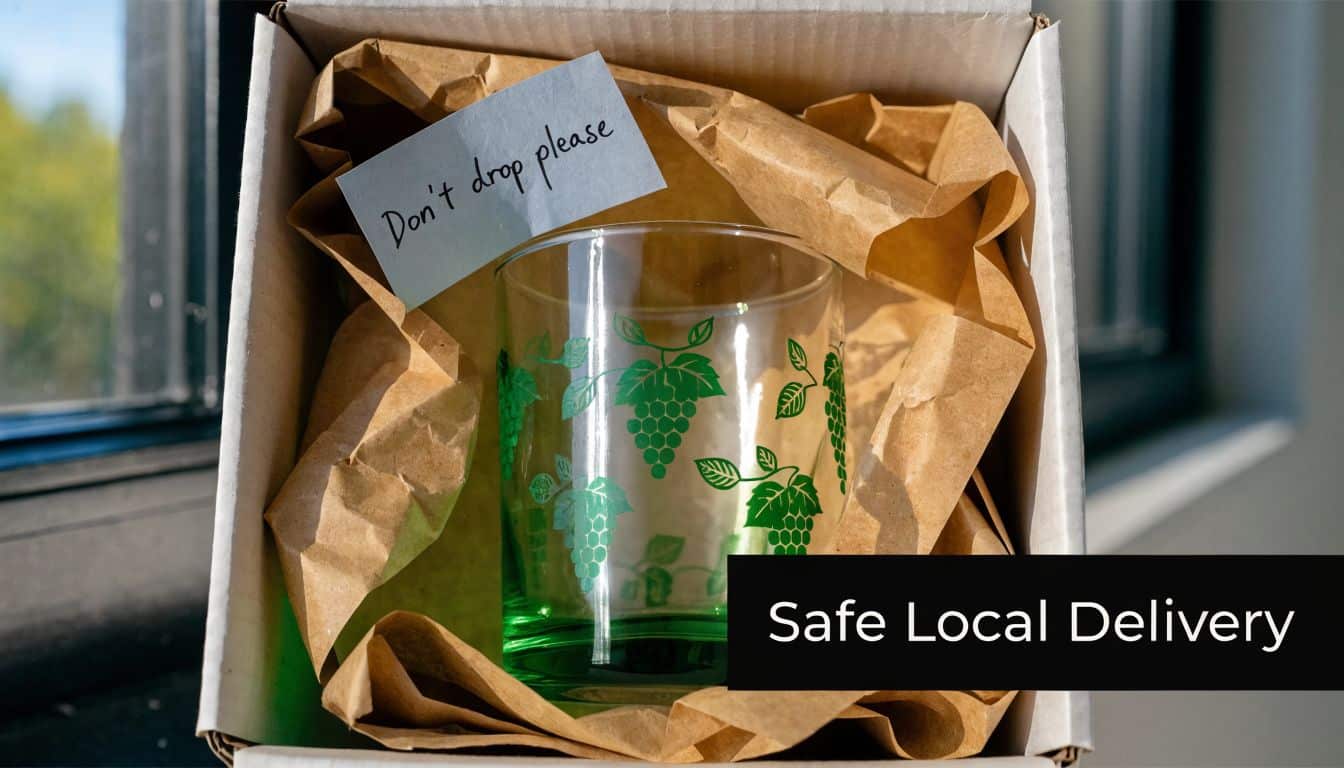
A better process is simple. Approve the design locally. Engrave the pieces. Pack them at the same counter using the right materials for stems, bowls, and gift sets. Then send each box by pickup or carrier based on where it needs to go.
That matters for weddings with more than one destination. Parent gifts can ship directly. Head-table flutes can stay local. Groomsmen glasses can go out in individual cartons with the correct names already matched to the correct labels.
Keep one packing list tied to one approved proof. That prevents the common wedding mistake where the engraving file says one thing and the shipping labels say another.
Delivery is not the final step. Open custom glassware early, compare each piece to the proof, and store it where rims and stems will not knock together before the event. After the wedding, clean and store the glasses according to the engraving method and the glass type, especially if the order includes crystal.
If you want one place to handle custom wedding glassware from design approval through packing and carrier handoff, Business Mail Boutique LLC in Sugar Land offers engraving along with professional packing, UPS and FedEx shipping, and in-store pickup options. That setup works well when part of the order stays local and part needs to reach attendants, family, or event partners safely.

Related posts

Custom Engraved Coffee Mugs and Etched Mugs: A Guide
Custom Engraved Coffee Mugs and Etched Mugs: A Guide
You need a mug fast. Maybe it's a retirement gift for someone who's been drinki...
Personalized Engraved Gifts in Sugar Land, TX | Custom Laser Engraving
Personalized Engraved Gifts in Sugar Land, TX
You've got the gift idea, but you're stuck on the part that makes it feel personal. A ...
Professional Engraving Services in Sugar Land
Engraving near me
Same Day Engraving
You’re probably here because you need something made personal, and you need it to feel intenti...