
- Print Business Cards in Sugar Land – Same Day Service
- Copying Services
- Document Printing, Finishing & Lamination in Sugar Land
- Flyers
- Print Banner in Sugar Land | Same-Day Banner Printing Near Me
- Graphic Design
- Photo Printing
- Postcard Printing
- Document Printing
- EDDM Full Service Postcards
- FotoZoomer Large Format Printing


Federal Agency Fingerprinting.
Learn about federal agency fingerprinting, who needs it, and how to get fingerprinted correctly. A practical guide for applicants and employers.
Businessmailboutique
11645 S. Hwy 6
Sugar land, Texas 77498 United States (US)
Email: info@businessmailboutique.com
Route
You arrive at a fingerprinting appointment with an instruction sheet, a government ID, and one urgent question: Will these prints go to the right agency? That question matters more than many applicants realize. A readable fingerprint capture can still be rejected or sent down the wrong path if the submission uses the wrong form, missing information, or an incorrect agency identifier.
Federal agency fingerprinting isn’t one universal service with one destination. The correct process depends on why you’re being fingerprinted, which agency requested the check, whether the request is for personal review or official screening, and whether the submission must travel through a state bureau or authorized channeling agency. This guide explains those distinctions in plain language so you can arrive prepared and avoid paying for a submission that doesn’t satisfy your employer, licensing board, immigration case, or federal agency.
Table of Contents
- What Federal Agency Fingerprinting Actually Means
- Who Checks Your Prints and Why It Matters
- Inside the FD-258 Card and Type-4 Electronic Standard
- Common Reasons People Get Fingerprinted by a Federal Agency
- How the Live Scan and Ink Card Workflows Actually Run
- Mistakes That Delay or Reject Federal Fingerprint Submissions
- Quick Checklist and Common Questions Before You Go
What Federal Agency Fingerprinting Actually Means
At a front counter, federal agency fingerprinting usually begins with a specific trigger. A nursing board asks for prints before reviewing your license application. A school district needs a teacher screened through its approved channel. A contractor receives instructions for federal personnel vetting. An immigration applicant receives a notice requiring biometrics. In each situation, fingerprints connect your identity to a background-record search, but the receiving agency and submission rules can differ.
The service may use a traditional ink fingerprint card, commonly the FBI FD-258, or a live scan electronic capture. With an ink card, a trained technician records rolled and plain impressions on the designated form, checks the fields, and prepares the card for delivery according to the requesting agency’s instructions. With live scan, the technician captures the impressions digitally and sends them through an approved electronic route when the destination accepts that format.
The important distinction is that “federal” describes the requested level or purpose of the check, not necessarily the place where you’ll be fingerprinted. A local print-and-scan provider may collect your prints, while the actual search is performed by the FBI, a state identification bureau, or an authorized channeling agency. The provider handles capture and submission preparation. The requesting organization determines where the record must go.
Why the request language matters
Read the instructions before booking an appointment. Look for:
- The requesting organization: This may be an employer, licensing board, government agency, immigration authority, or contractor.
- The destination: Instructions may identify the FBI, a state bureau, a channeling agency, or a federal security-vetting system.
- The format: The request may specify live scan, FD-258, or another approved card.
- The agency identifier: An ORI or comparable code tells the receiving system where the transaction belongs.
- Supporting documents: You may need a consent form, authorization sheet, or agency-provided fingerprint card.
Nurses, teachers, government contractors, security personnel, immigration applicants, and professional license candidates commonly encounter this process. The same person may need different fingerprint submissions for different purposes, so keeping a copy of every instruction sheet is practical.
Who Checks Your Prints and Why It Matters
The biggest misunderstanding is assuming that every fingerprint check searches the same records. The FBI Identity History Summary Check is a personal review record. The FBI specifically explains that it isn’t a universal national employment or licensing background check and may not contain state repository information that an employer or licensing board can access through its authorized process. You can review the FBI’s explanation of Identity History Summary Checks before choosing a route.
The three common layers
The FBI operates the national system used for authorized criminal-history and civil transactions. The FBI’s national fingerprint infrastructure began when its Identification Division was created on July 1, 1924, consolidating 810,000 fingerprint files into one federal repository, as described by the FBI Criminal Justice Information Services Division. That system later developed into the modern CJIS structure.
A state centralized identification bureau searches state records and may forward fingerprints for a national search when state law or the requesting program requires it. A licensing board or state employer often directs applicants through this state-centered route rather than accepting a personal FBI record.
An authorized channeling agency acts as an approved intermediary. It collects or receives the applicant’s information and submits the transaction through the route required for a particular employer, profession, or government program. The channeler may use its own instructions, agency code, consent documents, and electronic standards.
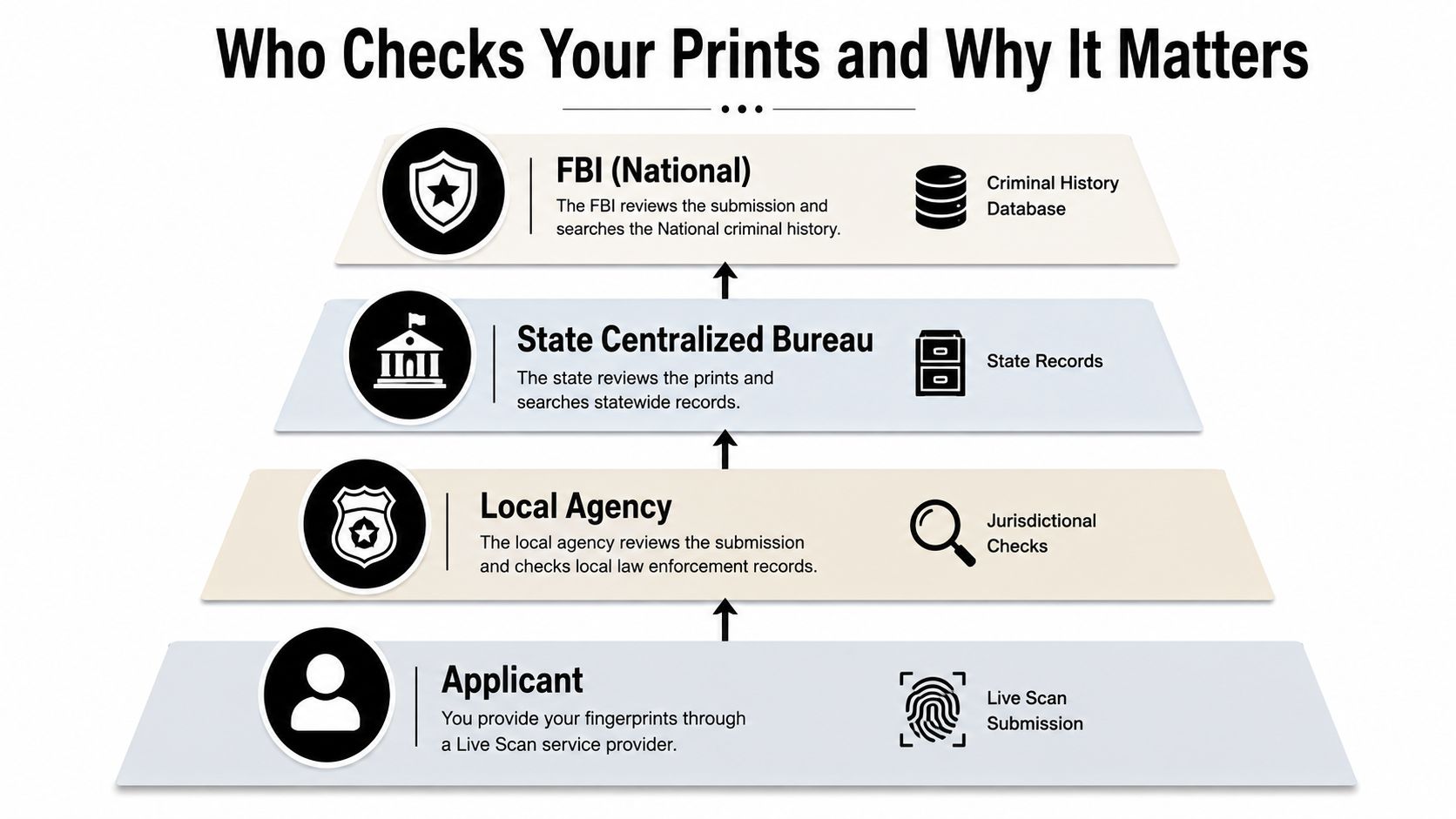
The practical result is simple: the purpose determines the route. An applicant ordering a personal record for review shouldn’t assume that document will satisfy a school district or licensing board. The FBI states that many U.S. employment, licensing, and adoption requests must go through a state identification bureau or another authorized channeling agency. For broader background-screening context, Burnt’s resource on background checks can help explain how different screening components fit together.
Before you pay for a capture, confirm the receiving agency and the exact submission instructions. This FBI background check guide can also help you identify whether you’re requesting a personal review or completing an official agency-directed transaction.
Inside the FD-258 Card and Type-4 Electronic Standard
A fingerprint card isn’t just a place to roll your fingers. The FD-258 is a structured submission document, and the FBI’s guidance identifies required information that helps the receiving system connect the impressions to the correct person and purpose.
What the FD-258 requires
Review the card before the technician begins. Required information identified in the FBI’s FD-258 guidance includes:
- ORI: The Originating Agency Identifier directs the transaction to the correct recipient.
- Date of birth: This helps distinguish applicants who may have similar names.
- Place of birth and sex: These demographic fields support identity matching.
- Date fingerprinted: The receiving agency needs to know when the impressions were captured.
- Reason fingerprinted: This connects the transaction to the authorized purpose.
- Complete impression boxes: The rolled and plain impressions must be present and usable.
Missing required fields can cause rejection rather than manual correction. That means a technician should check the metadata before you leave, not only inspect whether the ridge detail looks clear. A technically sharp impression won’t rescue a card that lacks the ORI or reason for fingerprinting.
Practical rule: Treat the card and the fingerprints as one submission. Both must be complete.
What Type-4 means for electronic submissions
For federal personnel-vetting transactions, the Defense Counterintelligence and Security Agency says it currently accepts Type-4 fingerprint images. Its fingerprint requirements call for 10 rolled impressions, simultaneous plain impressions of the four fingers on each hand, and plain thumb impressions. DCSA also states that, as of April 24, 2025, the sex field must be populated as Male or Female on both electronic and hardcopy submissions.
That requirement isn’t merely a technical preference. Standardized image and demographic fields help automated intake and matching systems process the transaction. If your employer gives you a specific electronic submission instruction, don’t substitute an ordinary personal FBI request or a generic card.
The following video offers a visual introduction to fingerprint-card handling and capture expectations. Use it as general orientation, but follow your requesting agency’s current instructions if they differ.
For FINRA-related appointments, bring the card and instructions supplied for that purpose. Information about FINRA fingerprint cards can help applicants distinguish that transaction from an FBI personal review request.
Common Reasons People Get Fingerprinted by a Federal Agency
The destination changes with the applicant’s situation. Consider these examples as routing patterns, not substitutes for the instructions issued by your agency.
A nurse applying for a license
A nurse may be directed by a state licensing board to complete a state-based fingerprint submission that can include a national search. The board or its approved vendor typically supplies the agency instructions, required code, consent language, and submission method. Bringing only a generic FD-258 card may not satisfy the board if it requires electronic delivery through its designated channel.
The nurse should bring a current government-issued ID, the board’s fingerprint instruction sheet, any authorization or consent form, and payment accepted by the capture provider. The critical question is not, “Do you send prints to the FBI?” It is, “Does this transaction go through the licensing board’s required route?”
A teacher entering a school system
A teacher may be fingerprinted through a state education channel or an approved local provider. The school district may identify the exact ORI, electronic vendor, or card process. A teacher who already ordered a personal FBI Identity History Summary may still need a separate submission because the district’s screening route can involve state records and an authorized national check.
The applicant should bring the district’s instructions, identification, and any forms that must be signed at capture. Don’t assume a previous fingerprint appointment transfers between employers. The destination and purpose are tied to the specific request.
A real estate or insurance license candidate
Professional licensing candidates often receive instructions from a state regulator or licensing vendor. The form may be an FD-258, but the ORI and reason-for-fingerprinting fields must match the regulator’s directions. If the card is sent to the wrong recipient, the applicant may need to start again even though the fingerprints themselves are readable.
A government contractor
A contractor entering federal personnel vetting may follow an employer-managed electronic process. The employer or security office may provide the submission link, authorization details, and required image standard. DCSA’s Type-4 requirements apply to the federal personnel-vetting context described earlier, so the applicant shouldn’t replace those instructions with a personal record request.
An immigration applicant
An immigration case may involve biometrics or another federal channel directed by the relevant agency. The applicant should follow the notice exactly, including the appointment location, identity documents, and any case-specific paperwork. A private fingerprint card prepared for another purpose usually won’t replace an agency appointment.
The safest pattern is consistent across all five examples. Follow the requesting organization’s route first, then choose the capture provider.
How the Live Scan and Ink Card Workflows Actually Run
A walk-in appointment usually starts with document review, not fingerprint capture. The technician confirms your identity, examines the requesting agency’s instructions, checks the destination code, and determines whether the transaction requires live scan or an ink card.
The electronic path
With live scan, the technician captures rolled impressions and plain impressions on a digital device. The system may flag incomplete fingers, poor contact, or other capture problems while you’re still at the counter. The technician can then recapture the affected impression instead of discovering the problem after a mailed card reaches the recipient.
The provider submits the transaction through the authorized electronic route when the destination accepts that method. Electronic transmission can reduce mailing steps, but it doesn’t guarantee immediate agency adjudication. Intake review, record searches, and the requesting organization’s own processing remain separate stages.
The ink-card path
For an FD-258 submission, the technician records the impressions on the physical card, completes the required fields, and reviews the card for smearing, missing boxes, and inconsistent information. The card then follows the delivery instructions, which may involve mailing it to the designated recipient.
Ink cards can be appropriate when the receiving agency requires a physical document or when electronic capture isn’t available for that transaction. The tradeoff is that errors may be discovered later, after the card has left the location. If a card is rejected, you may need another capture and another delivery attempt.
For readers comparing this administrative workflow with other identification procedures, a general explanation of the Colorado jail booking process shows why booking fingerprints and applicant background submissions shouldn’t be treated as the same event. They serve different purposes and follow different custody and routing rules.
Live Scan vs Ink Card Workflow at a Glance
| Factor | Live Scan, Electronic | FD-258 Ink Card |
|---|---|---|
| Capture | Digital rolled and plain impressions | Ink impressions on a physical card |
| Error handling | The system or technician may identify capture issues during the appointment | Problems may be noticed during review or after mailing |
| Delivery | Transmitted through an approved electronic route | Physically delivered according to agency instructions |
| Best fit | Agencies that require or accept electronic submissions | Requests that specifically require a hardcopy card |
| Applicant’s priority | Confirm the correct electronic destination and code | Confirm the card fields, impressions, and mailing instructions |
Bring a current government ID, the complete agency instruction sheet, the correct card if one was supplied, any required consent form, and an accepted payment method. If you’re visiting a Sugar Land provider, call ahead if the agency’s instructions are unusual or if you aren’t sure whether the transaction requires live scan or ink.
The ink and live scan fingerprinting service information can help you compare the two capture methods before scheduling.
Mistakes That Delay or Reject Federal Fingerprint Submissions
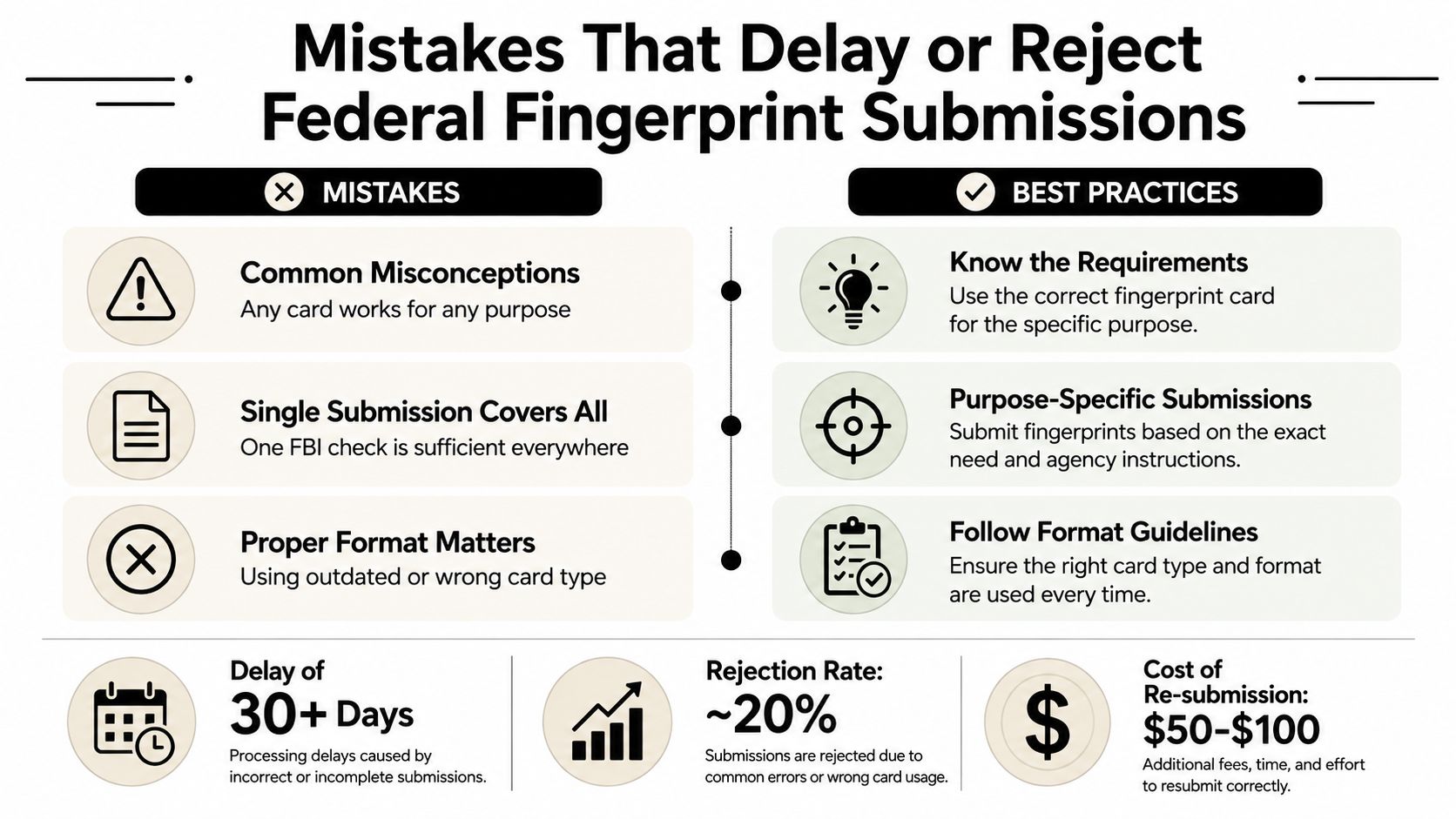
Three assumptions cause repeated trouble.
Assumption one, any fingerprint card works. It doesn’t. The recipient may require a particular form, an exact ORI, a specific reason code, or an electronic channel. A card prepared for a personal record request may not satisfy a licensing board or employer.
Assumption two, one FBI submission covers every purpose. The FBI distinguishes a personal Identity History Summary from an official employment, licensing, or adoption check. State repositories and channeling agencies may participate in the authorized route, and the FBI says many requests must begin with those organizations rather than with an individual’s personal request.
Assumption three, rejection means the record contains a serious problem. A rejection often concerns the submission itself. Smudged impressions, incomplete fingerprint boxes, missing demographic fields, and incorrect routing information can stop intake before an agency evaluates the underlying record.
What to verify before leaving
- Match the ORI: Compare the code on the card or electronic order with the requesting agency’s written instructions.
- Review every demographic field: Check your name, birth information, place of birth, sex, and fingerprint date.
- Inspect all impressions: Ask the technician to confirm the rolled and plain impressions are complete and clear.
- Confirm the recipient: Know which agency or channeler receives the transaction.
- Keep your receipt: Save proof of capture, submission, and any tracking information.
Corrections require the right route too. The FBI explains that many record changes must first go through the state centralized agency when state information is involved. Sending a dispute to the wrong office can create another delay, even when the applicant has identified a genuine error.
The best prevention is a final review at the counter. Ask one direct question before you leave: “Is this submission going to the exact agency named in my instructions?”
Quick Checklist and Common Questions Before You Go
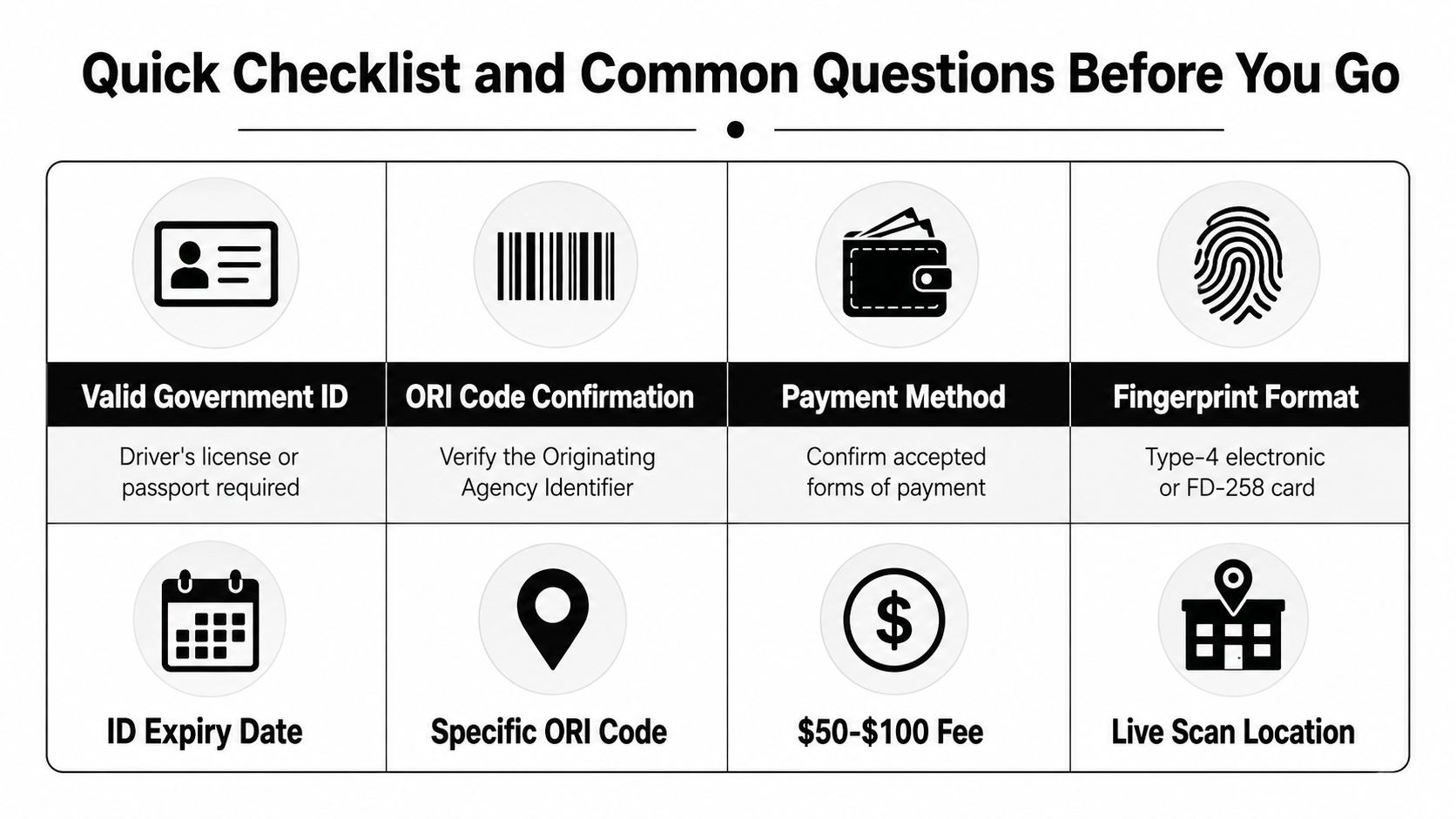
Use this checklist before your appointment:
- Government ID: Bring an unexpired, accepted form of identification.
- Agency instructions: Carry the complete letter, email, or authorization sheet.
- ORI confirmation: Verify the exact Originating Agency Identifier.
- Format: Confirm whether you need Type-4 electronic capture or an FD-258 card.
- Forms: Bring any consent, authorization, or case-specific paperwork.
- Payment: Confirm accepted payment methods and retain your receipt.
- Follow-up: Ask how you’ll receive proof of submission or resubmission instructions.
Common questions
How do I request my own FBI record? Use the FBI’s Identity History Summary process for personal review. Don’t present it as a universal employment or licensing clearance.
What happens if my record has an error? Follow the correction route identified by the relevant state bureau or federal process. State-originated information may need to be corrected through the state centralized agency first.
How can I verify a channeling agency? Confirm its name and submission role with the employer, licensing board, or government program that gave you the instructions. Don’t rely only on a search result or an unsolicited vendor message.
How fast will results arrive? Capture and agency adjudication are different stages. Electronic capture may reduce delivery steps, but the requesting organization controls much of the remaining process.
Business Mail Boutique LLC provides fingerprinting support for FBI background-check requests, FD-258 and FD-1164 card collection, FINRA card services, ink-and-roll capture, live scan options, passport photos, and notary services in Sugar Land. Visit Business Mail Boutique LLC with your agency instructions before your appointment so the correct format and routing details can be reviewed.

Related posts

Custom Memorial Glasses Engraved in Three Hours in Sugar Land
When a customer needed eight personalized glasses for a memorial, Business Mail Boutique completed the engraving or...

Custom Martini Glass Engraving in Sugar Land, TX
Custom Logo Engraving on Martini Glasses in Sugar Land, Texas.
Business Mail Boutique recently completed a beautiful custom engravin...

Custom Engraved Wine Glasses for a Golf Club Event in Sugar Land, TX
Custom Engraved Wine Glasses for a Golf Club Event in Sugar Land.
Custom wine glass engraving in Sugar Land, TX at Business Mail Bouti...