
- Print Business Cards in Sugar Land – Same Day Service
- Copying Services
- Document Printing, Finishing & Lamination in Sugar Land
- Flyers
- Print Banner in Sugar Land | Same-Day Banner Printing Near Me
- Graphic Design
- Photo Printing
- Postcard Printing
- Document Printing
- EDDM Full Service Postcards
- FotoZoomer Large Format Printing


Fragile Item Shipping: A Pro’s Guide to Perfect Packing
Businessmailboutique
11645 S. Hwy 6
Sugar land, Texas 77498 United States (US)
Email: info@businessmailboutique.com
Route
You’ve got the item on the counter right now. Maybe it’s a framed print headed across Texas, a set of ceramic mugs for an Etsy order, or your daughter’s violin going to a repair shop. The box looks fine. The bubble wrap looks thick enough. And yet this is the point where most fragile shipments go wrong.
Fragile item shipping isn’t won by tossing in extra padding and hoping for the best. It’s won in the small decisions. Box strength. Cushion depth. Whether the item can move a fraction of an inch. Whether you can prove how it was packed if a claim turns ugly. Those details matter because breakable goods now account for 38% of all product returns in e-commerce, with an estimated $9 billion annual cost tied to damage, according to FreightAmigo’s 2025 fragile shipping overview.
The good news is that careful packing still works. In a place like Sugar Land, where small businesses ship gifts, electronics, collectibles, baked goods, office equipment, and family keepsakes every day, the same pro rules apply whether the package is going to Houston, Austin, or overseas. If the item is delicate, the process has to be deliberate.
Table of Contents
- Choosing Your Packing Arsenal
- The Art of Packing with Professional Techniques
- Sealing Labeling and Documenting for Proof
- Navigating Carriers Services and Insurance
- Common Fragile Shipping Mistakes to Avoid
- The Sugar Land Solution Expert Packing at Business Mail Boutique
Choosing Your Packing Arsenal
The first mistake people make is trusting the box they already have. Old moving boxes, thin retail cartons, and grocery-store leftovers fail because they’ve already done a job once. Corners weaken. Walls soften. Flaps lose rigidity. For fragile item shipping, that’s enough to turn a minor drop into a broken item.
A double-wall corrugated box is the right baseline for delicate shipments. If the item has weight, sharp edges, glass components, or sentimental value, single-wall cardboard is a gamble. Professional packers start with structure first, then cushioning.
Start with the box, not the bubble wrap
A solid packing setup usually needs:
- New double-wall boxes for primary protection and crush resistance.
- Inner cartons if you’re using a box-in-box method.
- Bubble wrap for surface protection around the item itself.
- Void fill such as crinkle paper, kraft paper, or air pillows to stop movement.
- Strong packing tape with a reliable tape gun.
- Corner protection or foam sheets for frames, screens, and hard edges.
Cheap tape causes more trouble than commonly expected. Weak adhesive lifts at the seams, especially in heat, humidity, or long transit cycles. Around Sugar Land, where a package may sit in a truck, on a porch, or in a sorting area, tape quality matters more than is commonly realized.
Match the cushioning to the item
Not all cushioning does the same job. Bubble wrap protects surfaces and edges. Crumpled paper fills dead space. Air pillows work well for void fill in the right application, but they shouldn’t be the only protection around something brittle or pointed.
For multi-item shipments, biodegradable fillers deserve a serious look. Noissue’s packaging guide notes that biodegradable void fillers like crinkle paper and air pillows can reduce shipping costs by 15 to 20% while maintaining 95% breakage prevention rates for multi-item fragile packages. That matters for local makers shipping candle jars, ceramic sets, or bundled gift boxes from Sugar Land.
Practical rule: Use one material to wrap the item and another to immobilize it. One layer rarely does both jobs well.
Build a real packing station
If you ship often, don’t keep improvising from a junk drawer. Keep your materials in one place and standardize what you use. That alone cuts mistakes.
A simple shopping list should include a few box sizes, heavy-duty tape, a tape dispenser that doesn’t bind, bubble wrap in more than one size, paper void fill, scissors, a marker, and labels. If you need help choosing the right materials locally, this guide to shipping supplies near Sugar Land, TX is a practical starting point.
What doesn’t work
A few materials consistently fail in fragile item shipping:
| Material or shortcut | Why it fails |
|---|---|
| Old used box | Hidden crush damage and weaker corners |
| Plastic grocery bags | Poor shock absorption and uneven support |
| Shredded paper only | Settles too easily and allows movement |
| Masking or duct tape | Wrong adhesive behavior for shipping cartons |
If the item would upset you to see broken, pack like the box will be dropped, compressed, and slid across conveyors. Because it probably will be.
The Art of Packing with Professional Techniques
Packing fragile items well isn’t about stuffing the box tighter. It’s about controlling energy. Drops, jolts, side impacts, and compression happen during normal transit. Good technique creates distance between that abuse and the item inside.
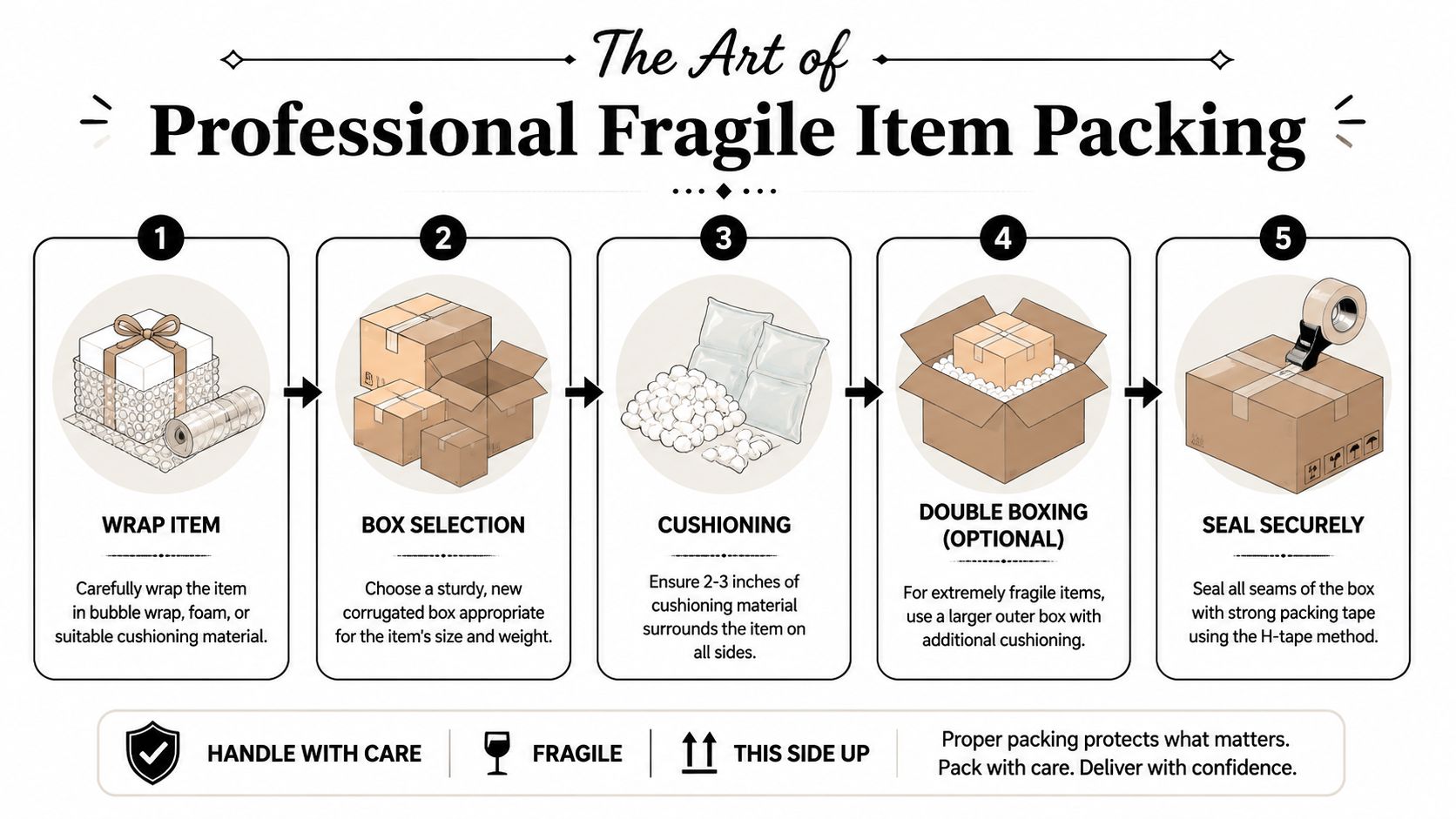
Wrap the item as if the box will fail
The item itself gets protected first. Wrap it individually so exposed edges, handles, lids, or protruding parts can’t strike the box wall or another object. If you’re packing multiple fragile pieces together, every piece gets its own wrap. Never let glass touch glass, ceramic touch ceramic, or metal hardware touch a polished surface.
For unusually delicate shapes, movers often use methods that cross over well into parcel packing. This overview of TLC Moving expert packing guidance is useful because it reflects the same habit pros rely on: protect weak points first, then build outward.
Use the box-in-box method correctly
The box-in-box method is one of the few techniques that consistently separates amateur packing from professional packing. The inner box holds the item securely. That inner box then sits inside a stronger outer box with cushioning around it.
According to DHL’s fragile packing guidelines, the method requires a minimum 14cm gap between the inner and outer boxes, and failing to maintain that separation leads to a 60% increase in breakage rates compared with compliant shipments. That’s the sort of detail basic guides often skip, but it’s exactly what protects ceramics, electronics, instruments, and framed items from impact.
Control the void fill
Packing fails when the item moves, but it also fails when the cushioning is jammed in too tightly. Too loose, and the item shifts. Too tight, and pressure points form on weak spots.
The best fit is snug and cushioned. The item should feel suspended, not wedged. Fill corners carefully. Support the base. Protect the top. Don’t leave open channels inside the box where the item can build momentum.
A practical sequence works well:
- Create a base layer of cushioning in the inner box.
- Set the wrapped item upright or flat based on its strongest resting position.
- Add side support evenly so it can’t drift left or right.
- Cap the top layer before sealing the inner carton.
- Repeat the support process inside the outer box.
If one corner of the item carries more weight than the others, that corner needs more protection than the rest. Equal packing on all sides isn’t always the same as smart packing.
Finish with the shake test
The last step is the one people skip because they’re in a hurry. Don’t skip it.
Phase V’s packing guidance states that to achieve a 99% success rate, the packed box must pass a shake test with no internal movement. If anything shifts, the box isn’t ready. The same guidance notes that the optimal cushioning technique places material exactly 2 inches between the item and the box wall, reducing energy transfer by 40%.
That gives you a simple standard to work with:
- Listen for clicks, slides, or internal tapping.
- Feel for weight shifting to one side.
- Open and correct if there’s any movement at all.
Don’t forget box strength
For high-risk items, the box itself has to stand up to handling. A heavy-duty double-wall corrugated box with a 350 ECT rating is the kind of packaging pros reach for when they need real crush resistance. That’s especially useful when a package may travel through multiple hubs before reaching its destination.
If you’re shipping from Sugar Land during a busy season, assume your box will be stacked, conveyed, moved by multiple handlers, and parked under other freight. Packing for a gentle ride is what breaks things.
Sealing Labeling and Documenting for Proof
A well-packed box still needs a proper finish. Boxes burst open because of bad taping. Claims get denied because the shipper can’t prove the condition of the item or the quality of the packaging. And labels don’t always help the way people think they do.
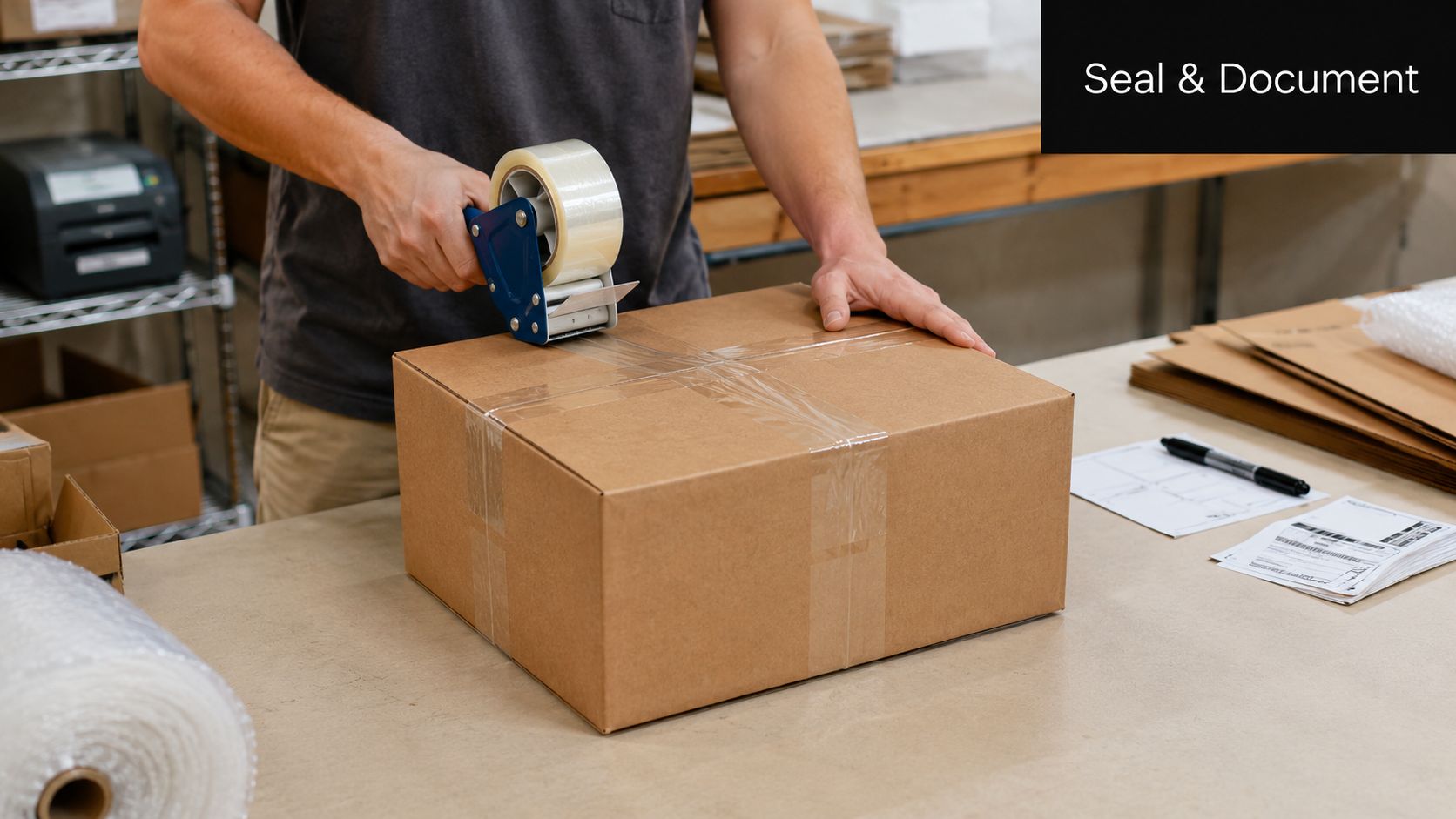
Seal the carton like it matters
Use the H-tape method on the top and bottom of the box. That means one strip along the center seam and additional strips across both edge seams, forming an H. This keeps flaps from lifting and strengthens the points that split first under stress.
Cheap tape and rushed work quickly reveal their flaws. If the tape wrinkles badly, lifts at the ends, or won’t bond cleanly, replace it before you trust the shipment to a carrier.
Handle fragile labels with judgment
It’s often assumed that more “FRAGILE” stickers automatically mean safer handling. Real-world packing experience is more complicated. The fragile labeling paradox says that while those labels are intended to help, some labeled parcels may be more likely to be damaged or targeted. That concern is discussed in this video on fragile handling behavior.
That doesn’t mean labels are always wrong. It means labels aren’t a substitute for good packaging.
A practical middle ground often works best:
- Use orientation labels when the item must remain upright.
- Use shipping labels cleanly so barcodes scan without extra handling.
- Avoid relying on warning stickers as your main protection plan.
Your package should survive rough handling even if nobody reads a single label on it.
Create your proof file before drop-off
Documentation saves arguments later. If you ever need to file a claim, you want a simple visual record that shows the item, the materials, and the final package.
Take photos in order:
| What to photograph | Why it helps |
|---|---|
| Item before packing | Shows pre-shipment condition |
| Inner wrapping | Proves direct protection was used |
| Cushioning in the box | Shows immobilization and support |
| Sealed carton | Confirms box condition before tender |
| Shipping label | Ties the package to the shipment record |
A short packing video can help too, especially for expensive electronics, artwork, or family heirlooms. If the item matters enough to insure, it matters enough to document.
For a quick demonstration of strong box sealing technique, this clip is worth a look before you tape your next parcel:
In practice, proof doesn’t prevent damage. It protects you when damage happens anyway.
Navigating Carriers Services and Insurance
A Sugar Land sender drops off a well-wrapped ceramic bowl, buys extra coverage, and assumes the hard part is over. Then the carton gets denied in claims because the service level was wrong for the item, the declared value was misunderstood, or the carrier decided the packaging did not meet its standard. I see that chain of mistakes all the time.
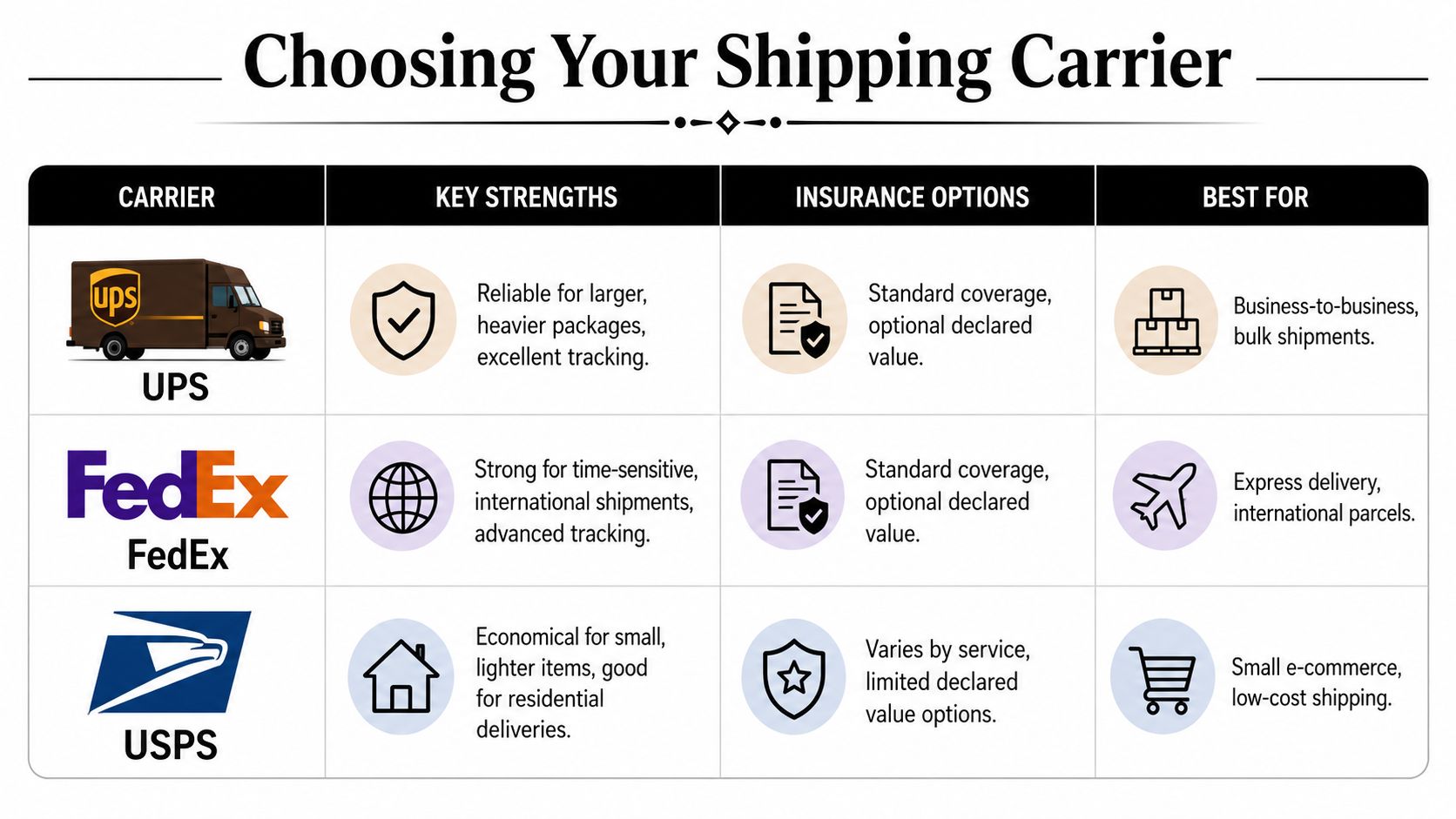
Match the carrier to the actual risk
UPS, FedEx, and USPS can all move fragile parcels. The better question is which one gives your shipment the best odds based on weight, dimensions, transit time, tracking quality, and claim handling.
In practice, I sort shipments like this:
| Carrier | Often a strong fit for | Watch-outs |
|---|---|---|
| UPS | Heavier cartons, higher-density goods, many business shipments | Dimensional charges can rise fast |
| FedEx | Time-sensitive parcels, business deliveries, many specialty service options | Service selection matters, because the price gap between options can be large |
| USPS | Smaller, lighter residential shipments and lower-value parcels | Large or high-fragility items can push past its practical comfort zone |
A pottery seller in Sugar Land shipping to Dallas has one set of priorities. A family shipping framed art to Arizona has another. A local business sending glass awards to a client needs something else again. Speed is part of the equation, but so are transfer points, carton size, and how painful a loss would be.
Small business owners comparing service levels can use this breakdown of shipping services for small business to line up carrier options with the package profile instead of picking on price alone.
Fragile labels help less than people think
Carriers process parcels in volume. Conveyors, trailers, sorting belts, stacked loads, and repeated touchpoints decide what happens to your box. A fragile sticker may encourage better handling from an attentive employee, but it does not create a separate safety bubble around the carton.
That is the fragile labeling paradox. The label matters most when orientation affects the item, but the package still has to survive routine impact and compression without anyone honoring the sticker. If a carton would fail after one sideways set-down or a moderate top load, the service choice and the packing spec need work.
Box strength and service level belong together
Many DIY shipments become financially problematic when the sender pays for faster service or extra coverage, but uses a carton that is too weak for the route.
For fragile shipments, I look at box strength the same way I look at cushioning. It is a risk control, not a cosmetic detail. A single-wall carton with a low ECT rating may be fine for soft goods. It is a poor match for dense ceramics, glassware, or electronics with concentrated weight. If the package is heavy, stacked, or traveling several zones, move up to a stronger box. The claim department will look at that after damage happens.
A stronger service choice cannot rescue a crushed carton.
Liability, declared value, and true insurance are different products
This point needs plain language.
- Carrier liability means the carrier may pay under its rules if the shipment qualifies and the packaging met its standard.
- Declared value sets the carrier’s maximum liability in many cases. It does not turn that shipment into broad insurance coverage.
- Third-party shipping insurance is usually the cleaner option for high-value, hard-to-replace, or dispute-prone shipments.
That difference matters most with one-of-one items. Family china, signed memorabilia, custom prototypes, framed artwork, and handmade goods do not behave like standard retail inventory. The replacement cost may be unclear. The emotional value may be impossible to measure. The burden of proof is usually still on the sender.
If the shipment involves a household move instead of a standard parcel, the same risk logic applies. This guide on protecting fragile possessions during relocation is useful because it focuses on practical protection choices instead of wishful thinking.
How I’d choose coverage in real shipments
For a replaceable item with a clear invoice and excellent packing, declared value may be enough.
For collectibles, antiques, electronics, instruments, or sentimental items, I would price third-party insurance and read the exclusions before tendering the box. That extra step can save a hard argument later. It also forces the sender to confirm the item’s documented value, packaging method, and claim requirements before anything goes wrong.
One more pro-level detail. Check whether the service and coverage terms make special assumptions about fragile goods, used items, or items with limited market comps. Those are the shipments that create the biggest gap between what a customer thinks they bought and what the carrier is willing to pay.
The safest approach is simple. Choose the carrier for the shipment profile, choose the service for the risk, and buy financial protection that matches the consequence of loss.
Common Fragile Shipping Mistakes to Avoid
A customer walks in from Telfair with a porcelain serving bowl packed in a grocery box, one layer of wrap, and a big FRAGILE sticker on top. By the time that carton reaches a sorting hub, the sticker means almost nothing. The bowl survives or breaks based on box strength, internal movement, separation, and whether the package was packed for conveyor belts instead of careful hands.
That is the pattern behind damaged fragile shipments. The failure usually starts before the box ever leaves Sugar Land.
The mistakes that break boxes and contents
The first mistake is choosing a carton by size alone. Fragile shipments need a box with enough crush strength for the weight inside it, not just enough room to close the flaps. If the box is soft, previously used, or lacks the right ECT rating for the load, the walls give up before the cushioning can do its job.
The second mistake is leaving any internal movement at all. A proper shake test is simple. Close the box, lift it, and give it a firm but controlled shake. If you hear a click, slide, thunk, or rattle, the item is still building momentum inside the carton. That movement is what turns a small drop into a claim.
The third mistake is creating pressure instead of protection. Too little cushioning lets the item travel. Too much cushioning can preload fragile surfaces, corners, handles, or glass panels and crack them under normal handling. Good packing holds the item in place without squeezing it.
The errors I see over and over
- Using a worn-out box: Creased corners and softened walls fail fast under stacking pressure.
- Ignoring box rating: A heavy ceramic, metal, or glass item in a light single-wall carton is asking the box to do a job it was not built for.
- Packing two breakables together without a divider: One survives, the other becomes the impact point.
- Letting the item touch the outer wall: Corner and side impacts transfer straight into the product.
- Relying on a fragile label: Labels can help at the margins, but they do not override automated handling. This is the fragile labeling paradox. The sticker gets attention from the sender, but protection still comes from the package design.
- Skipping photos before tender: If damage happens, you want clear proof of the item condition, the cushioning layers, and the sealed box.
- Assuming carrier liability equals insurance: It does not. Reimbursement disputes often start with poor packing and weak documentation, not just the damage itself.
One sentence I use at the counter all the time: the box should feel quiet.
If it sounds alive, it is not ready.
What good shippers do differently
They match the carton to the shipment, isolate each fragile component, control movement, and document the finished package before handoff. They also know when a double-box setup is smarter than adding more loose fill to one oversized carton.
That matters for local shipments too. A package going out through a Sugar Land packing and shipping service may still see sorting equipment, stacked trailers, transfers, and porch delivery conditions that punish weak packing decisions.
Close enough is what breaks fragile items. Proper packing is risk control, not decoration.
The Sugar Land Solution Expert Packing at Business Mail Boutique
Some shipments shouldn’t be a DIY project. If you’re mailing crystal, framed art, electronics, instruments, ceramic gifts, trade show pieces, or a family item that can’t be replaced, handing it to a professional is often the lower-risk move.
That matters in Sugar Land because many local customers aren’t just shipping ordinary retail goods. They’re sending custom products, school items, office materials, online orders, presentation pieces, and personal keepsakes. Each one has a different risk profile. The packing approach should change accordingly.
What expert packing changes
Professional pack-and-ship service removes the guesswork that causes most damage:
- Box choice is deliberate, including heavy-duty options for vulnerable items.
- Cushioning is matched to the object, rather than stuffed in at random.
- Box-in-box packing is used when needed, especially for high-risk shipments.
- Carrier paperwork and shipment setup are handled cleanly, which reduces avoidable errors at tender and delivery.
Why local help matters
A local shipping center sees the patterns national guides miss. In Sugar Land, that might mean a student moving valuables out of a nearby apartment, a small business shipping branded mugs to a client, or a resident sending framed family photos to another state. Those shipments look different on the counter, and they need different handling.
A good local center also helps with the details around the box. Documentation. Label placement. Carrier choice. Service speed. Practical advice on whether the item should go parcel, express, or freight. If you need a local option for those tasks, this Sugar Land shipping and mailing service covers the kind of support that saves time and lowers the odds of a costly mistake.
The biggest benefit is peace of mind. Not vague reassurance. Real peace of mind based on trained packing, proper materials, and a workflow that’s built around risk reduction instead of guesswork.
If you’d rather not gamble with a fragile shipment, Business Mail Boutique LLC in Sugar Land can handle the packing, shipping setup, and documentation for you. Bring in your delicate item, and the team can help you choose the right materials, the right carrier, and the right level of protection so your package has the best possible chance of arriving in one piece.

Related posts

Custom Brass Plate Engraving in Sugar Land | Business Mail Boutique
Custom Brass Plate Engraving in Sugar Land: A Personal Tribute to Remember
A few carefully chosen words can turn a small brass plate i...

Silver Bracelet Engraving in Sugar Land | Business Mail Boutique
Personalize silver bracelets with names, dates, and hearts at Business Mail Boutique in Sugar Land. Call 281-875-0161 for a quote.
ers...

Graduation Gift Engraving Sugar Land | Business Mail Boutique
Graduation Gift Engraving Sugar Land | Business Mail Boutique.
A Personalized Texas A&M Graduation Gift: Custom Glass Engraving in...