
- Print Business Cards in Sugar Land – Same Day Service
- Copying Services
- Document Printing, Finishing & Lamination in Sugar Land
- Flyers
- Print Banner in Sugar Land | Same-Day Banner Printing Near Me
- Graphic Design
- Photo Printing
- Postcard Printing
- Document Printing
- EDDM Full Service Postcards
- FotoZoomer Large Format Printing


How Much Is Freight Shipping? Cost Guide
Businessmailboutique
11645 S. Hwy 6
Sugar land, Texas 77498 United States (US)
Email: info@businessmailboutique.com
Route
You’re probably here because a shipment got too big, too heavy, or too awkward for normal parcel service. Maybe you sold a display fixture to a customer across Texas. Maybe your shop needs to move a pallet of printed materials, equipment, or inventory. You checked the box size, looked at UPS or FedEx parcel options, and realized this isn’t a regular package anymore.
That’s the moment many small business owners ask the same question. How much is freight shipping? The honest answer is that there isn’t one flat price. Freight works more like booking space for cargo than buying a stamp. The good news is that the price isn’t random. Once you know what carriers look at, the quote starts to make sense.
Your First Big Shipment Navigating Freight Costs
A common first freight moment looks like this. A local business lands a wholesale order, stacks the goods on a pallet, wraps everything carefully, and then hits a wall at checkout. Parcel shipping doesn’t fit. The shipment is too bulky, too heavy, or both.
That can feel frustrating because freight pricing seems less obvious than mailing a box. With parcel shipping, you’re used to entering dimensions, a weight, and a destination. Freight adds a few more moving parts, and that’s where confusion starts.
Think of freight like moving furniture instead of mailing a gift. A small parcel slips into an established system. Freight takes planning. The carrier needs to know how much floor space your shipment uses, how easily it can be stacked, how it will be loaded, and what kind of location it’s going to.
Freight pricing makes more sense when you stop thinking in terms of “one package, one rate” and start thinking in terms of truck space, handling, and route.
Some shipments move as LTL, or less-than-truckload. That means your pallet shares trailer space with other shipments. Other moves are FTL, or full-truckload, where one shipper books the whole trailer. The right option depends on the size of the shipment, how quickly it needs to move, and whether sharing space makes sense.
If you’re shipping freight for the first time, you don’t need to learn every industry term at once. You just need to understand what drives the quote, what add-on fees can appear, and what details to gather before you ask for pricing.
The Core Factors That Determine Freight Costs
Freight quotes look complicated at first, but most of them come back to a handful of inputs. If you understand those inputs, you can usually tell why one shipment costs more than another.
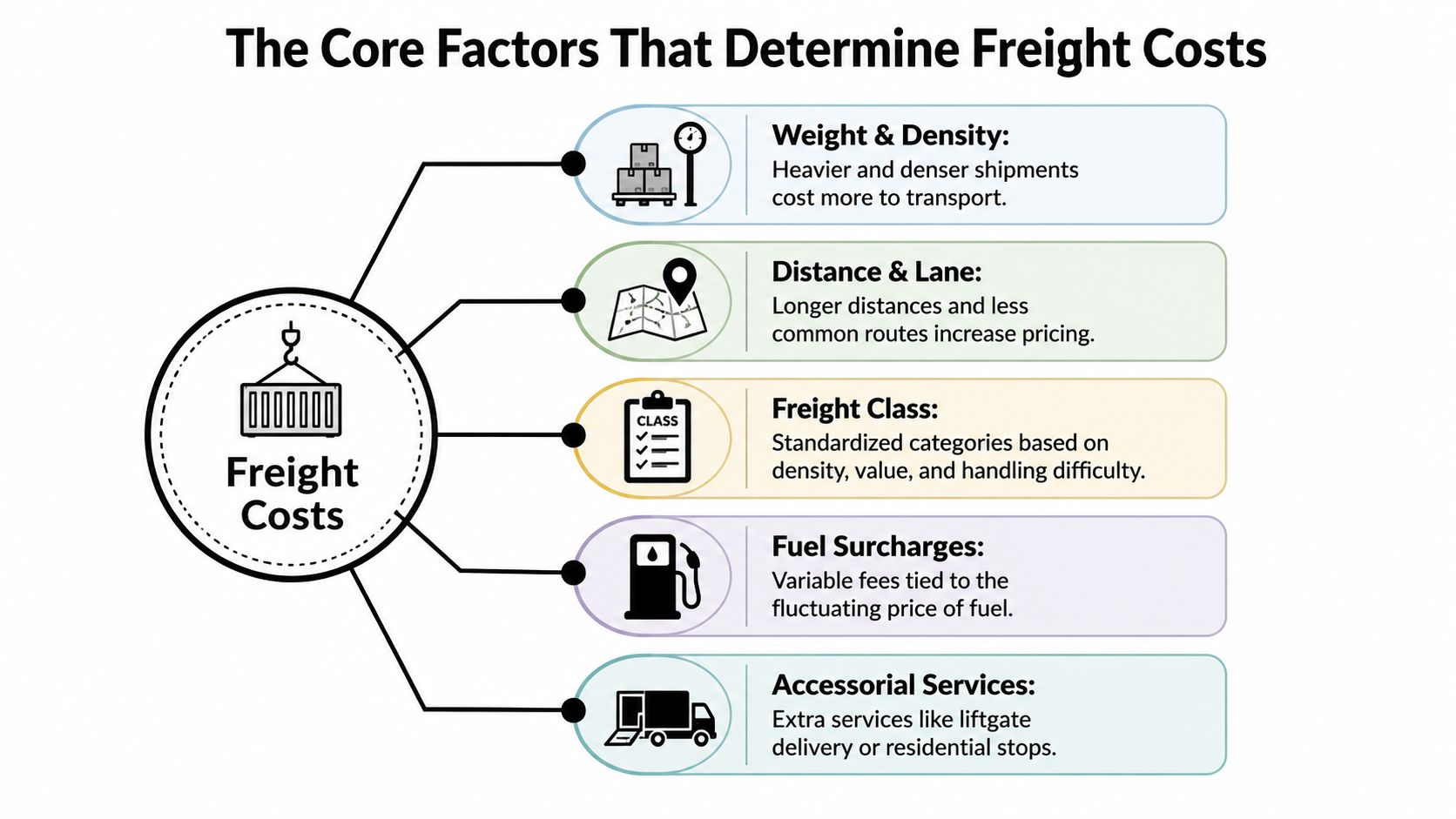
Weight and density shape the baseline
Two pallets can weigh the same and still price differently. That surprises a lot of first-time shippers.
Picture a pallet of pillows and a pallet of metal parts. The pillow pallet takes up a lot of room for its weight. The metal pallet is compact and dense. Carriers care about both because trailer space is limited. A shipment that “ships light but lives large” can cost more than you’d expect because it uses valuable room.
Distance matters too, but not just in a straight-line sense. Carriers price by lane, which means the specific route between origin and destination. A common business corridor is usually easier to service than a pickup or delivery point that sits outside regular freight patterns.
If you’re trying to estimate costs before asking for a quote, it helps to think through your packaging first. Tight, stable packaging often makes a shipment easier to price and handle. For international auto buyers comparing landed costs, a tool like this kompleksowy kalkulator kosztów importu is useful because it shows how logistics costs stack up when multiple charges affect the final total.
A practical explanation of freight class can also help if you’re still learning the language. This guide to freight shipping class and lower costs breaks down why classification matters.
Freight class helps carriers sort risk and space
Freight class is one of the terms that sounds intimidating but works like a category label. It helps carriers evaluate how easy or difficult an item is to transport.
The National Motor Freight Classification system uses 18 classes ranging from Class 50 to Class 500. Lower classes generally apply to dense items with lower transport cost, while higher classes apply to lighter, less dense, or harder-to-handle items. The NMFTA notes that Class 50 covers low-cost, dense items and Class 500 can include low-density items like ping pong balls, which is a memorable example because they take up lots of room for very little weight (NMFTA NMFC overview).
Later in the pricing process, carriers may also factor in fuel surcharges and any special handling requirements. That’s why two shipments with similar weights can still come back with different totals.
Here’s a simple side-by-side view of the two main freight modes.
LTL and FTL solve different problems
| Feature | LTL (Less-Than-Truckload) | FTL (Full-Truckload) |
|---|---|---|
| Truck space | Shared with other shippers | Dedicated trailer |
| Best for | Smaller freight shipments | Large loads or shipments needing more control |
| Budget fit | Usually better when you don’t need a full trailer | Often makes sense when your shipment is large enough to fill or justify the trailer |
| Handling | More touchpoints because freight moves through a shared network | Fewer touchpoints because one truck carries the load |
| Speed | Can take longer due to multiple stops and terminal handling | Often more direct |
| Typical decision | One or a few pallets | Large volume, special equipment, or high-priority freight |
Practical rule: If your shipment only needs part of a trailer, LTL is usually the first option to price. If your freight is large, sensitive, or time-critical, FTL may be the better fit even if the quote is structured differently.
Real World Freight Cost Examples LTL and FTL
This is the part most business owners want first. They want a number. Fair enough. But because freight prices depend on lane, packaging, class, and service needs, examples work best as patterns, not promises.

What an LTL quote usually reflects
Say a Sugar Land business wants to ship one pallet of marketing materials to another Texas city. The shipment is neatly wrapped, stackable, and going from one commercial address to another. That’s often one of the cleaner LTL situations because the freight is straightforward and the addresses are carrier-friendly.
Now change one detail. The delivery is going to a home office, a church, a school, or a construction site. The pallet still weighs the same, but the service is more complicated. The carrier may need special equipment or extra coordination, so the final price can rise.
Here are a few realistic ways to think about LTL, without pretending there’s a universal rate card:
A single pallet moving a shorter regional distance often prices far more favorably than the same pallet moving across multiple states.
A dense pallet of boxed parts usually gets treated more efficiently than a bulky pallet of lightweight displays, even if both look similar at first glance.
A shipment with clear dimensions, a stable pallet, and commercial dock access usually gets cleaner quotes than one with missing measurements or special delivery constraints.
That’s why it helps to get your shipment measured and classified before you start comparing options. If you’re reviewing available services, this page on freight shipping services gives a practical look at the kinds of freight support small businesses often need.
What changes when you book FTL
FTL works differently because you’re no longer buying part of a trailer network move. You’re booking dedicated truck capacity for your load.
For a business owner, that changes the decision more than the math. You might choose FTL because the shipment is large, because the freight is fragile and you want fewer handling points, or because the delivery window matters enough that a dedicated truck is worth it.
A useful way to picture it is this:
- LTL is like sharing a moving truck with several other customers.
- FTL is like reserving the whole truck for your move.
- Special equipment adds complexity if the freight needs unusual loading, securement, or trailer type.
- Directness can matter when inventory timing is tight or damage risk is a concern.
Some first-time shippers assume FTL only makes sense for very large companies. That’s not true. A smaller company may book FTL for a trade show booth, equipment relocation, or a load that should not be transferred through multiple terminals.
The cheapest freight option isn’t always the lowest quote. If a lower-cost mode increases delay risk, handling risk, or re-delivery problems, the real business cost can be higher.
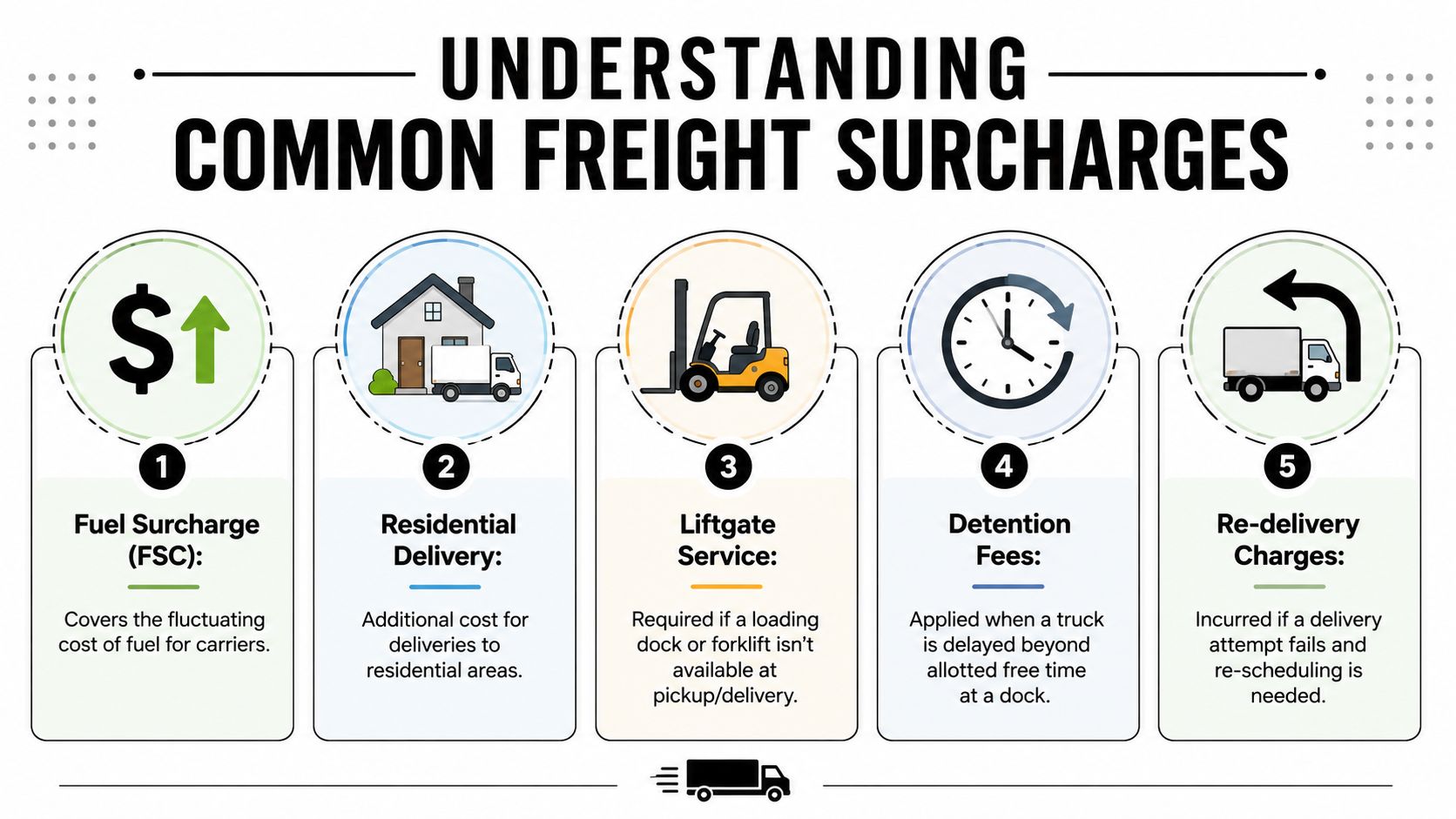
Understanding Common Freight Surcharges
The base quote is only part of the story. Freight bills often include accessorials, which is industry language for extra services outside a standard dock-to-dock move.
Why extra fees show up
These charges aren’t random penalties. They usually appear because the driver, truck, or terminal has to do more work than a standard shipment requires.
A normal freight pickup assumes a commercial location with a loading dock, shipping hours, and staff ready to load or unload. When that setup changes, the carrier often adds a service charge.
For small businesses, these are the most common examples:
- Liftgate service means the truck needs a powered platform to raise or lower the freight because there’s no dock or forklift on site.
- Residential delivery applies when the destination is a home or home-based business location rather than a standard commercial address.
- Limited access can apply to places like schools, storage facilities, job sites, or other locations that are harder for freight trucks to enter and service.
- Inside delivery means the driver is being asked to move the shipment beyond the curb or dock area.
The surcharges small businesses see most often
Fuel surcharge is another common line item. Unlike special location charges, it reflects the carrier’s operating environment rather than your packaging or address details.
Detention and re-delivery fees also catch people off guard. Detention can happen when a truck is kept waiting too long for loading or unloading. Re-delivery can happen when the carrier arrives but can’t complete the delivery because the site is closed, unprepared, or unable to receive the freight.
If a freight quote seems higher than expected, check whether the carrier included add-on services you actually need. That’s often where the difference lives.
The easiest way to avoid surprise surcharges is to describe the pickup and delivery locations accurately. If there’s no dock, say so. If the destination is residential, note it upfront. Accurate details usually lead to more accurate pricing.
Five Smart Ways to Reduce Your Freight Costs
Most freight savings come from preparation, not luck. Small businesses usually lower costs by making the shipment easier to handle, easier to route, and easier to quote correctly the first time.
Savings usually come from planning
Start with packaging. If you can tighten the footprint of a shipment without damaging the product, you may improve its density and make it easier for the carrier to load. A stable pallet with no overhang is easier to stack, safer to move, and less likely to trigger avoidable issues.
Then look at timing and consolidation.
- Combine what you can: Two separate shipments often create more handling and paperwork than one well-planned outbound move.
- Use commercial locations when possible: Shipping from a business address with a dock or forklift can help you avoid extra service fees.
- Give a flexible window: If your customer can accept delivery across a broader time frame, you may have more routing options.
- Confirm measurements before quoting: A quote built on rough guesses can change later if the actual shipment is larger or denser than expected.
- Ask whether mode matters: Sometimes a different service type fits the shipment better than the first option you considered.
There’s also a mindset shift that helps. Don’t focus only on the visible transportation charge. Think about the full move. Packaging mistakes, missed appointments, and inaccurate location details can cost more than the line-haul itself.
If your business sometimes handles vehicle-related logistics during relocations, this guide on how to ship cars affordably for relocations is a useful example of the same principle. The lowest initial price isn’t always the lowest total hassle.
Good freight planning is simple. Measure carefully, package tightly, disclose special conditions early, and avoid paying for preventable complications.
Get Your Accurate Freight Quote in Sugar Land
When you’re ready to stop estimating and get a usable number, gather the shipment details first. That saves time and helps you avoid revised pricing later.
What you need for a freight quote
Bring or prepare these details before requesting a quote:
- Exact dimensions: Length, width, and height of the pallet or crate after it’s fully packed.
- Accurate weight: The total shipment weight, not a rough guess.
- Origin and destination information: Full addresses or at least ZIP codes for pickup and delivery.
- Packaging type: Pallet, crate, boxes on skid, machinery, or another format.
- Location details: Whether each site is commercial, residential, limited access, or dock-equipped.
- Special services: Liftgate, inside delivery, appointment delivery, or anything else the carrier needs to know.
If you leave out one of those items, the quote can still come back, but it may not be the quote you end up paying.
Why local help makes the first shipment easier
For many small businesses, the hardest part isn’t the truck. It’s preparing the freight correctly. That means measuring the packed shipment, weighing it, making sure the pallet is stable, and describing the pickup and delivery conditions clearly.

A local shipping center can make that process much smoother because you’re not trying to decode freight rules by yourself at a computer screen. If you need in-person help with shipping preparation, packaging support, and business shipping logistics, this Sugar Land shipping and mailing service page shows the kinds of services available locally.
The big takeaway is simple. If you’ve been asking how much freight shipping is, the answer depends on the shipment’s size, density, route, service level, and delivery conditions. Once those details are clear, freight stops feeling mysterious. It becomes a practical business task you can manage with confidence.
If you’re in Sugar Land and need hands-on help with a pallet, oversized shipment, or first-time freight move, Business Mail Boutique LLC can help you get it packed, measured, and routed without the guesswork. Bring in your shipment details, or bring the items themselves, and the team can help you prepare an accurate freight quote and handle the shipping process from start to finish.

Related posts

Custom Memorial Glasses Engraved in Three Hours in Sugar Land
When a customer needed eight personalized glasses for a memorial, Business Mail Boutique completed the engraving or...

Custom Martini Glass Engraving in Sugar Land, TX
Custom Logo Engraving on Martini Glasses in Sugar Land, Texas.
Business Mail Boutique recently completed a beautiful custom engravin...

Custom Engraved Wine Glasses for a Golf Club Event in Sugar Land, TX
Custom Engraved Wine Glasses for a Golf Club Event in Sugar Land.
Custom wine glass engraving in Sugar Land, TX at Business Mail Bouti...