- Print Business Cards in Sugar Land – Same Day Service
- Copying Services
- Document Printing, Finishing & Lamination in Sugar Land
- Flyers
- Print Banner in Sugar Land | Same-Day Banner Printing Near Me
- Graphic Design
- Photo Printing
- Postcard Printing
- Document Printing
- EDDM Full Service Postcards
- FotoZoomer Large Format Printing


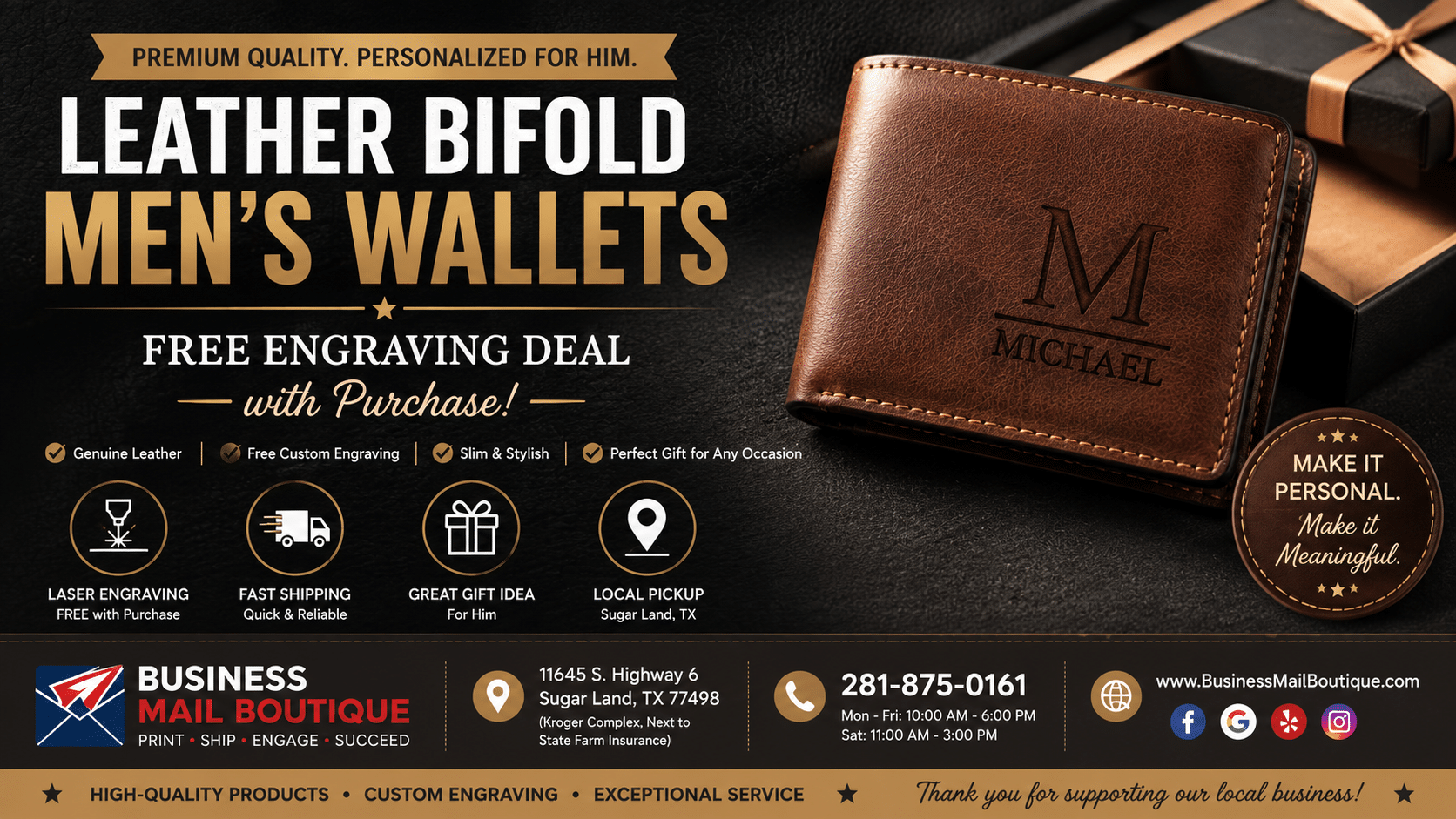
Leather Bifold Men’s Wallets: Free Engraving Deal with Purchase.
Find your ideal leather bifold men’s wallets free engraving deal with purchase. Our 2026 guide covers quality, custom engraving design, and essential care tips.
Businessmailboutique
11645 S. Hwy 6
Sugar land, Texas 77498 United States (US)
Email: info@businessmailboutique.com
Route
You’re probably looking at a wallet right now and asking two questions at once. First, is this a good wallet? Second, is the free engraving deal with purchase worth taking, or is it just a checkout gimmick that leaves you with tiny text in a bad spot?
That’s the right way to think about it. A personalized wallet can be one of the best practical gifts you’ll buy because it gets used every day, develops character over time, and carries a message that means something to the person holding it. But the result depends on more than the word “free.” Leather quality, finish, engraving method, artwork prep, and aftercare all decide whether the final piece feels sharp or disappointing.
The upside is that you don’t have to guess. If you know how online offers usually work, and you know what a local engraving shop can adjust on the fly, you can get the best of both worlds with a leather bifold men’s wallets free engraving deal with purchase.
Table of Contents
Why a Personalized Wallet Is a Timeless Upgrade
A plain wallet solves a practical problem. An engraved wallet does that and carries a memory with it. That’s why people keep coming back to them for birthdays, graduations, anniversaries, retirement gifts, and wedding party gifts.
A bifold works especially well because it’s familiar. Most men already know how they like it to fold, how many cards they carry, and whether they prefer a slim profile or a fuller interior. When you add initials, a date, or a short private message, the wallet shifts from a standard accessory to something chosen for one person.
That shift matches what buyers are already doing in the market. The global leather wallet market was valued at USD 23.4 billion in 2022 and is projected to reach USD 35.2 billion by 2030, with a CAGR of 6.0%, driven in part by interest in premium, durable accessories and value-added services such as free engraving, according to leather wallet market reporting.
For gift buyers, that makes sense. People want something useful, but they also want it to feel considered.
A wallet is one of the few gifts that can feel personal without becoming decorative clutter.
There’s also a reason engraved leather shows up so often in milestone events. If you’re comparing ideas for coordinated gifts, keepsakes, or event accessories, this guide to monogrammed leather accessories for weddings is a helpful example of how personalization turns everyday items into occasion pieces.
When customers ask what message ages best, the answer usually isn’t the longest one. Initials on the outside, a date inside, or a short phrase that means something only to the recipient often lands better than a full quote. Simple choices tend to wear well visually and emotionally.
If you’re browsing broader gift options before settling on a wallet, it also helps to compare styles across categories such as personalized engraved gifts for men. A wallet often wins because it balances sentiment with daily use, and that combination is hard to beat.
Decoding Leather Quality and Wallet Construction
The engraving gets attention first. The wallet itself decides whether the gift still looks good a year later.
Start with the leather, not the engraving
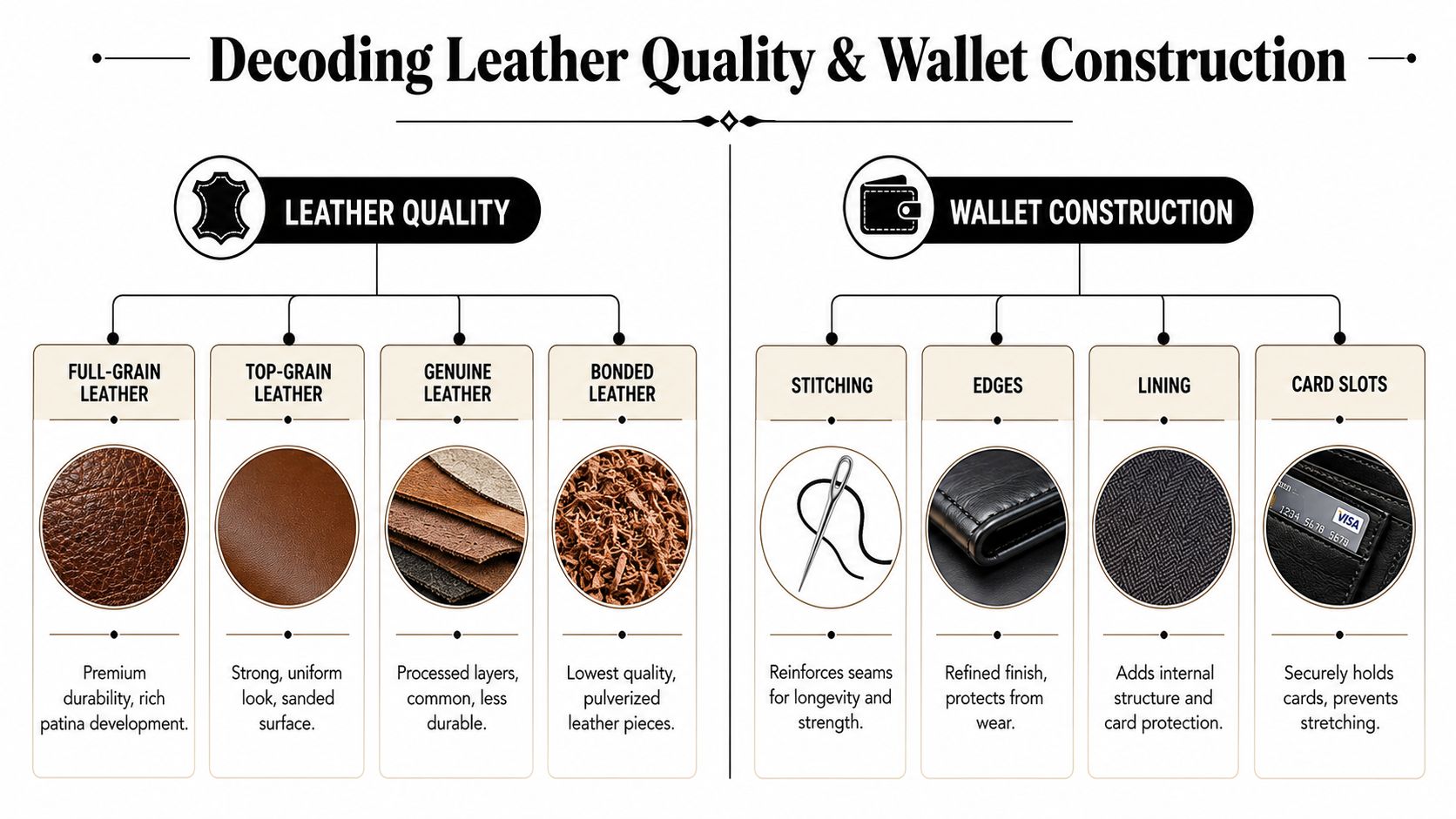
For men’s bifolds, top-grain leather is the material you’ll see most often because it balances durability, appearance, and cost. In wallet manufacturing, top-grain is the most common material used for bifold men’s wallets, and free engraving is typically applied with a 15 to 30W laser. That same technical reference also notes a common issue. On oiled or waxed leather, uneven engraving depth occurs in 3.8% of cases, which can reduce contrast and legibility, according to this engraving process reference.
That matters because shoppers often focus on leather labels without looking at the finish. A smooth, corrected, or heavily waxed surface can still feel nice in hand, but it may not take an engraving as cleanly as a more stable, less oily finish.
Use this quick filter when you shop:
- Top-grain for balance: Often the safest pick if you want a clean look, consistent surface, and dependable engraving results.
- Full-grain for character: Great when you want visible natural markings and a richer patina, but the final engraving can look more organic than perfectly uniform.
- Heavily oiled finishes with caution: They can look handsome on the shelf, but they’re more likely to produce inconsistent depth or lower contrast.
Construction details that matter in daily use
Leather grade is only half the job. A bifold gets opened, flexed, and sat on every day. Bad construction shows up fast.
Look closely at these areas before you get excited about the personalization offer:
| Area | What to look for | Why it matters |
|---|---|---|
| Stitching | Straight lines, tight spacing, no loose ends | Weak seams fail before the leather does |
| Edges | Cleanly folded, painted, or burnished edges | Rough edges fray and make the wallet look cheap |
| Card slots | Even spacing and firm tension | Loose slots stretch out, tight ones fight the user |
| Lining | Smooth interior material without bubbling | A poor lining catches cards and wears unevenly |
A good wallet should feel composed, not floppy. The fold should sit naturally. The slots should hold cards without forcing them. The edges should look finished, not raw unless that rougher style is clearly intentional.
Practical rule: If the wallet doesn’t look worth buying before the engraving, it won’t become worth buying after the engraving.
One more thing customers miss. Ask where the engraving will go in relation to folds, stitching, and pockets. A perfect design in the wrong spot can distort over time because the leather keeps bending at that exact line.
What a Free Engraving Deal Really Includes
“Free engraving” sounds generous, but the actual value depends on the limits wrapped around it.
What online offers usually cover
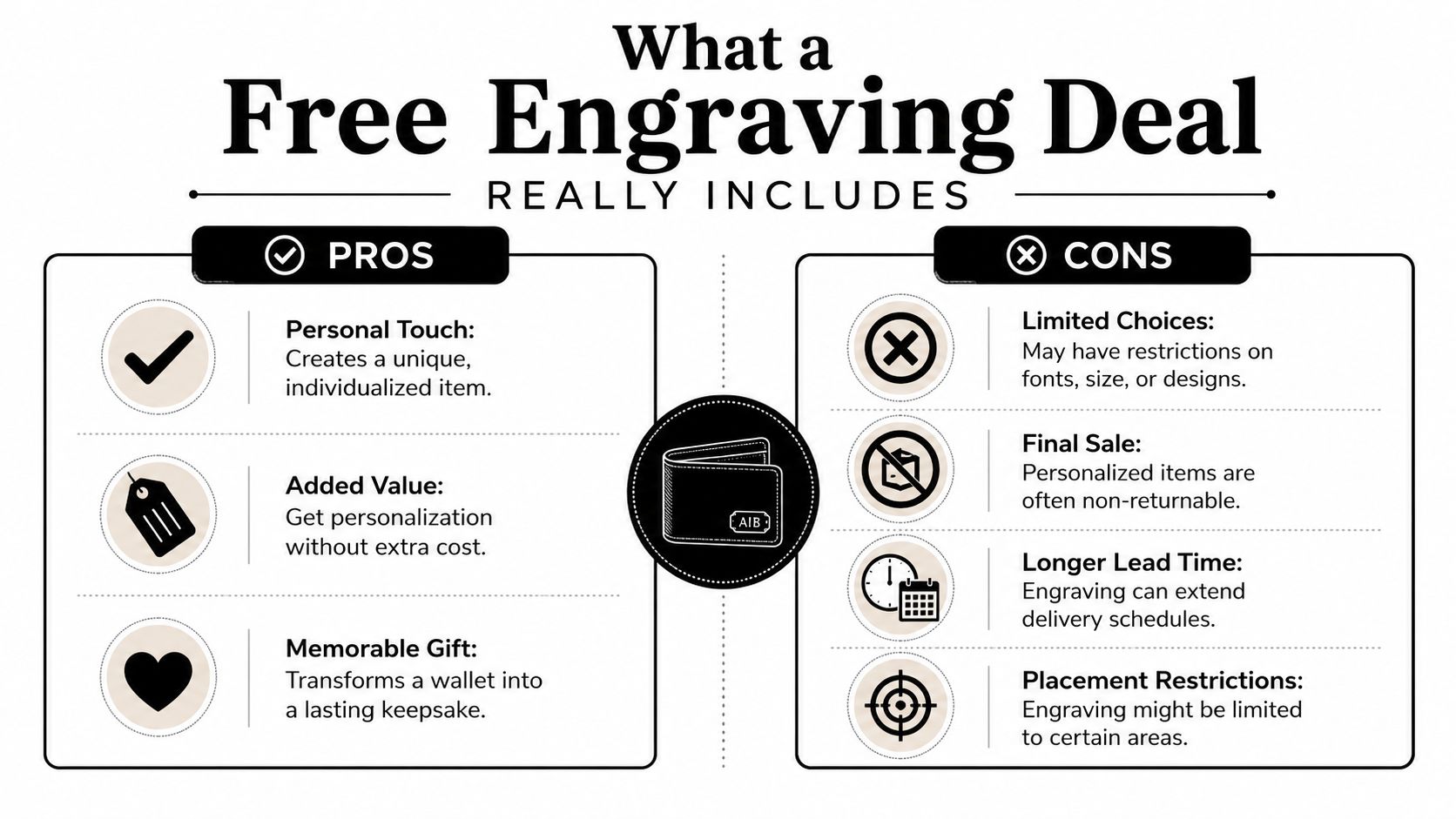
Most online wallet deals include the basics only. You’ll usually get one approved location, a short line of text, a limited font menu, and no real flexibility once the order is submitted. That can work fine if you want simple initials in a standard position.
Where people get tripped up is assuming “free” means “custom.” It usually doesn’t.
Common restrictions include:
- Placement limits: Inside corner only, center panel only, or one preset exterior location.
- Design limits: Text only, no handwritten notes, no custom logo, no nonstandard layout.
- Approval limits: A tiny digital preview that doesn’t fully show leather grain, scale, or contrast.
- Return limits: Personalized items are commonly final sale.
That last point matters. If the engraving is smaller than expected or lands too close to a stitch line, the seller may still consider the order correct because it matched the preset production setup.
Laser engraving versus embossing
Many free deals use laser engraving because it’s efficient and easy to standardize. That method can look clean and modern, especially on smooth darker leather. But it isn’t the only personalization method, and it’s not always the best match for what the buyer imagines.
Recent industry data shows that 44% of premium wallet buyers in the US and EU prefer the tactile feel of embossing, while 72% are unaware that laser engraving can alter leather’s texture and biodegradability due to carbonization, according to Smithers packaging market trend coverage.
Here’s the practical difference:
- Laser engraving removes or darkens the surface visually. It’s sharp for names, initials, and simple graphics.
- Embossing presses the design into the leather. It gives depth you can feel, and many people read that as more traditional or luxurious.
- Foil stamping adds a decorative finish, but it’s more style-dependent and usually less subtle.
If you’re choosing between them, don’t just ask what’s free. Ask what look you want in hand. A customer expecting deep, pressed lettering may feel underwhelmed by a laser mark, even if the execution is technically correct.
The best engraving deal is the one that matches your expectation before you place the order, not after the package arrives.
From Idea to Artwork How to Prepare Your Engraving
The wallet may be premium, and the deal may be solid, but the engraving can still go wrong if the artwork is overcomplicated.
What works best on a wallet
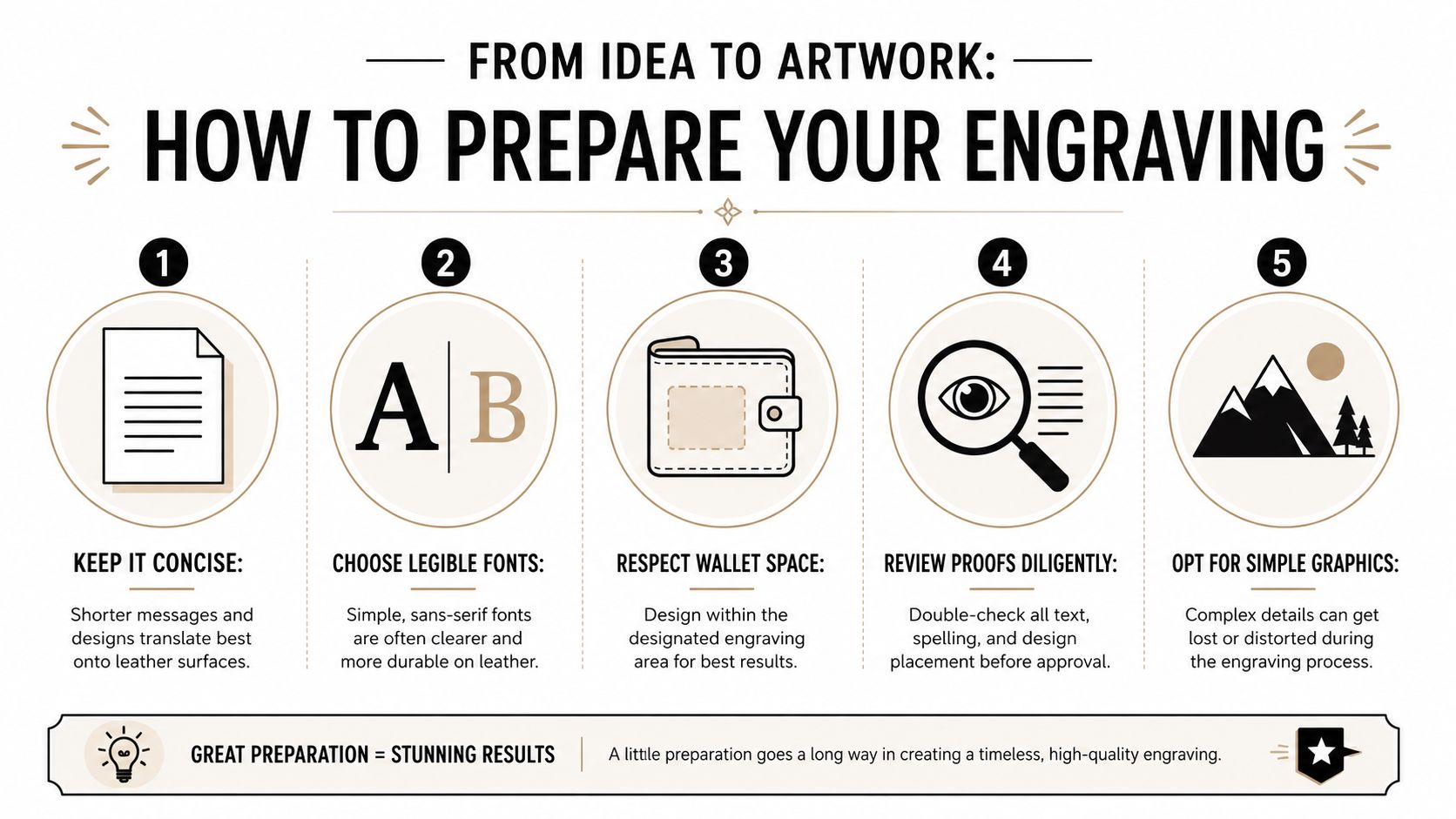
The best wallet engravings are compact. A few initials. A date. A short phrase. A small symbol with clear lines. Leather isn’t a full poster board, and a bifold has folds, pockets, and edges competing for space.
That restraint lines up with what buyers value. A 2023 survey found that 42% of U.S. consumers were willing to pay an additional 15% for a wallet with personalized engraving, highlighting how much perceived value people place on customization, according to market data on personalized wallet demand.
A few design choices consistently work well:
- Initials and monograms: Clean, classic, and easy to place.
- Short dates: Good for anniversaries, graduations, and retirements.
- One-line messages: Best when they’re brief and readable at a glance.
- Simple marks or logos: Fine if the artwork has bold shapes and not too much tiny detail.
If you want inspiration from another category where personalization has to balance sentiment with scale, this article on personalized jewelry for occasions is useful because the same design principle applies. Small pieces need strong, uncluttered personalization.
A quick visual overview helps before you finalize your layout:
How to avoid proofing mistakes
Font choice does more work than people think. Delicate script can look elegant on screen and turn muddy on leather, especially at small size. Clean serif or sans-serif fonts usually hold up better.
Before approving anything, check these five things:
- Spelling first: Names and dates are where costly mistakes happen.
- Case style: ALL CAPS, title case, and script initials each create a different mood.
- Scale on the actual wallet: A proof can be technically correct and still feel too small.
- Placement near folds: Avoid areas that bend every time the wallet opens.
- Artwork simplification: Thin lines, tiny flourishes, and crowded symbols often disappear.
If you’re unsure whether your file or message will translate well, it’s smart to ask detailed production questions before ordering through a service page like engraving support and questions. A few minutes of review can save you from a finished piece that looked better in your head than on the leather.
The Ordering Process Online vs Local Shops
Both ordering paths can work. They just solve different problems.
The online path
Online ordering is usually best when you already know the exact wallet, exact wording, and exact style you want. The process is straightforward. Pick the wallet, choose the engraving option, enter text, review the preview, and check out.
The convenience is real, especially if the seller has a strong product page and a clean proofing tool. But online systems are built for production consistency, not conversation. If your request falls outside the template, you often hit a wall fast.
Typical online pain points include slower revision cycles, uncertainty about final contrast, and no chance to physically compare placement before production.
The local shop path
A walk-in shop changes the process because you can talk through the result while holding the item. That matters when the leather has a unique finish, when you’re deciding between inside and outside placement, or when the artwork needs simplification.
This local engraving example shows the kind of service setup many customers prefer when they want live guidance and visual confirmation:
A local shop is especially useful in three situations:
- You already bought the wallet elsewhere: Some shops can engrave an item you bring in.
- You need flexibility: Custom layout, nonstandard placement, or a quick adjustment is easier in person.
- You want confidence before production: You can ask how the leather finish will react and whether the mark will stay readable.
Bring the wallet, the exact spelling, and a backup version of your message. If the available space looks tighter in person, a shorter option can save the design.
If you’re comparing service providers, this guide on choosing a local print shop in Sugar Land is useful because the same evaluation habits apply to engraving. Look for responsive communication, clear proofing, and staff who can explain trade-offs instead of just taking the order.
Protecting Your Wallet and Its Engraving for Years to Come
The biggest hesitation buyers have isn’t usually the wallet. It’s whether the engraving will still look good after months of pocket wear, heat, friction, and cleaning.
That concern is common. A 2024 study by the Leather Industry Association found that 68% of consumers hesitate to buy engraved leather goods because they worry about fading or cracking over time, yet only 12% of product pages provide maintenance guidance, according to this engraved leather care discussion.
Safe cleaning habits
Start gently. Leather wallets don’t need heavy treatment. Over-cleaning does more harm than light, consistent care.
Use a soft dry cloth first. If the surface needs more help, use a lightly damp cloth and keep moisture controlled. Don’t soak the leather. Don’t scrub across the engraving aggressively. Let it air dry naturally away from direct heat.
A few habits make a real difference:
- Empty the wallet before cleaning: That keeps the leather from stretching while you handle it.
- Test products discreetly: Try conditioner or cleaner on a hidden area first.
- Avoid oily over-application: Too much product can darken leather unevenly and affect the appearance around the engraving.
- Skip harsh household cleaners: They can dry the leather or leave residue.
What to do as the wallet ages
An engraved wallet won’t stay factory-fresh forever, and that’s not a flaw. Good leather develops patina. The surface softens, darkens slightly, and shows use. In many cases, that makes the piece look better.
What you want to avoid is unnecessary stress in the engraved area. Don’t overstuff the wallet. Don’t keep it in a damp pocket after workouts or rain. If it gets wet, empty it, pat it dry, and let it rest open at room temperature.
Minor scuffs around the engraving are normal. Heavy rubbing with conditioner to “fix” them usually isn’t. Treat the wallet as a leather item first and a personalized item second. Slow, minimal care wins.
Leather ages best when you leave room for natural wear and resist the urge to overcorrect every mark.
If you’re giving the wallet as a gift, include one simple care note. Store it dry, clean it gently, and condition sparingly. That small instruction can keep the engraving looking sharp much longer.
If you want help choosing the right engraving method, checking whether a wallet’s leather finish is suitable, or getting a personalized piece done with real guidance instead of a generic checkout form, Business Mail Boutique LLC can help. Their Sugar Land team handles custom engraving along with printing, shipping, and other business services, so you can walk in with a wallet, a gift idea, or a deadline and get practical advice before anything is marked permanently.

Related posts

Custom Memorial Glasses Engraved in Three Hours in Sugar Land
When a customer needed eight personalized glasses for a memorial, Business Mail Boutique completed the engraving or...

Custom Martini Glass Engraving in Sugar Land, TX
Custom Logo Engraving on Martini Glasses in Sugar Land, Texas.
Business Mail Boutique recently completed a beautiful custom engravin...

Custom Engraved Wine Glasses for a Golf Club Event in Sugar Land, TX
Custom Engraved Wine Glasses for a Golf Club Event in Sugar Land.
Custom wine glass engraving in Sugar Land, TX at Business Mail Bouti...