
- Print Business Cards in Sugar Land – Same Day Service
- Copying Services
- Document Printing, Finishing & Lamination in Sugar Land
- Flyers
- Print Banner in Sugar Land | Same-Day Banner Printing Near Me
- Graphic Design
- Photo Printing
- Postcard Printing
- Document Printing
- EDDM Full Service Postcards
- FotoZoomer Large Format Printing


Local Mailbox Rental: What It Is and Why It Works.
Learn what local mailbox rental is, how it compares to PO boxes and home delivery, and how small businesses in Sugar Land can rent a real street address.
Businessmailboutique
11645 S. Hwy 6
Sugar land, Texas 77498 United States (US)
Email: info@businessmailboutique.com
Route
You’re reviewing a business invoice at the kitchen table when you notice the return address. It’s your home. A customer, supplier, or stranger can now connect your company with the place where you live. If you’re trying to look professional while protecting your privacy, local mailbox rental can give you a practical middle ground, a local business address without putting your residential address on every label, invoice, or public listing.
The important part is choosing the right service and preparing the paperwork before you arrive. A private mailbox isn’t just a locked box. It’s a regulated mail-receiving arrangement with address-format rules, identity verification, package policies, and optional forwarding costs. Once those pieces make sense, the decision becomes much easier.
Table of Contents
- Why a Home Address Stops Working for Growing Businesses
- What Local Mailbox Rental Actually Means
- Local Mailbox Rental Compared to PO Boxes and Home Delivery
- Signing Up and the USPS Form 1583 Step
- Pricing, Forwarding Fees, and Package Handling Costs
- Choosing the Right Local Provider
- A Sugar Land Example and Your Next Step
Why a Home Address Stops Working for Growing Businesses
A freelance graphic designer in Sugar Land might start by sending invoices from her kitchen table. At first, using her home address feels harmless. Then a client forwards an invoice to a competitor, a vendor adds the address to a shipping record, and the designer realizes that her street address, phone number, and even glimpses of family life are tied to the business.
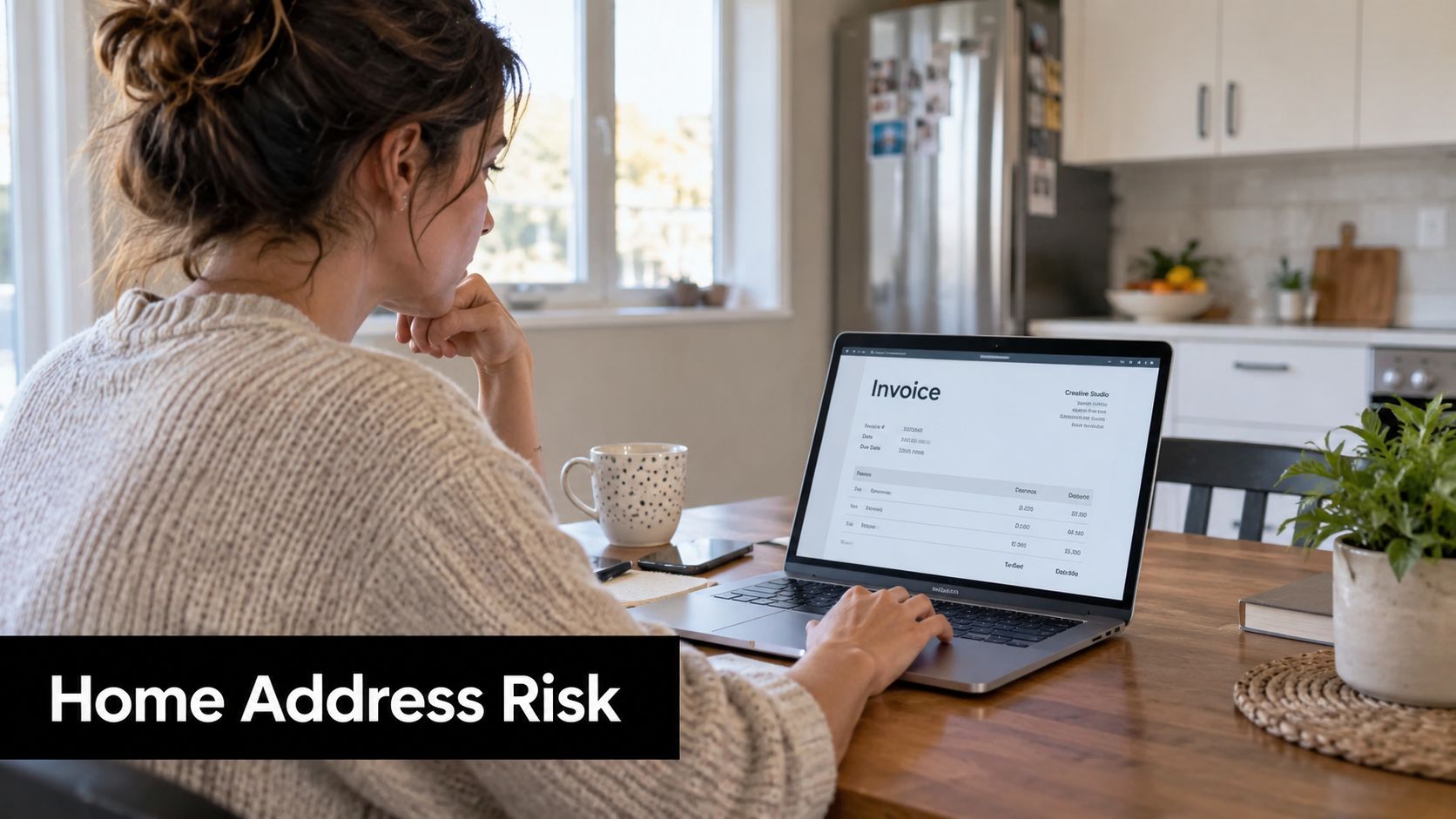
A residential address can create several everyday problems:
- Privacy exposure: Your address may appear on invoices, return labels, websites, directories, and public business records.
- Unwanted visits: Customers, salespeople, and delivery drivers may assume your home is an office open to visitors.
- Mixed business signals: A lender, supplier, or customer may see a residential address where they expected a dedicated commercial location.
- Public-facing presentation: A home address on stationery or a Google Business Profile can make a growing company look less established, even when the work itself is excellent.
None of this means a home-based business is unprofessional. It means your personal address is doing a job it wasn’t designed to do. You’re asking one location to function as your family’s private residence, your business headquarters, and a public contact point.
A local address without the home exposure
A local mailbox rental separates those functions. You rent a numbered mailbox at a storefront in your area, then use the provider’s street address and your mailbox identifier for business correspondence. Your company can remain connected to Sugar Land while your household address stays off routine mail.
For a deeper look at how entrepreneurs can use a business address, review this business mail address guide for entrepreneurs. It helps put the address decision in context, especially if you’re updating invoices, registration records, shipping labels, or customer-facing materials.
The fix is manageable. This week, identify the business documents that currently display your home address, shortlist a local provider, and ask for its Form 1583 requirements before you pay. That small preparation step prevents a rushed signup later.
What Local Mailbox Rental Actually Means
A local mailbox rental is a private mailbox service operated by a Commercial Mail Receiving Agency, or CMRA, from a physical storefront. You rent a numbered box inside the location’s mailroom, and the provider receives mail and packages for you. The arrangement gives you a street address in your town, rather than a standard USPS-only P.O. Box address.
The distinction matters because the address is structured for private mailbox use. An example might look like:
1234 Main St, PMB 17
The PMB or # identifies the customer’s private mailbox within the provider’s address. USPS guidance requires CMRA addresses to use one of those designators followed by the mailbox number, and it prohibits combining the customer’s box number with other secondary-address identifiers. USPS Publication 28 explains the required private mailbox format.
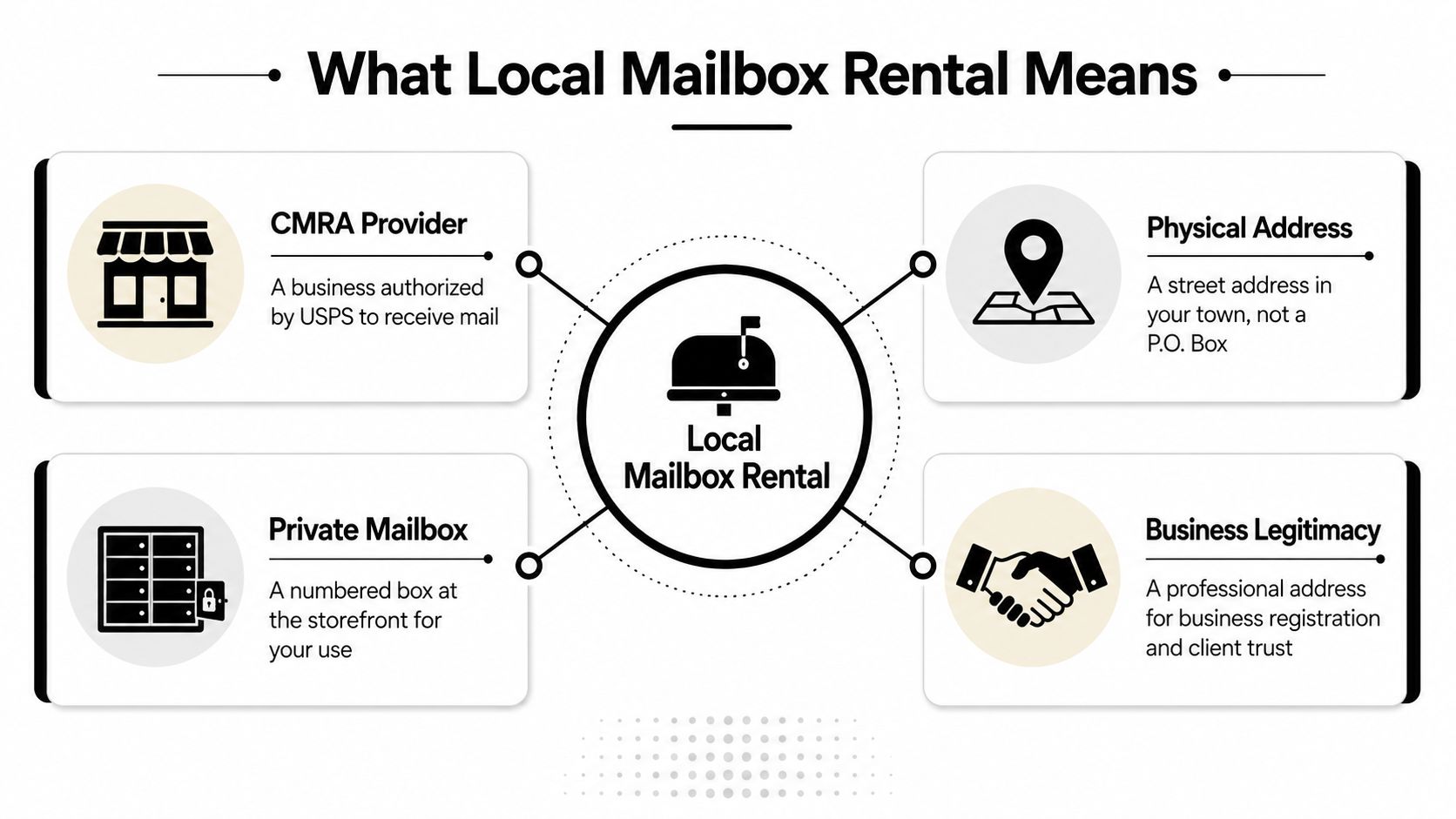
How the service feels day to day
Home delivery is simple because the carrier brings mail to your residence. A P.O. Box is a locked compartment at a post office, with access governed by that facility. A private mailbox sits at a commercial storefront, where the provider can receive mail and packages through the service policies it offers.
Your routine may look like this:
- You visit the storefront during its access hours.
- You sign in or use your assigned access method.
- You open your numbered box and collect letters.
- You pick up packages held behind the counter.
- You give outgoing mail to the clerk or use the location’s available shipping services.
The provider’s exact package limits, notification options, forwarding services, and access arrangements vary, so ask before signing. The key idea is straightforward: you’re renting a physical receiving point that uses a real street address, not asking the post office to assign you a box number.
The service has a longer regulatory history than many first-time renters realize. USPS tightened CMRA rules around 1999 to 2001, requiring private mailbox customers to use a secondary designator such as PMB or #. Federal Register notices in 2000 described formats such as “PMB 234” and “#234,” and a USPS-related update reported that the revised rule became effective in August 2001 after industry pushback. This historical account describes the USPS rule change. That change helped establish mailbox rental as a regulated service rather than an informal convenience.
Local Mailbox Rental Compared to PO Boxes and Home Delivery
The best option depends on what you need the address to do. A P.O. Box may suit someone who receives routine letters and wants a low-cost USPS collection point. Home delivery costs nothing beyond ordinary mail service, but it exposes your residence and leaves you responsible for packages at home.
A local mailbox rental generally sits between those choices. It costs more than basic home delivery, but it can provide a commercial street address and a storefront for package receiving. A provider may also offer forwarding, scanning, or shipment handling, though those features and charges must be confirmed locally.
| Feature | PO Box | Local Mailbox Rental | Home Delivery |
|---|---|---|---|
| Address type | USPS P.O. Box address | Street address with PMB or # and mailbox number | Residential street address |
| Carrier acceptance | USPS-focused | Provider policies may support USPS and private carriers | Carrier delivers to your home |
| Package handling | Subject to box and post-office limitations | Storefront receives packages within its stated limits | Packages arrive at your residence |
| Access | Post-office access schedule | Storefront access schedule | Access at home |
| Privacy | Keeps home address private | Keeps home address private | Home address is exposed to senders |
| Extra services | Usually limited to postal features | May include forwarding, scanning, or pickup | You handle sorting and forwarding yourself |
For a fuller side-by-side explanation, see this guide to mailbox rental versus a P.O. Box. The practical difference is not only the monthly rental. It’s also whether the location can accept the carriers you use, how it handles oversized packages, and whether staff notify you when something arrives.
A quick fit test
Choose a P.O. Box if you mainly receive letters, want a postal address, and don’t need a commercial street address. Home delivery can remain sensible for personal mail when privacy and package security aren’t concerns.
A private mailbox is often a better fit for:
- Home-based professionals: Keep a residential address off invoices and client documents.
- Online sellers: Route returns and carrier deliveries to a staffed storefront.
- New companies: Use a consistent business address where an ordinary P.O. Box may not meet a form’s requirements.
- Local operators: Collect mail in person while keeping the business tied to the community.
If you travel frequently or want to manage mail online, ask whether the provider also offers a digital or virtual mailbox. That model may include scanning and remote forwarding, while a traditional private mailbox is built around physical pickup.
Signing Up and the USPS Form 1583 Step
The part most new renters underestimate is USPS Form 1583. A CMRA must keep this form on file for the owner or manager and for each person, business, or firm receiving mail through the mailbox. The form supports identity verification and tells the provider who is authorized to receive mail.
You’ll generally need two forms of identification. One should be a photo ID, such as a driver’s license or passport. The second should verify your address. The provider keeps the completed form and supporting information. You don’t fill it out and send it to the post office yourself.
What to bring
| ID Type | Acceptable Examples | Role on Form 1583 |
|---|---|---|
| Photo identification | Driver’s license or passport | Confirms your identity and includes identifying details |
| Address verification | A qualifying document accepted by the provider | Connects you to the address listed on the application |
Requirements can vary in how the provider reviews documents, so contact the location before visiting. Some situations may require notarization or additional document handling, especially when an owner cannot appear in person. Neutral mailbox FAQs also highlight the need to prepare Form 1583, two forms of ID, and address verification before activation. Review this Form 1583 FAQ for onboarding questions.
The address line is part of the process
Once approved, your address must use the private mailbox format. That means the provider’s street address appears first, followed by PMB or # and your mailbox number. Don’t replace that designator with an unrelated suite label or combine multiple secondary identifiers.
This detail affects banking documents, online registrations, shipping labels, and business correspondence. USPS states that mail addressed to a CMRA customer must use the proper private-box format, so address normalization is a deliverability safeguard, not a decorative choice.
A typical signup sequence is simple:
- Choose the mailbox size and rental term.
- Complete Form 1583 with the provider.
- Present the required IDs and address verification.
- Sign the rental and service agreement.
- Receive your keys or access instructions.
- Confirm the exact address format before updating business records.
Mail acceptance may begin once the provider completes its process, but ask the store when your box becomes active. The safest approach is to leave with a written address format and a clear explanation of what the provider can accept.
Pricing, Forwarding Fees, and Package Handling Costs
A mailbox can look affordable until you add the services you use. Separate the bill into three layers: the base rental, optional services, and setup or administrative charges. The advertised rate may cover only the box, while forwarding, scanning, oversized packages, and special handling raise the monthly total.
The base rental commonly changes with box size and location. A suburban storefront may charge differently from a downtown center. Start by identifying your routine: letter storage, frequent package receiving, or room for larger shipments. That choice gives you a more useful comparison than the smallest advertised rate.
Build the total before you sign
Forwarding fees often create confusion because providers use different billing methods. Ask whether the charge applies per envelope, by shipment weight, or according to the carrier service selected. Priority and overnight shipments may also include separate postage or handling costs.
Package rules deserve the same careful review. A provider may charge for oversized items, hold packages for pickup without a forwarding fee, or automatically forward everything under a standing instruction. Scanning may have its own fee when you request a digital image without forwarding the physical mail.
| Cost Category | Typical Range | When It Applies |
|---|---|---|
| Base mailbox rental | Varies by box size and location | Recurring access to the private mailbox |
| Setup or administrative charge | Provider-specific | New-account processing, keys, or onboarding |
| Mail forwarding | Provider-specific | When letters or parcels are shipped to another address |
| Scanning | Provider-specific | When incoming mail is opened or digitized by request |
| Package handling | Provider-specific | Oversized, unusually heavy, or specially managed items |
| Special shipping service | Provider-specific | Priority, overnight, or other selected carrier services |
These are qualitative ranges because each provider sets its own fees. For a Sugar Land business, request a quote for a mid-size box, weekly forwarding of five to ten envelopes, and handling for two packages. The provider should list each cost separately. A single headline rental price does not show what that routine will cost.
E-commerce operators can also review PledgeBox’s Kickstarter fulfillment pricing options when estimating broader shipping and fulfillment expenses. That resource is not a mailbox-rental price list, but it can help separate package-receiving costs from order-handling costs.
Practical rule: Request the fee schedule in writing, then price one ordinary month and one busy month. The busy-month estimate often reveals the charges that affect your budget most.
The U.S. private mail center market includes mailbox rental, forwarding, package receiving, and related services, so providers may follow different service models rather than one shared price structure. Research and Markets reports about $3.7 billion in sales in 2024, roughly 4,463 companies, average sales of about $0.8 million per company, and growth of 3.8% annually over the prior five years in its U.S. private mail center market overview. Those figures describe the wider industry, not the price of a specific mailbox.
Choosing the Right Local Provider
A good mailbox shop should answer practical questions without making you feel rushed. Start with the physical location, then evaluate the service agreement. You’re not only buying a box. You’re choosing the people and procedures that will receive items in your company’s name.
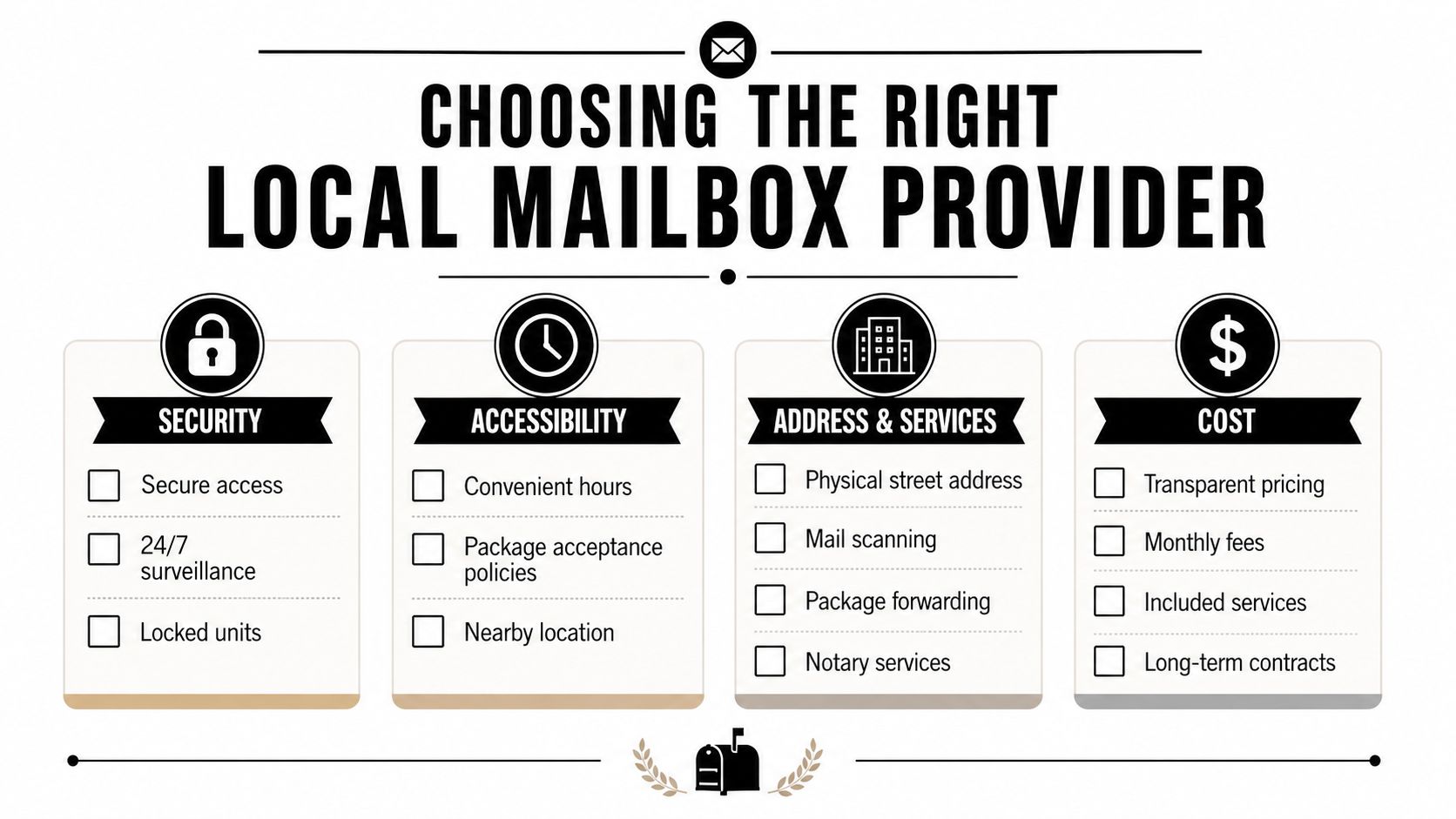
Inspect security and access
Look for a locked mailroom, individual keyed boxes, and visible camera coverage. Ask who can enter the receiving area and how staff handle packages that don’t fit inside the box. If the provider discusses background checks for employees, that can help you understand how access is controlled.
Accessibility matters just as much. Check whether the storefront’s hours match your workday, whether weekend pickup is available, and whether customers can pull in easily for larger packages. Ask how arrival notifications work. Email or text alerts may be useful if you don’t visit every day.
Confirm the address and service boundaries
Request the exact address format in writing. It should show the street address plus PMB or # and the assigned mailbox number. Ask whether the provider accepts deliveries from the carriers you use, what happens with oversized packages, and how long packages remain available for pickup.
Then review the add-ons:
- Mail scanning: Is scanning available, and is it requested per item or included in a plan?
- Forwarding: Does the provider ship on request, on a schedule, or automatically?
- Package notifications: Are alerts immediate, scheduled, or unavailable?
- Other services: Can the location support shipping, printing, notary appointments, or returns if those needs arise?
Use a two-minute field check
Before enrolling, test the provider’s clarity:
- Ask staff to write the address on a sample envelope.
- Request the complete fee schedule.
- Ask how a package notification would reach you.
- Present a Form 1583 question and see whether the explanation is confident and specific.
Cost transparency should be visible in the agreement and receipts. Watch for vague “handling” language, unexplained surcharges, or a service bundle that doesn’t identify what’s included. A provider that explains its rules clearly at signup is easier to work with when your mail volume changes.
A Sugar Land Example and Your Next Step
A Sugar Land boutique owner might rent a private mailbox near Highway 6 for three practical reasons. Wholesale invoices can arrive at a business address instead of the owner’s home, e-commerce returns can be directed to a staffed storefront, and bank paperwork can use a clean street-address format that separates the company from the owner’s residence.
The mailbox doesn’t replace good recordkeeping. The owner still needs to update vendors, confirm the PMB or # format, and understand which packages the provider will accept. But the arrangement creates one consistent receiving point for business correspondence and shipments.
Three actions to take this week
- Shortlist two locations: Compare nearby CMRAs by access hours, package policies, security, and forwarding services.
- Prepare your documents: Gather one photo ID, a second address-verification document, and the information needed for USPS Form 1583.
- Request the total cost: Ask for the mailbox rental, setup charges, forwarding fees, scanning costs, package handling rules, and any special-service charges in writing.
Business Mail Boutique LLC provides private and digital mailbox rentals in Sugar Land, with a real street address, mail and package receiving, and forwarding services. The storefront also supports shipping, returns, printing, packing, and related office services, so it can be a practical option for local small businesses that want to manage several errands in one place.
Visit Business Mail Boutique LLC to ask about Sugar Land mailbox availability, pricing, and the Form 1583 onboarding process. Bring your identification questions, package needs, and forwarding preferences, and request a clear service quote before choosing your mailbox.

Related posts

Custom Memorial Glasses Engraved in Three Hours in Sugar Land
When a customer needed eight personalized glasses for a memorial, Business Mail Boutique completed the engraving or...

Custom Martini Glass Engraving in Sugar Land, TX
Custom Logo Engraving on Martini Glasses in Sugar Land, Texas.
Business Mail Boutique recently completed a beautiful custom engravin...

Custom Engraved Wine Glasses for a Golf Club Event in Sugar Land, TX
Custom Engraved Wine Glasses for a Golf Club Event in Sugar Land.
Custom wine glass engraving in Sugar Land, TX at Business Mail Bouti...