
- Print Business Cards in Sugar Land – Same Day Service
- Copying Services
- Document Printing, Finishing & Lamination in Sugar Land
- Flyers
- Print Banner in Sugar Land | Same-Day Banner Printing Near Me
- Graphic Design
- Photo Printing
- Postcard Printing
- Document Printing
- EDDM Full Service Postcards
- FotoZoomer Large Format Printing


Businessmailboutique
11645 S. Hwy 6
Sugar land, Texas 77498 United States (US)
Email: info@businessmailboutique.com
Route
You’re probably not short on effort. You’re short on uninterrupted work time.
A lot of Sugar Land business owners start the day with a real plan and end it feeling like they spent most of it in the car, in line, or following up with vendors. One stop at the post office. Another at a print shop because the flyers weren’t ready. Then a shipping run before cutoff. Add a notary need, a return label issue, or a customer asking for a rushed banner, and the day starts running you.
That’s where one stop office solutions matter. Not as a buzzword, but as a practical way to stop breaking simple tasks into five separate errands. Instead of managing shipping in one place, printing somewhere else, mailbox service somewhere else, and document help from whoever can fit you in, you centralize the routine work that keeps interrupting your core work.
That model isn’t niche. The global One Stop Office Platform market is projected to grow from $15.3 billion in 2023 to $28.6 billion by 2032 at a 7.1% CAGR, reflecting rising demand for consolidated business services, according to Dataintelo’s One Stop Office Platform market report. Local businesses don’t need a global market lesson to feel that shift. They’re living it every week.
Table of Contents
- The End of Business Errands A New Approach
- What Is a One Stop Office Solution
- The Full Suite of Services Unpacked
- Why Smart Businesses Choose a Single Partner
- How to Maximize Your Local Business Center
- Choosing the Right Center in Sugar Land
- Frequently Asked Questions
- What do I need to bring for notary service
- Can someone help pack my shipment
- What is the difference between a digital mailbox and a PO box
- What file formats work best for printing
- Can a local office center help with more than business tasks
- Is a one stop office setup only useful for larger companies
The End of Business Errands A New Approach
A contractor prints proposal packets at one shop, ships samples from another, and uses a basic mailbox option that can’t handle package receiving the way he needs. A realtor needs signs, flyers, overnight envelopes, and occasional notarized paperwork, but each task lives with a different vendor. An online seller spends more time comparing shipping counters and return options than updating product listings.
That’s the pattern that wears small businesses down. Not one big failure. Just constant task switching.
When owners in Sugar Land talk about operational chaos, it usually sounds ordinary on the surface. Lost receipts. Missed cutoffs. Re-explaining the same project to different providers. Driving across town for one missing piece. The problem isn’t only the errands themselves. It’s the mental drag of managing fragmented admin work while trying to keep sales, service, and customers moving.
Practical rule: If a task repeats every week, it shouldn’t require a new decision every time.
A one stop office setup changes that by turning separate chores into one managed flow. You drop off returns, ship outbound packages, print materials, handle mail, and knock out document tasks in one visit. That’s far easier to maintain than stitching together a patchwork of stores and service counters.
For many local owners, the shift starts when they realize they don’t need five separate specialists for routine business support. They need one dependable hub with enough range to cover the jobs that interrupt the day most often. A neighborhood center like The Postal Depot service hub in Sugar Land shows what that can look like in practice when shipping, printing, and mailbox needs are handled under one roof.
Why this approach feels different
Traditional vendor management sounds organized until real life hits. One place closes early. Another has long turnaround times. A third doesn’t accept the file format you brought. Suddenly “keeping options open” turns into wasted time.
With a single local office services partner, business owners usually get:
- Fewer handoffs because one team sees the whole job
- Less travel time because common errands happen in one stop
- Cleaner communication because you’re not relaying details between vendors
- More continuity because repeat orders and preferences are easier to track
That simplicity is the point. The work still has to get done. You just stop paying for it with your focus.
What Is a One Stop Office Solution
Think of it as a business dashboard in physical form.
Instead of opening one app for shipping, another for document help, another for printing, and another for mail handling, a one stop office solution puts those practical functions in one place. It’s the storefront version of a unified workflow. That’s why the model makes sense for small teams, solo operators, and growing companies that need support without building an internal admin department.
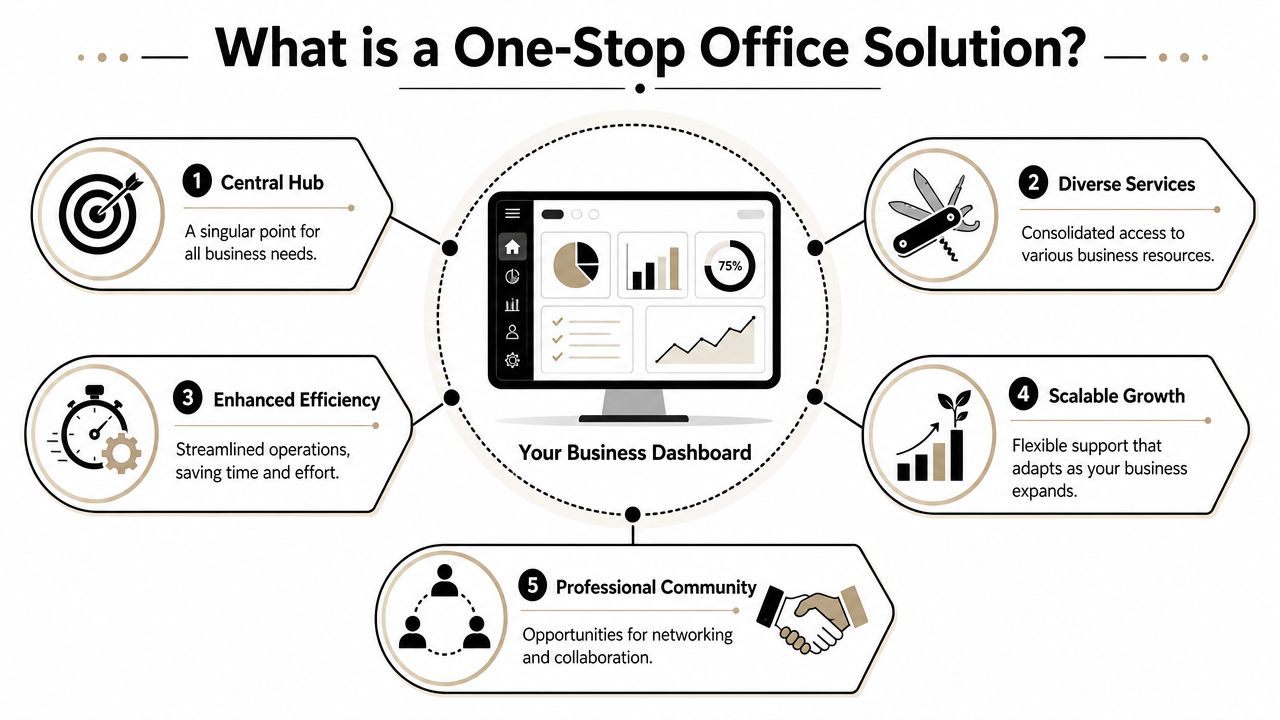
At its best, the concept is simple. You’re not buying random convenience. You’re reducing friction across related tasks that already belong together.
A Swiss Army knife for daily business operations
Most entrepreneurs don’t need a huge corporate back office. They need reliable support for recurring jobs such as:
- Outbound shipping for sales, samples, returns, and vendor paperwork
- On-demand printing for signs, cards, handouts, labels, and presentations
- Mail services that create a more professional business presence
- Document support for notarization, finishing, scans, copies, and IDs
- Specialty requests that pop up without much warning
When those services are centralized, you stop treating each one like a separate project.
That same idea shows up in digital operations too. Businesses that are rethinking office efficiency often apply the same logic to phone, messaging, and collaboration tools. If you want a clear example on the communications side, this guide to Unified Communications as a Service breaks down how companies simplify scattered systems into one working platform.
Good one stop office solutions don’t just offer many services. They connect tasks that naturally happen together.
What this changes for a small business owner
The big shift is psychological as much as logistical. Once you see shipping, printing, mail handling, and document support as one workflow, you stop outsourcing one task at a time and start outsourcing interruptions.
That’s a much more useful way to think about admin support. A center such as this guide to a copy and ship headquarters reflects that model well because it treats everyday office needs as one connected system instead of unrelated errands.
Here’s the practical test. If you often need something printed right before you ship it, or need a business address plus package receiving, or need signs and promotional materials on short notice, you’re already a candidate for a one stop setup. You don’t need more tools. You need fewer disconnected ones.
The Full Suite of Services Unpacked
A one stop office center earns its value by handling the jobs that interrupt real work in Sugar Land. The point is not to offer a long menu of unrelated services. The point is to keep an owner from bouncing between a shipping store, print shop, mailbox provider, notary office, and specialty vendor in the middle of a busy week.
Shipping and Packing That Solves Problems
Shipping gets complicated fast once the item is fragile, oversized, urgent, or headed out as a return. A capable local counter helps you choose the right carrier, pack the item correctly, print labels, track the shipment, and handle drop-offs in one visit.
That matters across industries. Law firms send signed originals. Designers send proofs and sample kits. Contractors ship parts. Online sellers need outbound shipments, then return handling a day later.
Packing quality matters too. Bad box choices, weak cushioning, and rushed sealing create damage claims, replacements, and customer frustration. For a small business, that is not a minor mistake. It cuts into margin and burns time twice.
Printing for Daily Work and Short-Notice Jobs
Printing separates average office service centers from useful ones.
A stronger setup handles both routine materials and customer-facing pieces in the same place. That includes business cards, flyers, banners, posters, yard signs, decals, presentation packets, photo prints, and large-format plans or blueprints.
In Sugar Land, that mix matters because local demand changes fast. A restaurant may need menu inserts before the lunch rush. A realtor may need open-house flyers and sign riders by Friday. An engineer may need full-size plan prints after a revision comes in late. The convenience is not just speed. It is consistency. Colors, paper choices, sizing, and finishing stay aligned when one team handles the job from start to finish.
If a printed piece represents your business in person, quality problems show up immediately.
Mailbox and Mail Handling Services
Mailbox service does more than give a business a place to collect envelopes. A useful setup provides a professional street address, package receiving, forwarding, and a cleaner separation between business mail and home life.
That helps several types of local operators:
- Freelancers and consultants who do not want a home address on public listings
- E-commerce sellers who receive inventory, packages, and returns regularly
- Home-based businesses that want a more established business presence
- Mobile teams that need mail managed while they work in the field
The benefit becomes obvious once the mail starts to matter. Vendor checks, legal notices, customer returns, and signed documents are easier to manage when they are not mixed with household deliveries.
Notary, Document, and Identity Support
This category saves a lot of interrupted afternoons.
Small business owners often need notarization, passport photos, ID photos, scans, copies, lamination, or document finishing with very little notice. These jobs do not happen every day, but they usually show up on the day you already have too much going on. One location that can handle them in a single stop removes a surprising amount of friction.
Some centers also offer remote online notary, fingerprinting, key duplication, and similar utility services. Those may sound secondary until you need one at short notice for hiring paperwork, licensing, travel documents, or a last-minute client request.
Custom Personalization and Specialty Work
Some office centers stop at shipping and copies. Others can also produce engraved or sublimated items such as plaques, mugs, and key chains.
That helps with more than gifts. Local businesses use these services for client thank-yous, team recognition, event merchandise, promotional items, and short-run branded products. In practice, it means one less vendor to research, brief, and follow up with when a standard office task turns into a custom project.
For Sugar Land owners trying to reduce vendor sprawl, that range matters. The less often you have to piece together five providers for one week’s worth of tasks, the easier it is to keep your attention on customers, staff, and sales.
Why Smart Businesses Choose a Single Partner
Convenience gets the first yes. Efficiency is what keeps businesses with the model.
When owners centralize recurring office tasks, they usually notice the same thing first. The day gets less fragmented. Fewer texts to different vendors. Fewer file resends. Fewer follow-up calls asking whether the shipment went out, whether the print job is ready, or whether the signed document can be notarized today.
The Hidden Cost of Vendor Sprawl
Most small businesses don’t realize how much friction comes from scattered providers until they stop using them.
One vendor prints. Another ships. Another handles mail. Another does notary work. On paper, that looks flexible. In practice, it creates duplicate explanations, inconsistent quality, and a steady stream of tiny admin tasks that never make it onto a profit-and-loss statement.
A consolidated approach can improve more than convenience. Organizations using One Stop Service models have reported operational cost reductions of about 30% and service delivery speed improvements of about 25%, according to this summary citing Boston Consulting Group data.
That finding makes sense on the ground because small businesses waste energy in places that don’t look dramatic:
| Friction point | What happens with multiple vendors | What happens with one partner |
|---|---|---|
| Project instructions | You repeat specs to each provider | One team learns your usual needs |
| Timing | Separate deadlines conflict | Jobs are easier to sequence |
| Quality control | Output varies by vendor | Standards are easier to maintain |
| Problem solving | You chase the source of the issue | One point of contact handles it |
What Gets Easier With One Relationship
One relationship won’t solve every business problem. It does solve many routine ones.
For example, a local seller might print inserts, pack outgoing orders, process returns, and receive packages through one center instead of splitting that workflow between an office printer, a carrier store, and a separate mailbox location. A consultant might use the same location for a street-address mailbox, proposal printing, and overnight delivery. A community event organizer might handle banners, flyers, directional signs, and shipment of materials without coordinating separate shops.
The practical gains usually show up in four areas:
- Decision fatigue drops because you stop evaluating a new provider for every small job
- Workflow gets tighter because printing, packing, and shipping can be sequenced together
- Brand presentation improves because one team sees your materials repeatedly
- Follow-up gets simpler because there’s one place to call when timing matters
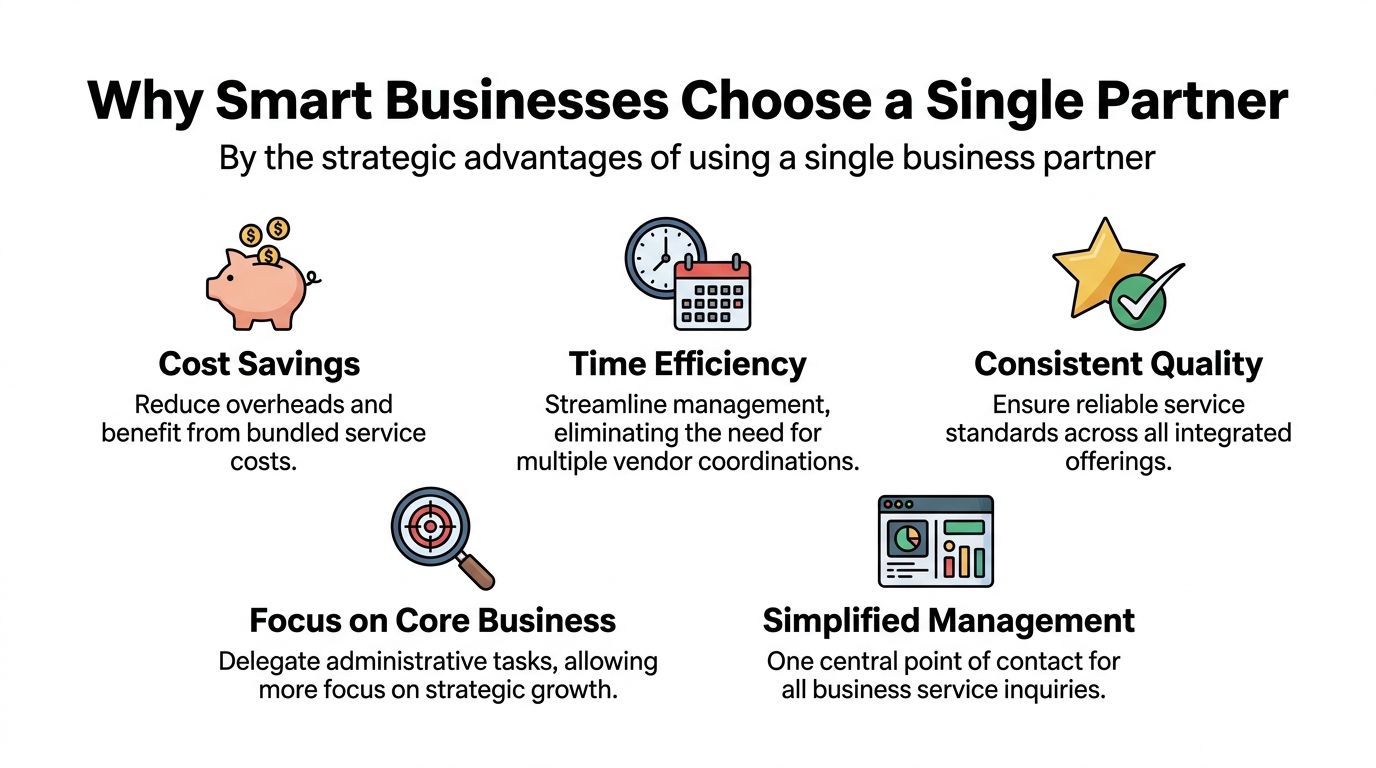
A single partner isn’t valuable because it’s simpler on paper. It’s valuable because it removes dozens of low-value decisions from the week.
There is a trade-off, of course. You need a provider with enough range and competence to properly carry the load. If a center only does one thing well, bundling won’t help. But when the service mix is strong and the staff understands real business workflows, the one stop model becomes less of a convenience and more of an operating advantage.
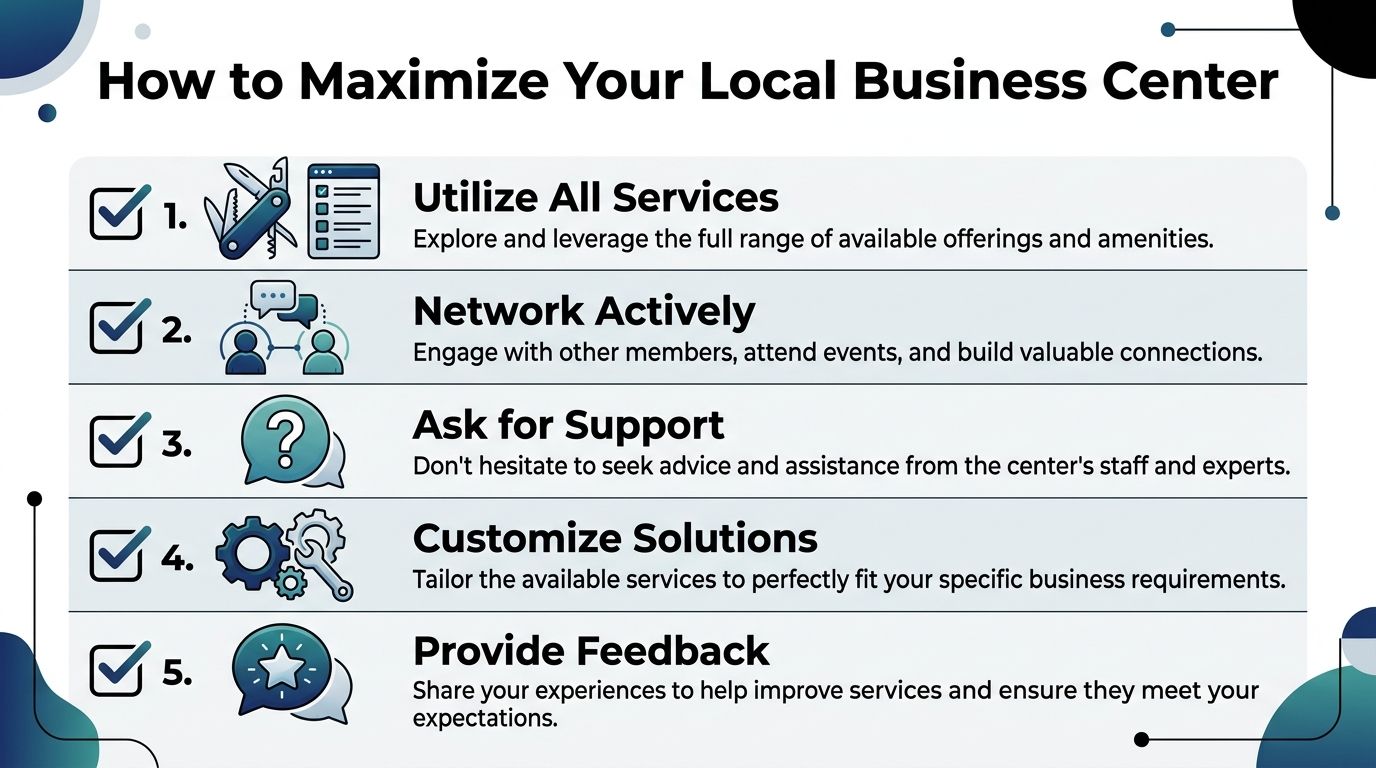
How to Maximize Your Local Business Center
The businesses that get the most value from a local office services center don’t use it randomly. They build it into their weekly routine.
That doesn’t require a big system. It just means turning repeated interruptions into planned tasks.
Build a Simple Weekly Rhythm
A lot of owners benefit from batching. Instead of reacting to each need as it pops up, group related tasks into one regular stop.
Try a rhythm like this:
- Start with outbound work by bringing packages, returns, and documents that need to leave that day
- Bundle print needs such as flyers, handouts, signs, forms, and customer materials into the same trip
- Check mail and package receiving at the same time if you use a mailbox service
- Handle document tasks together if you need copies, notarization, scans, lamination, or ID photos
This approach works especially well for online sellers, mobile service businesses, consultants, and home-based operators. One trip replaces several scattered ones.
Use Expertise Instead of Guesswork
Too many owners still try to solve admin issues alone when a quick question would save them time.
If you’re shipping something delicate, ask about packing options. If you’re printing event signage, ask what material makes sense. If you need a professional business address, ask whether a private mailbox or digital mailbox setup fits the way you work. The staff at a real local center usually sees patterns that customers only run into occasionally.
A second smart move is to pair your office services with better outside decision-making. If you’re also trying to choose outside marketing help, this resource on vetting marketing agencies with AI insights is useful because it focuses on how small businesses can evaluate service providers more clearly before committing.
Here are a few practical habits that pay off:
- Save your files properly so reorders and edits move faster
- Keep a running list of items that need shipping, printing, and notarization
- Use your street-address mailbox consistently on cards, websites, and customer-facing documents
- Ask about turnaround before you promise a date to your client
- Bring one sample of prior printed work if you want the next job to match it closely
The local center works best when you treat it like an extension of your workflow, not just a place you visit in emergencies.
Choosing the Right Center in Sugar Land
Not every office services location is built for business use. Some are fine for a drop-off or a copy run, but they aren’t set up to support the daily rhythm of an entrepreneur, a field team, or a growing small company.
That’s why selection matters.
What to Check Before You Commit
Start with service range. Can the center handle shipping, printing, mailbox services, and document support in one visit, or do they only do one or two things well?
Then check the day-to-day details that affect your week:
- Carrier flexibility so you’re not forced into one shipping path every time
- Print capability for both quick jobs and larger-format materials
- Mailbox options with a real street address and package receiving
- Document services such as notary, scans, copies, photos, and finishing
- Staff knowledge that goes beyond ringing up a transaction
A location can look convenient online and still be a poor fit if the staff can’t guide you through packaging choices, print setup, or mailing needs.
Why Local Fit Matters
In Sugar Land, convenience isn’t only about distance. It’s about whether the center fits your route, your deadlines, and the kinds of jobs you have.
A realtor, online seller, event organizer, and home-based consultant won’t use the same services in the same way. The right center should support those patterns without making every request feel unusual. If you’re comparing local options, this roundup of shipping store choices in Sugar Land is a practical starting point for seeing what’s available nearby.
The best fit usually comes down to one question. Can this place reduce my weekly friction, or will it become just another errand?
Frequently Asked Questions
What do I need to bring for notary service
Bring the unsigned document, a valid government-issued photo ID, and any required witnesses if your document calls for them. Don’t sign the document beforehand unless you’ve already confirmed that’s allowed for your specific paperwork. If the document has unusual requirements, call ahead so you don’t make an unnecessary trip.
Can someone help pack my shipment
Yes, many local office service centers can pack items for you. That’s especially useful for fragile goods, oddly shaped items, electronics, gifts, framed pieces, or anything you don’t want to risk boxing incorrectly. If you already have the item and any original packaging, bring it with you so the staff can recommend the best packing approach.
What is the difference between a digital mailbox and a PO box
A PO box is a traditional postal box. A digital or private mailbox service is usually more flexible for business use because it can provide a real street address and broader mail handling options. For entrepreneurs and home-based businesses, that often creates a more professional public-facing address and makes package receiving easier.
What file formats work best for printing
PDF is usually the safest option because fonts and layout stay more consistent. High-resolution image files can also work for some jobs, and editable design files may be useful when changes are needed. If color, size, or bleed matters, ask before sending the final file so you don’t have to reorder.
Can a local office center help with more than business tasks
Usually, yes. Many centers also support personal needs such as returns, passport photos, fingerprinting, key duplication, and mailing. That’s useful for business owners because personal errands often compete with work errands during the same week.
Is a one stop office setup only useful for larger companies
Not at all. Solo operators often feel the value first because they don’t have admin staff to absorb interruptions. If you’re the owner, manager, shipper, buyer, and marketer all in one, consolidating routine tasks can make the week feel much more manageable.
If you’re in Sugar Land and want a simpler way to handle shipping, printing, mailbox service, and day-to-day office tasks, Business Mail Boutique LLC is one local option to consider. It offers packing and shipping, print services, private and digital mailbox rentals, notary support, fingerprinting, passport photos, and related business services in one storefront, which can help reduce the vendor juggling that slows small businesses down.

Related posts

Perfume Bottle Engraving Sugar Land | Same-Day Service
Same-Day Perfume Bottle Engraving in Sugar Land.
Custom Perfume Bottle Engraving in Sugar Land — Same-Day Personalized Gifts
Make a...

Leather Portfolio Engraving in Sugar Land | Custom Initials
Custom Leather Portfolio Engraving in Sugar Land: Personalized Initials for Corporate Gifts
A professional portfolio is something ...

Corporate Watch Engraving in Sugar Land | Business Mail Boutique
Custom Watch Engraving in Sugar Land: Meaningful Gifts for Employee Appreciation
A personalized watch can turn a company’s thank-you i...