
- Print Business Cards in Sugar Land – Same Day Service
- Copying Services
- Document Printing, Finishing & Lamination in Sugar Land
- Flyers
- Print Banner in Sugar Land | Same-Day Banner Printing Near Me
- Graphic Design
- Photo Printing
- Postcard Printing
- Document Printing
- EDDM Full Service Postcards
- FotoZoomer Large Format Printing


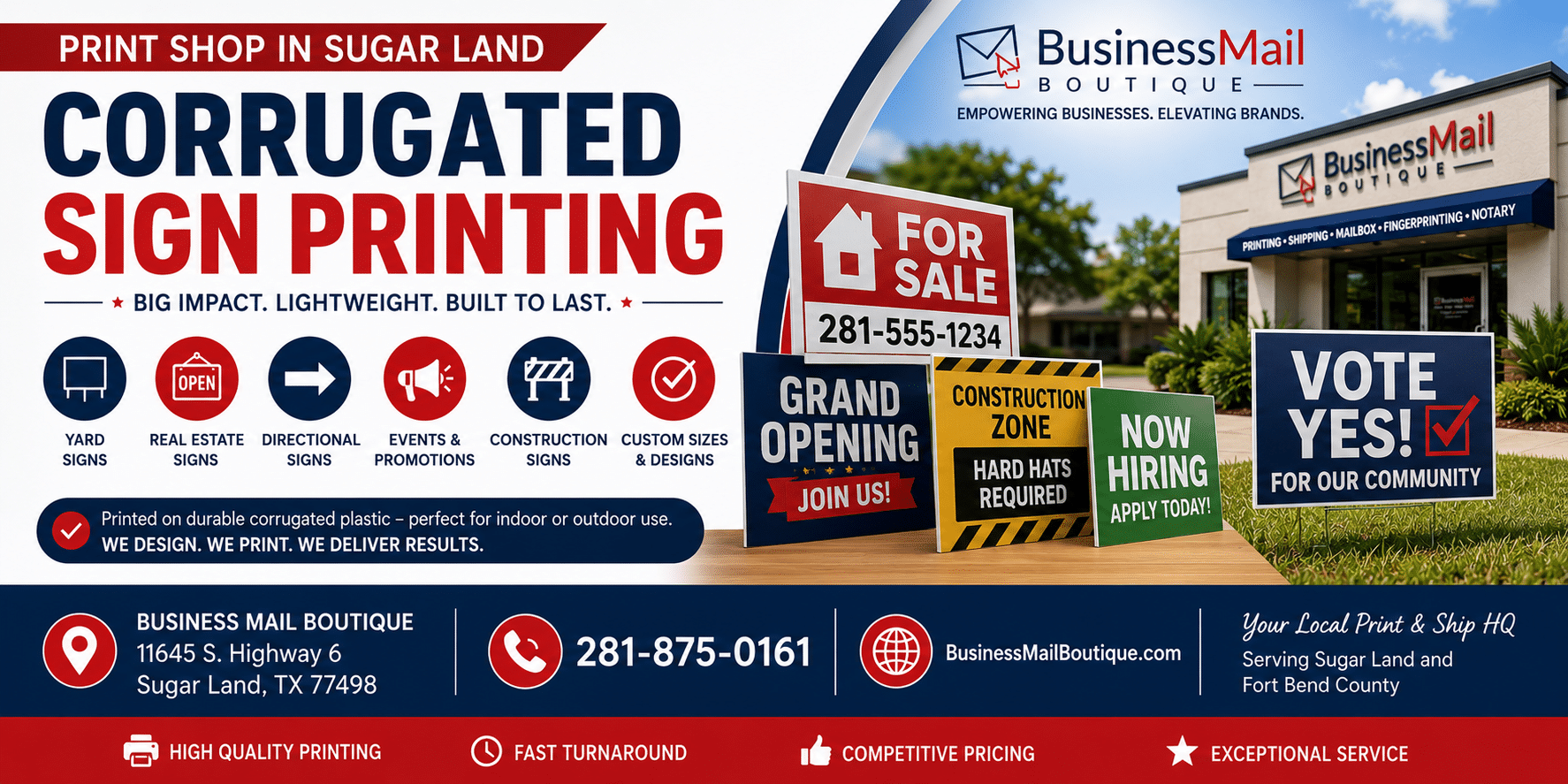
Print Shop: Corrugated Sign Printing in Sugar Land
Businessmailboutique, 11645 S. Hwy 6, Sugar land, Texas 77498, United States (US) - Phone: 281-875-0161 Email: info@businessmailboutique.com
You’ve probably been here before. A weekend sale is coming up, the church event banner is already handled, but you still need yard signs by tomorrow. Or you’re a real estate agent with an open house in Sugar Land and suddenly realize the directional signs in your trunk are faded, bent, or missing. Or maybe your school group, HOA, or local business needs a simple outdoor sign that looks clean, holds up outside, and doesn’t turn into a complicated print project.
That’s where corrugated signs usually make life easier. They’re one of the most practical options for temporary outdoor messaging because they’re lightweight, affordable, easy to place, and fast to produce. If you’re trying to get signs made quickly without guessing about size, finish, design, or setup, you need straight answers more than fancy print jargon.
Table of Contents
- Your Guide to Fast and Effective Local Signage
- What Are Corrugated Signs and When Should You Use Them
- Choosing Your Sign Options Material Size and Finish
- Designing Your Sign for Maximum Local Impact
- Understanding Pricing Turnaround and Same-Day Options
- Installation and Maintenance Tips for Your Signs
- How to Order Your Signs from Business Mail Boutique
- Frequently Asked Questions About Corrugated Signs
Your Guide to Fast and Effective Local Signage
A lot of sign orders don’t start with a big marketing plan. They start with a problem. A coffee shop needs to announce a pop-up event. A candidate needs signs before volunteers start canvassing. A family business needs roadside visibility before a weekend promotion begins.
In Sugar Land, that urgency is normal. People often need something they can place outdoors the same day, move easily, and read from a passing car without overthinking it. Corrugated plastic signs fit that need well because they’re built for short-run, temporary, practical use.
Practical rule: If your message needs to be seen fast, placed fast, and changed fast, corrugated signs are usually the first thing to price.
They also work well when you need multiple copies. A single storefront sign can help, but directional signs at nearby intersections, entrances, parking areas, or neighborhood turns often do more to bring people in. That’s especially true for open houses, school events, local festivals, service businesses, and political campaigns.
If you’re thinking beyond just one event, it’s also smart to watch how physical signage fits into broader local advertising. This overview of future OOH marketing trends is useful because it shows where out-of-home placement is headed and why simple, visible signage still matters even as marketing channels keep changing.
What Are Corrugated Signs and When Should You Use Them
The name sounds technical, but the product is simple once you see how it’s built. Corrugated sign printing uses corrugated plastic, a lightweight rigid sheet with internal flutes. It’s typically 4 mm thick and commonly sold in standard sizes like 18″ x 24″ and 24″ x 36″ for outdoor readability, with smaller signs often used on residential streets and larger ones used where traffic moves faster, as explained in this overview of corrugated yard sign dimensions and structure.
What corrugated actually means
Think of it as the plastic cousin of cardboard. Cardboard has a wavy inner layer that gives it strength without making it heavy. Corrugated plastic works the same way. Those inner channels, often called flutes, help the sign stay rigid while keeping it light enough to carry, stack, and install quickly.
That construction is a big reason these signs became the standard for temporary yard signs, political signs, event signage, and promotions. You can print on one side or both sides, and you can use them in a lot of places without needing a heavy mounting system.
Common ways people use them around Sugar Land include:
- Open house signs with arrows that direct traffic into neighborhood streets
- Grand opening signs near busy commercial roads
- Event parking signs for schools, churches, and community spaces
- Contractor or service signs placed near active job sites
- Sale and seasonal promotion signs for retail storefronts
- Directional signs that guide visitors to check-in tables, booths, or side entrances
For real estate in particular, these are often the go-to choice because they’re easy to deploy in multiples and easy to replace when details change. If that’s your use case, this page on real estate sign printing shows the type of jobs people usually request.
When these signs make the most sense
Corrugated signs are strongest when the job is temporary, local, and visibility-focused. They’re ideal when you need a sign that can handle outdoor conditions, but you don’t need the heavier feel or long-term durability of a permanent panel sign.
They’re a solid fit when:
| Situation | Why corrugated works |
|---|---|
| Weekend event | Fast to print and easy to place |
| Temporary promotion | Low hassle if dates or messaging change |
| Real estate directions | Lightweight and simple to install |
| School or church event | Easy to move, store, and reuse |
| Political campaign | Practical for higher quantities |
Use corrugated signs when the message matters more than the material prestige. They’re built to communicate clearly, not to look permanent.
Choosing Your Sign Options Material Size and Finish
Most ordering mistakes happen here. Not because people choose the wrong product, but because nobody explained the small options that affect how the sign looks and how it behaves once it’s outside.
Start with the basic build
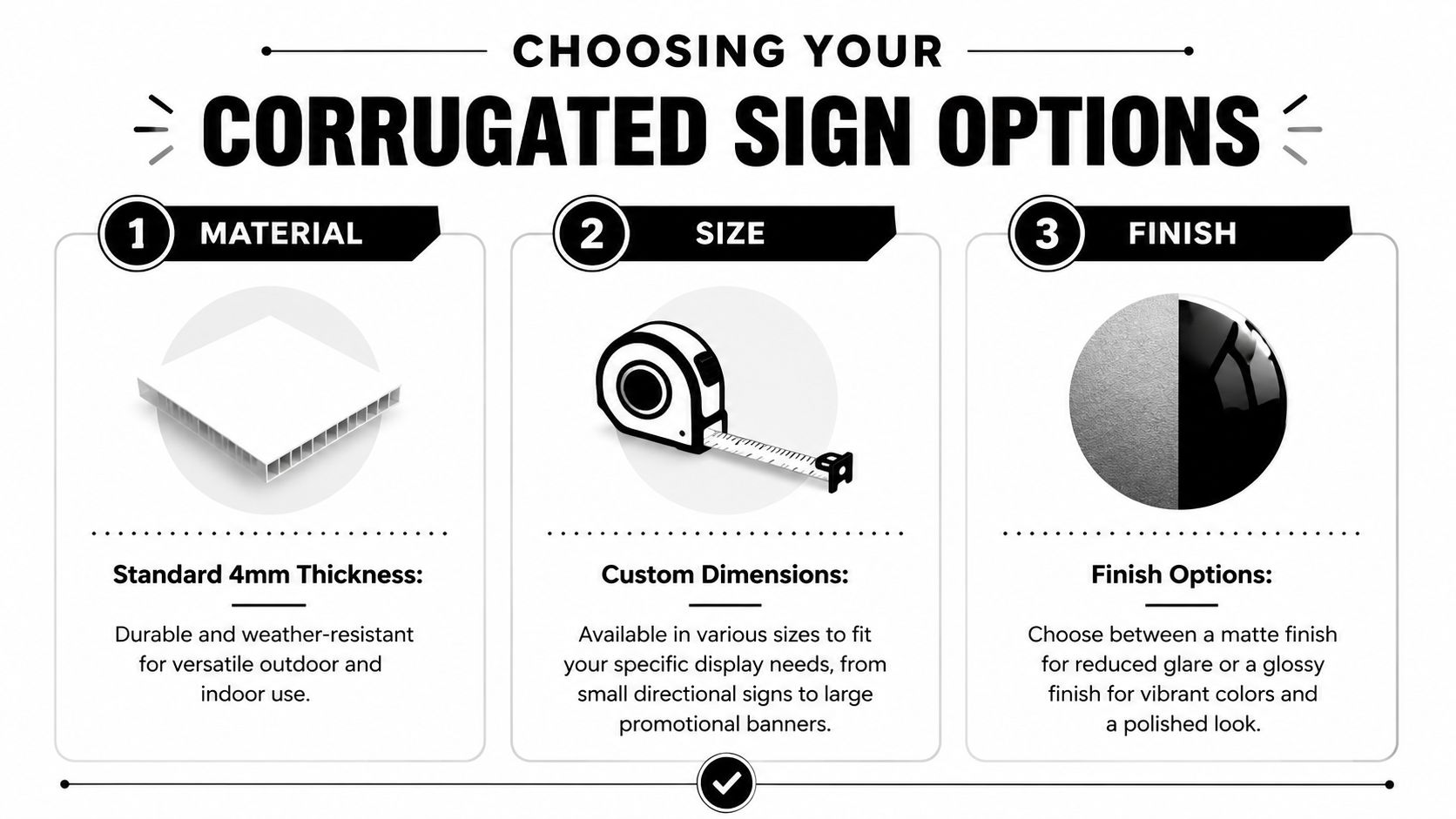
For everyday corrugated sign printing, 4 mm material is the normal starting point. It gives you a good balance of rigidity, portability, and cost. For most temporary outdoor uses, that’s enough. You don’t need to overcomplicate the material decision unless the installation method or display environment creates a special need.
A lot of local buyers order through a wide format printing print shop because they need more than one product at the same time, such as yard signs plus posters, banners, or window graphics. That matters if you’re coordinating a full event or storefront launch and want everything sized and branded consistently.
Size and sides matter more than people think
Size should follow viewing distance and traffic speed.
An 18″ x 24″ sign is the common yard sign format. It works well in residential areas, lawns, medians with slower traffic, neighborhood entrances, and directional use where people can get close enough to read it easily. A 24″ x 36″ sign gives the message more breathing room and improves visibility where traffic is moving faster or the sign will sit farther from the curb.
Single-sided versus double-sided is another basic choice that changes effectiveness:
- Single-sided makes sense when people approach from one main direction.
- Double-sided is worth it when foot traffic or car traffic comes from both directions.
- Directional signs with arrows often benefit from planning the side layout carefully instead of just duplicating the same artwork.
If you’re placing signs along a route, double-sided printing often reduces confusion because drivers and pedestrians can catch the message from either approach.
The finish details buyers often miss
Generic online sign descriptions usually stop too early. A practical buying guide from Digital Print Solutions on 4 mm corrugated plastic signs points out an issue many buyers overlook: choices like scored, unscored, full-bleed, and border-only prints can materially affect appearance, durability, and installation.
Here’s the plain-English version:
- Full-bleed means the ink and design run all the way to the edge. It looks more polished and uses the whole panel.
- Border-only leaves a margin, often white. Sometimes that’s intentional. Sometimes it just looks unfinished.
- Scored signs are made to fold or bend at a planned line.
- Unscored signs stay as a flat panel, which is what most yard sign buyers want.
A sign can be inexpensive and still be the wrong choice if the edge treatment or print layout makes it look cheap from the street.
If you want a cleaner visual result, ask specifically whether your artwork is being printed full-bleed and whether the panel is scored or unscored. Those sound like shop details, but they affect what people see.
Designing Your Sign for Maximum Local Impact
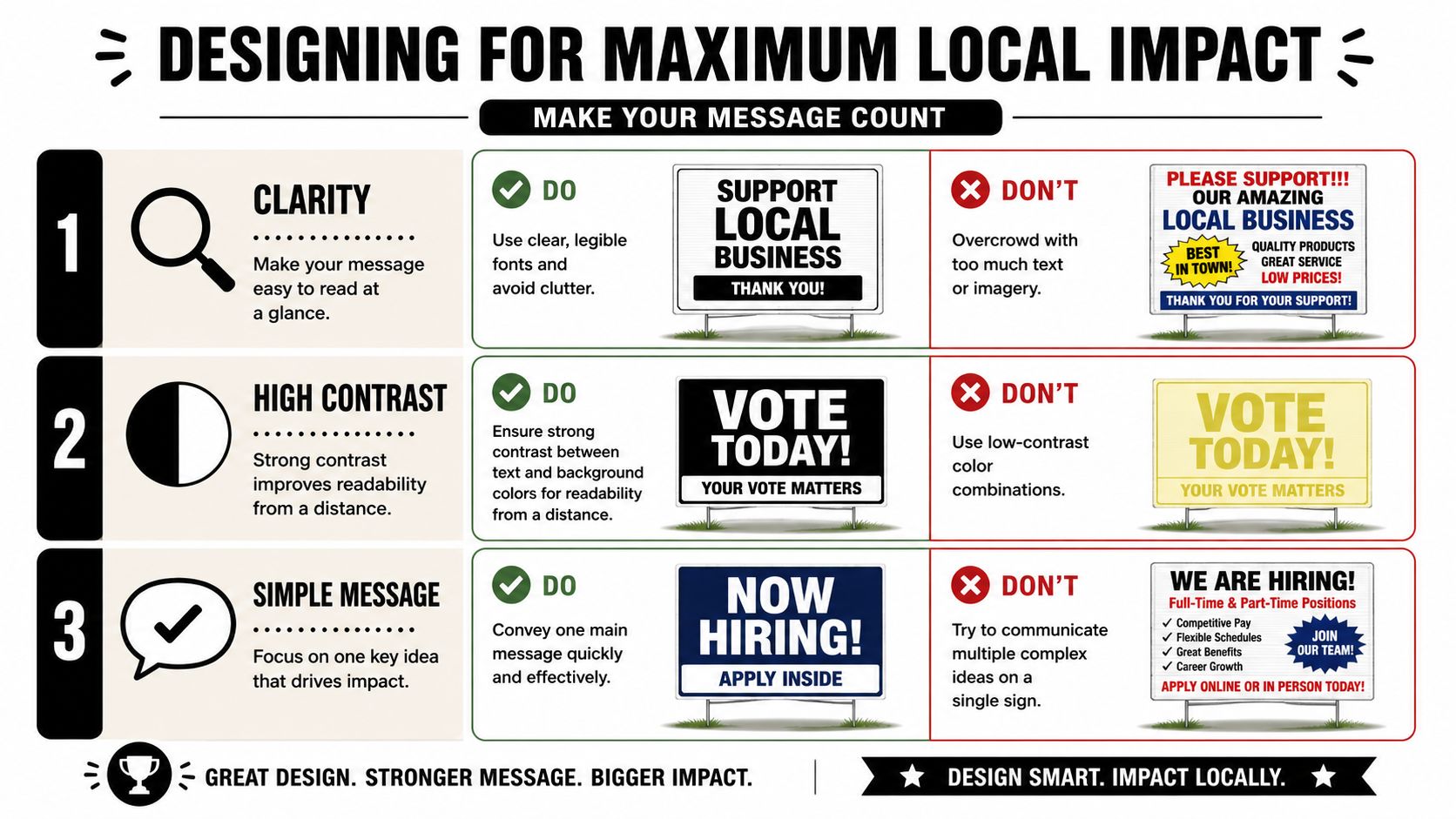
A corrugated sign has one hard job. It has to make sense in a glance. If someone has to slow down to decode it, the design is doing too much.
What people can read at a glance
The best sign designs are usually the simplest ones. One message. One call to action. One visual priority.
Good examples:
- Open House Today
- Now Hiring
- Grand Opening
- Parking This Way
- Vote Tuesday
- Sale This Weekend
Less effective signs try to do everything at once. They add a logo, slogan, website, phone number, social handles, three services, and a block of text. From the road, all of that collapses into clutter.
Use this checklist before you send the file:
- Lead with the main message. Put the most important words in the largest type.
- Choose bold, readable fonts. Fancy scripts and thin letterforms usually fail outdoors.
- Keep contrast strong. Dark text on a light background, or light text on a dark background, is easier to read fast.
- Limit the word count. If the sign can’t be understood quickly, trim it.
- Use arrows carefully. Make them large and obvious. Tiny arrows get missed.
If a driver remembers only three words, make sure those are the right three words.
A logo can help, but not at the expense of readability. On many local signs, the business name matters less than the immediate action. “Tax Prep” or “Open House” often deserves more visual weight than the logo mark.
How to send artwork that prints cleanly
Design quality isn’t just about colors and fonts. File setup matters. A clean print starts with a file that won’t blur, shift, or break when scaled.
If you already have artwork, send a print-ready PDF when possible. AI files can also work if fonts are outlined or packaged properly. If you built the sign in Canva, PowerPoint, or another basic tool, export the highest-quality PDF available.
A few practical rules help avoid problems:
| File issue | What happens in print |
|---|---|
| Low-resolution logo | Soft or pixelated edges |
| Tiny text | Hard to read from distance |
| No bleed setup | White edges may appear |
| RGB-only artwork | Colors may print differently than expected |
If you’re unsure whether the file is usable, ask for a quick review before production starts. That saves time, especially on rush orders, because it’s much faster to fix a file first than to reprint a sign later.
Understanding Pricing Turnaround and Same-Day Options
People usually ask two questions first. How much is it, and how fast can I get it? Both are fair questions, and both depend on a small set of production choices rather than guesswork.
Corrugated signs are part of a much larger print category. A market summary from UPrinting’s signage industry statistics notes that the U.S. signage industry was estimated at $16.7 billion in 2025 after a 3.3% CAGR over the prior five years, and that the global printed signage market is projected to reach $45.96 billion by 2030. For everyday buyers, the useful takeaway is simpler: signs remain a high-demand product, and corrugated plastic is a core volume format because it’s practical for temporary campaigns.
What changes the price
Most corrugated sign jobs are priced around a few variables:
- Size. Larger panels use more material and ink.
- Quantity. A single sign and a batch order are priced differently.
- One side or two. Double-sided printing adds production work.
- Artwork condition. Print-ready files move faster than files that need cleanup.
- Extras. Stakes, finishing requests, or special handling can affect the order.
That’s why a quick phone quote usually starts with the same details. Size, quantity, sides, and deadline. If you have those four answers ready, the shop can usually point you in the right direction fast.
Why local turnaround can matter more than the unit price
Online pricing can look attractive until shipping time gets involved. If your event is tomorrow, a lower price on a screen doesn’t help much. Local ordering is often about control. You can confirm the artwork, ask questions, avoid freight surprises, and pick up on your schedule.
If speed matters, this guide to rush printing near me and same-day success gives a good sense of how to prepare files and requests so a same-day order has the best chance of moving smoothly.
It also helps to understand the design side before you submit a rush job. If you want examples of layouts, branding choices, and common print pieces, this tag archive on print design for small businesses is a useful reference.
Installation and Maintenance Tips for Your Signs
A well-printed sign can still fail if it’s installed badly. Most bent corners, torn flute openings, and crooked displays come from rushing the setup.
Corrugated plastic signs are commonly offered in single- or double-sided versions and in sizes up to 36″ x 48″. One major retail provider lists outdoor suitability of up to 6 months, while another industrial supplier says 4 mm digitally printed corrugated signs can last up to 2 years outdoors under appropriate conditions, according to this product overview for corrugate signs and outdoor suitability. That range tells you something important. Outdoor life depends heavily on weather, placement, ink system, and how the sign is handled.
How to install a corrugated sign without damaging it
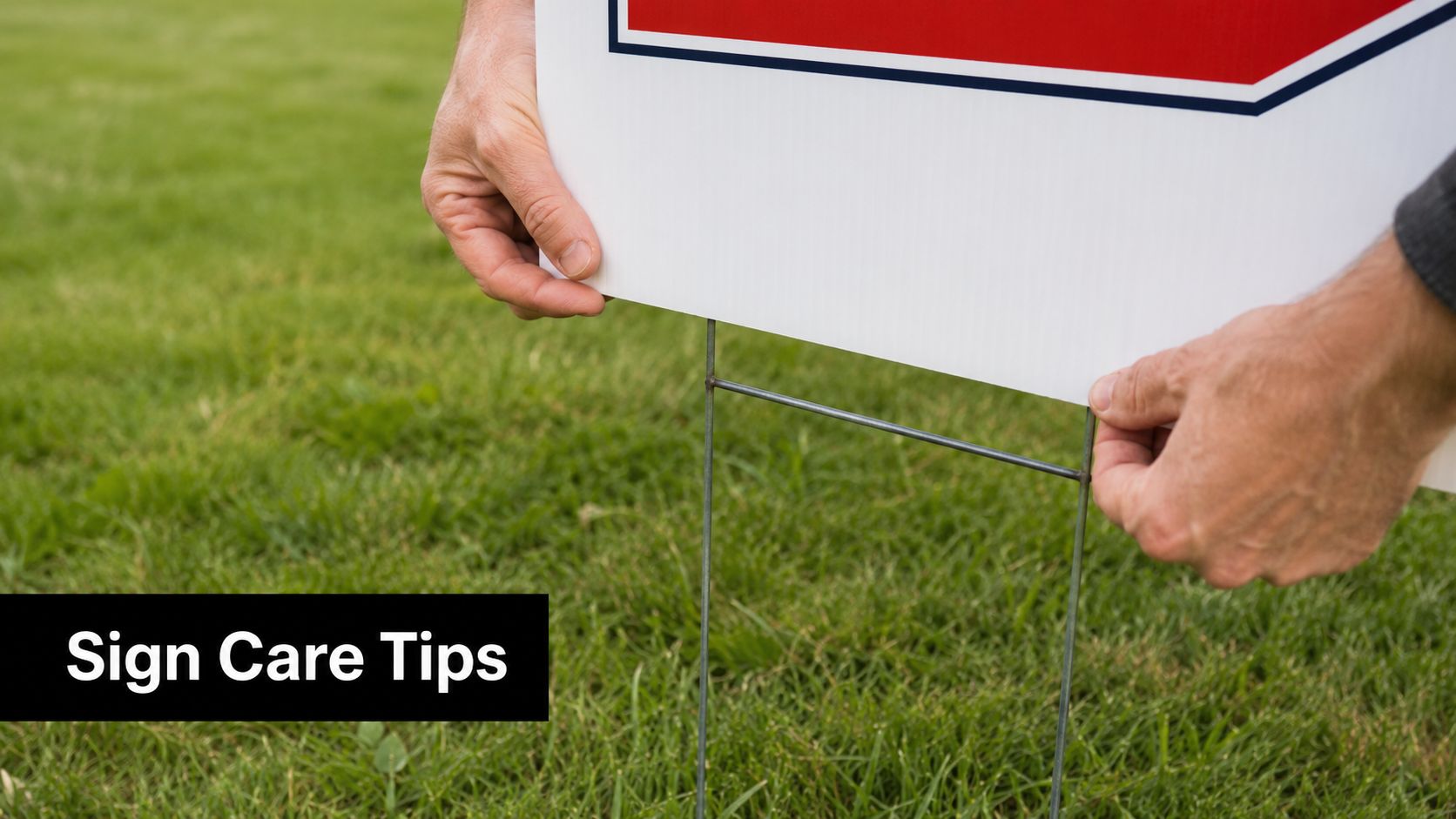
If you’re using H-stakes, pay attention to the flute direction. The stake slides into the open channels in the panel. If you force it through the wrong spot, you can crush the inner structure.
Use this sequence:
- Check the flutes first. Hold the sign edge and identify the channels.
- Line up the H-stake carefully. Don’t jam it in at an angle.
- Slide the sign onto the stake slowly. Let the stake follow the flute openings.
- Press the stake into the ground evenly. Push both sides down so the sign stays level.
- Face it toward traffic. Slight angle mistakes can reduce visibility more than people expect.
For local events, placement matters as much as installation. Don’t hide a sign behind parked cars, landscaping, utility poles, or a crowded median. Put it where drivers and pedestrians have time to register it.
A short demo helps if you’ve never set one up before:
How to keep signs looking decent longer
Texas weather is hard on temporary signs. Sun fades ink. Wind stresses corners. Wet ground can loosen stakes. A little care goes a long way.
Try these habits:
- Wipe gently. Use a soft cloth and mild soap if the sign gets dirty.
- Store flat. Leaning signs awkwardly can warp them.
- Keep them dry before storage. Trapped moisture can leave marks.
- Avoid repeated bending. Corrugated plastic is flexible, but it’s not meant to be folded casually.
- Inspect the edges. Damage often starts there first.
A reused sign only saves money if it still looks intentional when you put it back out.
How to Order Your Signs from Business Mail Boutique
It is 9:15 on a Tuesday morning in Sugar Land. Your event is this weekend, the address changed, and you need signs that are clear, fast, and correct the first time. Ordering goes much easier when you hand over the same basics a print shop needs to start production without guessing.
Business Mail Boutique LLC handles wide-format products such as yard signs and related signage, along with other business printing services. If you are buying locally, the fastest orders usually come from clear instructions, usable artwork, and a firm deadline.
A simple ordering checklist
Start with the message first. If the wording changes after printing starts, even a small edit can slow everything down.
Use this checklist before you place the order:
- Finalize the wording. Check names, dates, arrows, phone numbers, suite numbers, and street addresses.
- Send a print-ready file if you have one. A PDF is often the easiest format for production.
- Choose the sign size. Match it to viewing distance and placement, whether that is a neighborhood entrance, a roadside corner, or an event check-in area.
- Set the quantity. Count each location so you do not come up short on install day.
- Choose single-sided or double-sided printing. Double-sided signs help when traffic approaches from both directions.
- Request stakes if you need them. Include that in the order instead of assuming they come with the sign.
- Give a real deadline. “Need by Friday at 3 p.m.” is clearer than “ASAP.”
That list works like a packing list before a trip. Miss one item, and the delay usually shows up later.
What to bring if your file is not ready
A finished design is helpful, but it is not the only way to place an order. Many local customers start with partial materials, especially for school events, real estate signs, church functions, pop-up sales, and community promotions.
Bring or send whatever you already have:
- A logo file
- The exact wording
- Brand or preferred colors
- A photo of an older sign you want to match
- Your event date or in-hand deadline
- A simple sketch, even if it is drawn on paper
That gives the shop a starting point.
If you are emailing files, name them clearly. “Open-House-Elm-Street-Final.pdf” is much easier to track than “signv2newfinalFINAL.pdf.” That matters when several signs are being produced for one campaign, one event, or multiple Sugar Land locations at the same time.
Frequently Asked Questions About Corrugated Signs
Questions usually get more specific once the order details are clear. At that point, buyers in Sugar Land tend to ask about outdoor life, recycling, design help, and the difference between a yard sign and a corrugated sign.
How long do corrugated signs last outdoors
Corrugated signs hold up well for short-term outdoor use, but their lifespan depends on where and how you use them. A sign placed near a calm subdivision entrance will usually age better than one set along a busy road with strong wind, direct sun, and frequent handling.
A simple way to look at it is this. Corrugated plastic is built for temporary and semi-permanent jobs, not long-term display with little wear. It works well for open houses, school events, church programs, local campaigns, grand openings, and seasonal promotions. If you need a sign to stay outside for a long stretch and still look sharp, ask the shop about a more rigid long-term material.
What usually shows wear first is not the message. It is the fading, bent corners, or stressed edges.
Are corrugated plastic signs recyclable
Sometimes, yes. Locally, the answer depends on whether the recycling program accepts that type of plastic and whether the sign is clean enough to process.
That is why this question has two parts. Can the sign be reused? Can it be recycled in your area?
For many small businesses and event planners, reuse is the more practical goal. If you are ordering signs for repeat events in Sugar Land, storing them flat and keeping them clean often gives you more value than counting on recycling later.
Can someone help me design the sign
Yes. If your file is not print-ready, a local shop can often help with a basic layout, especially when you already have the message, logo, and deadline figured out.
The fastest design jobs are usually the simplest ones. Clear headline. One main call to action. Phone number, website, QR code, or arrow only if the sign has room for it. A corrugated sign is like a roadside instruction card. If you try to fit a whole brochure onto it, drivers and passersby will miss the point.
If you are ordering from Business Mail Boutique LLC in Sugar Land, bring what you already have, even if it is incomplete. A logo file, a sketch, brand colors, old sign photo, or just the exact wording can be enough to get started.
Bring the message first. Design moves faster when the wording is settled.
Is a yard sign the same as a corrugated sign
In many cases, yes. “Yard sign” usually describes where the sign is used. “Corrugated sign” describes the material.
That overlap causes confusion. Someone may ask for yard signs, while the print shop is discussing corrugated plastic with stake placement and print sides. They are often talking about the same product category.
The better question is which setup fits the job. Size matters. Single-sided or double-sided printing matters. Stakes matter. So does how long the sign needs to stay outdoors.
If you are ordering locally and want the process to go smoothly, use whatever term feels natural, then confirm the specs. That takes the guesswork out of the order and helps the shop produce the right sign the first time.

Related posts

Custom Memorial Glasses Engraved in Three Hours in Sugar Land
When a customer needed eight personalized glasses for a memorial, Business Mail Boutique completed the engraving or...

Custom Martini Glass Engraving in Sugar Land, TX
Custom Logo Engraving on Martini Glasses in Sugar Land, Texas.
Business Mail Boutique recently completed a beautiful custom engravin...

Custom Engraved Wine Glasses for a Golf Club Event in Sugar Land, TX
Custom Engraved Wine Glasses for a Golf Club Event in Sugar Land.
Custom wine glass engraving in Sugar Land, TX at Business Mail Bouti...