
- Print Business Cards in Sugar Land – Same Day Service
- Copying Services
- Document Printing, Finishing & Lamination in Sugar Land
- Flyers
- Print Banner in Sugar Land | Same-Day Banner Printing Near Me
- Graphic Design
- Photo Printing
- Postcard Printing
- Document Printing
- EDDM Full Service Postcards
- FotoZoomer Large Format Printing


Protective Packaging Materials.
Choose the right protective packaging materials for your shipments. Compare cushioning, void fill, and sustainable options with practical SMB selection rules.
Businessmailboutique
11645 S. Hwy 6
Sugar land, Texas 77498 United States (US)
Email: info@businessmailboutique.com
Route
You’ve probably had this happen. A customer orders a fragile item, the box looks fine on the outside, and then the email lands anyway, the product arrived broken, the packing was sloppy, and now you’re paying for a reshipment, a refund, and a bad review you didn’t need. That’s usually not a tape problem. It’s a protective packaging materials problem, and more specifically, a system problem.
For small and medium-sized businesses, packing isn’t a last-minute chore. It’s part of the shipping process, and it affects damage rates, return costs, and how customers judge your operation. Protective packaging is also a real market, not a side note. Industry forecasts place it at USD 30.9 billion in 2025 and USD 32.4 billion in 2026, while another report values it at USD 36.1 billion in 2025 and forecasts USD 55.8 billion by 2035 with a 4.2% CAGR from 2026 to 2035, and a separate forecast expects 4.70% CAGR through 2036, which tells you analysts see steady growth, not a flat category, in Future Market Insights’ protective packaging market report.
If you run a smaller shop, the useful question isn’t “Which filler is cheapest?” It’s “What combination of void fill, cushioning, and blocking/bracing keeps my product safe on this lane?” That’s the practical lens here, and it’s the one that keeps you from buying shelves full of materials you barely use.
Table of Contents
- Why Protective Packaging Materials Matter for Small Businesses
- How Protective Packaging Works as a System
- The Main Categories of Protective Packaging Materials
- Selecting Materials by Product, Weight, and Shipping Mode
- Sustainability Trade-offs Across Protective Materials
- Testing, Labeling, and Compliance Essentials
- Cost Considerations Beyond Unit Price
- Practical Packing Checklist and Returns Support
- How a Local Pack-and-Ship Center Helps SMBs
Why Protective Packaging Materials Matter for Small Businesses
A Sugar Land seller can ride a good season straight into avoidable losses if the pack-out is sloppy. Holiday orders go out, boxes move through sortation, corners get crushed, and the inbox fills with damage claims. The product did not fail. The packing did.
That is why protective packaging materials belong in the same conversation as margin, returns, and customer experience. They are logistics inputs that reduce transit damage across retail, industrial, and e-commerce shipments, and the category keeps growing as more shippers treat protection as part of the sale, according to Future Market Insights.
For SMBs, the mistake is treating every shipment the same. A lightweight apparel order does not need the same structure as a ceramic set, and a pallet of mixed goods does not need the same treatment as one boxed electronic device. The right packaging choice starts with the product, then the lane, then the damage risk.
Practical rule: If your team can describe a shipment only as “fragile,” you are already under-specifying the pack-out.
A good starting point is expert packing guidance that shows how professionals handle cushioning, fit, and stress in transit. If you want a useful comparison point, find expert packing guidance from Colorado Art Services and compare it with how your own boxes are being packed.
That same thinking is what a local pack-and-ship center brings to SMBs that do not want to stock every material on their own shelves. Business Mail Boutique can match void fill, cushioning, and blocking or bracing to the product and the shipping lane, then pack the order the right way instead of guessing. That matters because once you start shipping more than a handful of product types, guesswork gets expensive fast.
How Protective Packaging Works as a System
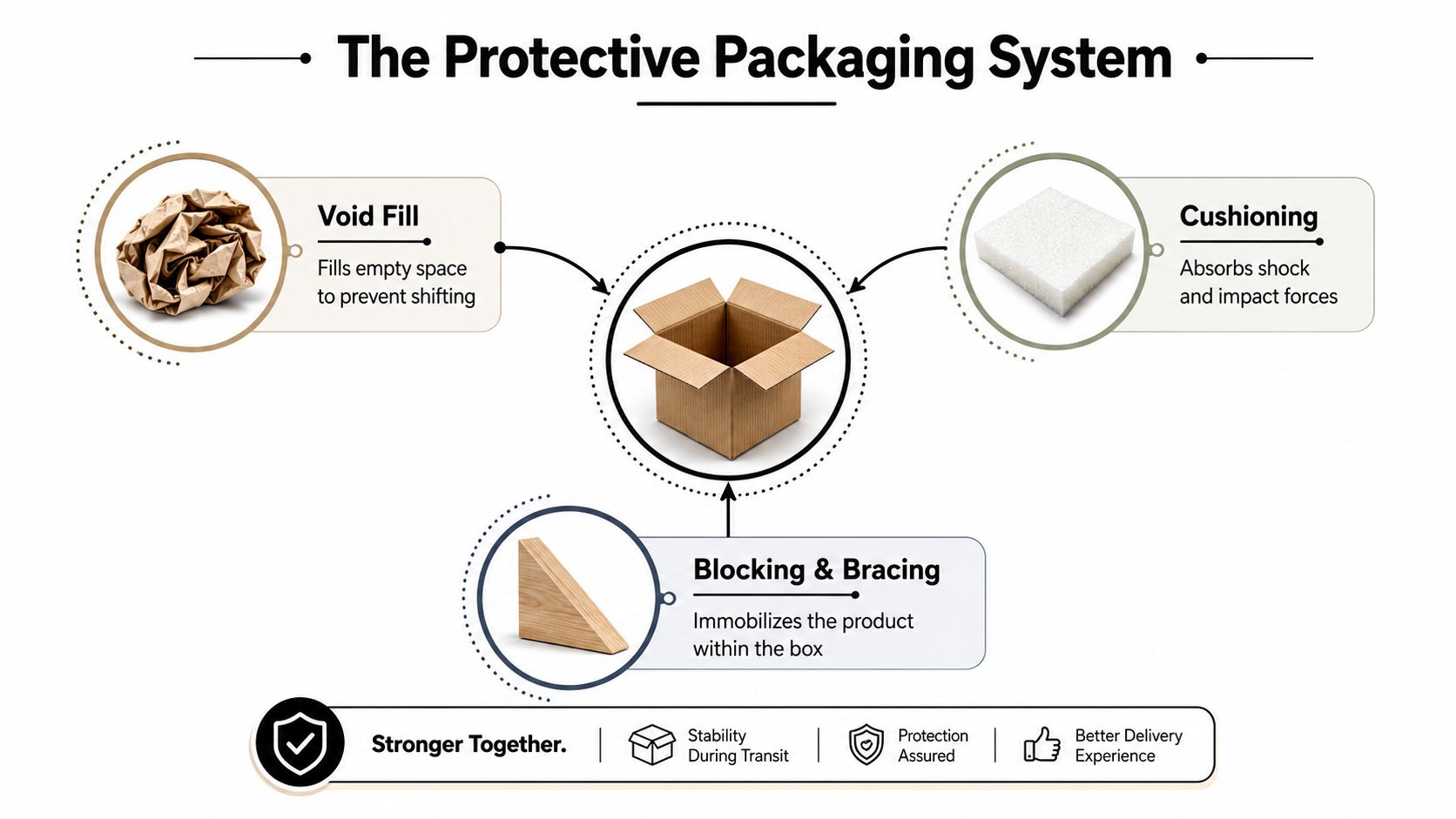
The strongest pack-outs don’t depend on one material doing all the work. They use void fill, cushioning, and blocking/bracing together, because each one handles a different failure point inside the box. Movement, impact, and vibration are related, but they’re not the same problem.
Void fill keeps the product from migrating
Void fill closes empty space so the item can’t slide around after the parcel gets tossed, stacked, or tipped. That matters in conveyor transfers and sortation, where a box that sounded tight on the packing table can loosen up fast in transit. Grainger’s shipping guide explains the role clearly, void fill is about reducing movement, while cushioning handles shock and blocking/bracing locks the product in place, as noted in its protective packaging guide.
Cushioning absorbs impact energy
Cushioning takes the hit when a box drops, bumps a belt edge, or gets stacked under load. Without enough cushion, the product takes the force directly. That’s why UPS guidance emphasizes at least two inches of appropriate cushioning, strong box selection, and reinforced edges, not just more loose material stuffed around the item, according to the packaging guidance in Industrial Packaging’s eGuide to Protective Packaging.
Blocking and bracing stop shift under repeated handling
Blocking and bracing are what keep the product fixed in place. This is especially important for odd shapes, heavier goods, and anything that can break loose and punch through a carton wall. The material can be excellent and still fail if the item is allowed to move inside the shipper.
A box can be full and still be unsafe. If the product can shift, the packing isn’t finished.
Think of the system this way. Void fill handles empty space. Cushioning handles shock. Blocking and bracing handle immobilization. When all three are used correctly, the package behaves like a unit instead of a loose container with something rattling inside it.
The Main Categories of Protective Packaging Materials
The packaging aisle is full of options, but the useful question is what each material does. A lot of SMBs buy by habit, then wonder why one product ships fine and another keeps coming back damaged. The fix is to match the material to the failure mode, not the aisle label.
Bubble, foam, and paper each solve a different problem
Bubble wrap gives light cushioning and surface protection, and it’s a normal choice for scratch-prone items. It’s useful, but it’s not a cure-all. Under sustained compression, it loses some of the gap that makes it protective in the first place, so it should support the pack, not substitute for box fit.
Foam materials, including EPE, EPS, and polyurethane, handle impact differently. Foam-in-place and shaped foam are strong choices for fragile or odd-shaped goods because they conform better and damp vibration. EPS can be effective, but it’s also a material that many people dislike handling because of bead shedding and cleanup.
Kraft paper and paper dunnage work well as void fill and light bracing. They’re common because they’re easy to handle and familiar. Corrugated inserts and edge protectors add structure, especially when the product needs a firmer internal fit or when load edges need reinforcement.
Special-purpose materials matter more than people think
Air pillows are fast void fill for lighter items, especially when you need speed and don’t want to overload the carton. Padded mailers are useful for smaller shipments that need built-in cushioning without a separate box. Thermal and insulating liners matter for temperature-sensitive shipments, and they should be chosen for performance first, not because they “look greener.”
Tamper-evident seals and tape don’t cushion anything. They protect chain of custody, show interference, and support claims handling. That’s a separate job, and it shouldn’t be confused with structural protection.
For a plain-English overview of common materials, Gentle Giant Removals & Relocations packing tips are useful because they show how the basics are grouped in real packing work, not just in product catalogs.
Common-use map
- Glassware, cosmetics, and small electronics: Foam-lined mailers, bubble, or shaped inserts.
- Ceramics and fragile retail goods: Corrugated trays, molded inserts, or foam with tight box fit.
- Apparel and soft goods: Light paper fill or a mailer, usually no heavy cushioning.
- Palletized mixed loads: Edge protectors, strapping, and bracing before you even think about wrap.
The trap is buying the most expensive material and assuming that means better protection. It doesn’t. The right material is the one that controls the specific failure you’re trying to prevent.
Selecting Materials by Product, Weight, and Shipping Mode
Selection gets easier when you stop thinking in product names and start thinking in shipment conditions. Fragility, weight, shape, and shipping mode tell you more than the item description does. A light but brittle product needs a different build than a heavy item with a tough shell.
Start with fragility, then build outward
If the item can chip, crack, dent, or leak, start with cushioning. If it can move inside the box, add void fill. If it’s a weird shape or has concentrated weight, add blocking or bracing so it can’t shift under repeated handling. That sequence keeps you from overpacking sturdy products and underpacking delicate ones.
Parcel shipments usually need tighter internal fit because they face more handling touches. LTL freight needs more load control, which is where edge protectors and strapping come in. International air adds another layer of pressure because the shipment may be handled multiple times across different systems, so fit accuracy matters even more.
Use the shipment, not the SKU, to choose the material
Cosmetics often need surface protection and tight fit. Electronics usually need shock control and anti-movement structure. Apparel is usually fine with much lighter packing. Perishables need thermal planning in addition to basic cushioning. Palletized freight needs compression control, which is where edge protectors and straps earn their keep.
| Product Type | Weight Range | Recommended Materials | Shipping Mode |
|---|---|---|---|
| Cosmetics | Light to moderate | Bubble, inserts, void fill | Parcel |
| Electronics | Light to moderate | Foam, corrugated inserts, blocking | Parcel or air |
| Apparel | Light | Paper fill or padded mailer | Parcel |
| Perishables | Varies | Insulating liner, cushioning, tight fit | Parcel or air |
| Palletized freight | Moderate to heavy | Edge protectors, strapping, bracing | LTL freight |
If you need a field-friendly example, a sturdy consumer item in a box with too much foam is just wasting money. A fragile ceramic piece in a loose mailer is asking for breakage. The material choice should fit the risk, not your leftover inventory.
Useful habit: Pick the minimum system that stops movement, absorbs impact, and keeps the item from shifting under the worst handling you expect.
Sustainability Trade-offs Across Protective Materials
Sustainability talk gets sloppy fast because people act like paper automatically wins and plastic automatically loses. That’s too simple for real shipping work. The better question is which option protects the item, recovers cleanly, and avoids waste from reshipments.
Paper looks cleaner, but it isn’t always the better choice
Paper-based options, like corrugated inserts and kraft dunnage, are easy to justify because they tend to fit familiar recycling habits better. They also work well when the item needs light bracing and the pack is dry. The weak point is moisture. Once paper gets damp, strength drops, and the pack no longer behaves the way it did on the table.
Plastic-based options, like air pillows and foam, are strong where moisture resistance matters. They also keep weight down, which helps when the goal is to protect a product without making the shipment bulky. The trade-off is end-of-life handling, since not every recycling stream accepts every plastic packaging format cleanly.
Fit accuracy can matter more than material type
A heavier package that prevents damage may have a lower overall impact than a lighter package that gets returned, replaced, and shipped twice. That’s the part a lot of green packaging marketing skips. If the fit is sloppy, the item breaks, and your sustainability claim gets erased by a second shipment.
For SMBs trying to make the switch without guesswork, bubble wrap alternatives for sustainable shipping are worth reviewing because the actual choice is usually not “paper or plastic,” it’s “which packing system reduces waste without causing more damage.”
Reusable options only work if the workflow supports them
Reusable protective materials make sense when the product returns, the boxes cycle internally, or the same lane repeats often. If the package disappears after one outbound shipment, reuse is harder to justify. Fit accuracy still matters most, because a reusable item that doesn’t immobilize the product is just durable waste.
Sustainability should follow protection, not replace it. Broken products are the worst kind of packaging waste.
If customers expect a greener story, give them a defensible one. Say what you chose, why it protects the product, and how you reduced unnecessary material without weakening the pack. That’s stronger than slogans.
Testing, Labeling, and Compliance Essentials
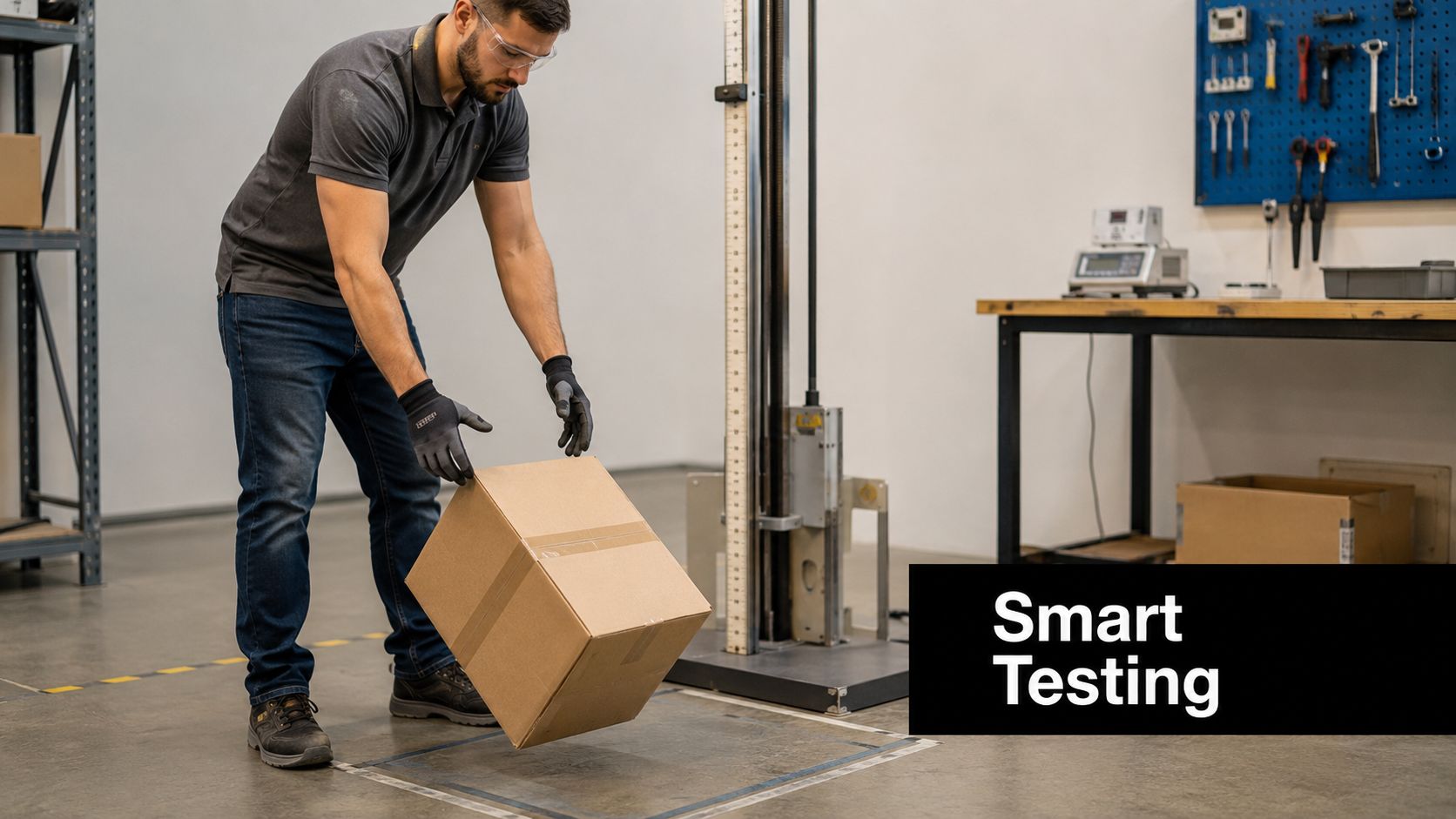
A box that looks solid on the bench can still fail in actual conditions. That’s why you need simple tests before you scale a pack style across your catalog. You don’t need a lab to catch obvious problems.
Run the basic checks first
Do a corner drop test for the carton, because corners take abuse fast. Do a shake test to hear whether the product moves or strikes the box wall. Do a visual clearance check to see whether the item has enough cushion on all sides and stays centered after handling.
ISTA testing is the more formal version of that logic. It uses transit simulation to recreate shipping stress, and it’s worth considering when the SKU is high-value, fragile, or shipped in volume often enough to justify the effort. The point isn’t certification for its own sake, it’s catching failure before customers do.
Label what handlers need to know
“Fragile” helps, but it doesn’t replace good packing. “This side up” and orientation arrows matter more when the contents have a preferred position or a spill risk. Labels don’t make a weak pack strong, they just reduce the chance of the wrong handling.
The second link belongs here because a good visual example helps staff understand what a tested pack-out should look like. A controlled drop test workflow for shipping boxes is the kind of thing teams should study before they assume their current pack is good enough.
Hazmat rules can override your packaging choice
Some items, like lithium batteries and aerosols, carry shipping restrictions that change what you can send and how you have to label it. Protective materials don’t override those rules. If the item is regulated, the shipping decision starts with the rules, then moves to the pack-out.
The clean rule is simple. Test the box, label it correctly, and verify the shipment class before the product leaves the counter. A well-cushioned box with the wrong label is still a problem.
Cost Considerations Beyond Unit Price
The cheap material is often the expensive choice. That’s because unit price is only one part of the cost. What matters is how much you use per box, how much space it takes, how often it prevents damage, and whether it creates avoidable reships.
Measure cost by outcome, not by roll price
A roll of cushioning looks inexpensive until you realize how much of it goes into each order. The same is true for void fill, inserts, and mailers. If a slightly better pack-out keeps the product from breaking, the higher unit cost can still come out ahead.
Dimensional weight can also punish overbuilt packages, especially when oversized materials inflate the carton size. That’s why the internal fit matters so much. If you’re trying to understand how carton size affects billing, how to calculate dimensional weight is a useful reference point for the shipping side of the equation.
Edge protection is not decorative on freight
For palletized shipments, edge protectors only earn their keep when they’re sized and placed correctly. The value is in compression control, strap support, and load stability. If you slap them on without measuring the load or covering the vulnerable edges, you’re paying for material that doesn’t change the outcome much.
Use a simple cost model
Here’s the right way to think about it.
- Material cost: What each pack-out consumes.
- Damage cost: What you lose when a shipment arrives broken.
- Return cost: What you spend to recover, replace, or reship.
- Time cost: What packing labor and rework eat out of the day.
If a stronger cushion adds a little cost but prevents repeated claims, it’s not extra expense. It’s insurance against avoidable loss. That’s the lens SMBs should use when they compare packing options.
Practical Packing Checklist and Returns Support
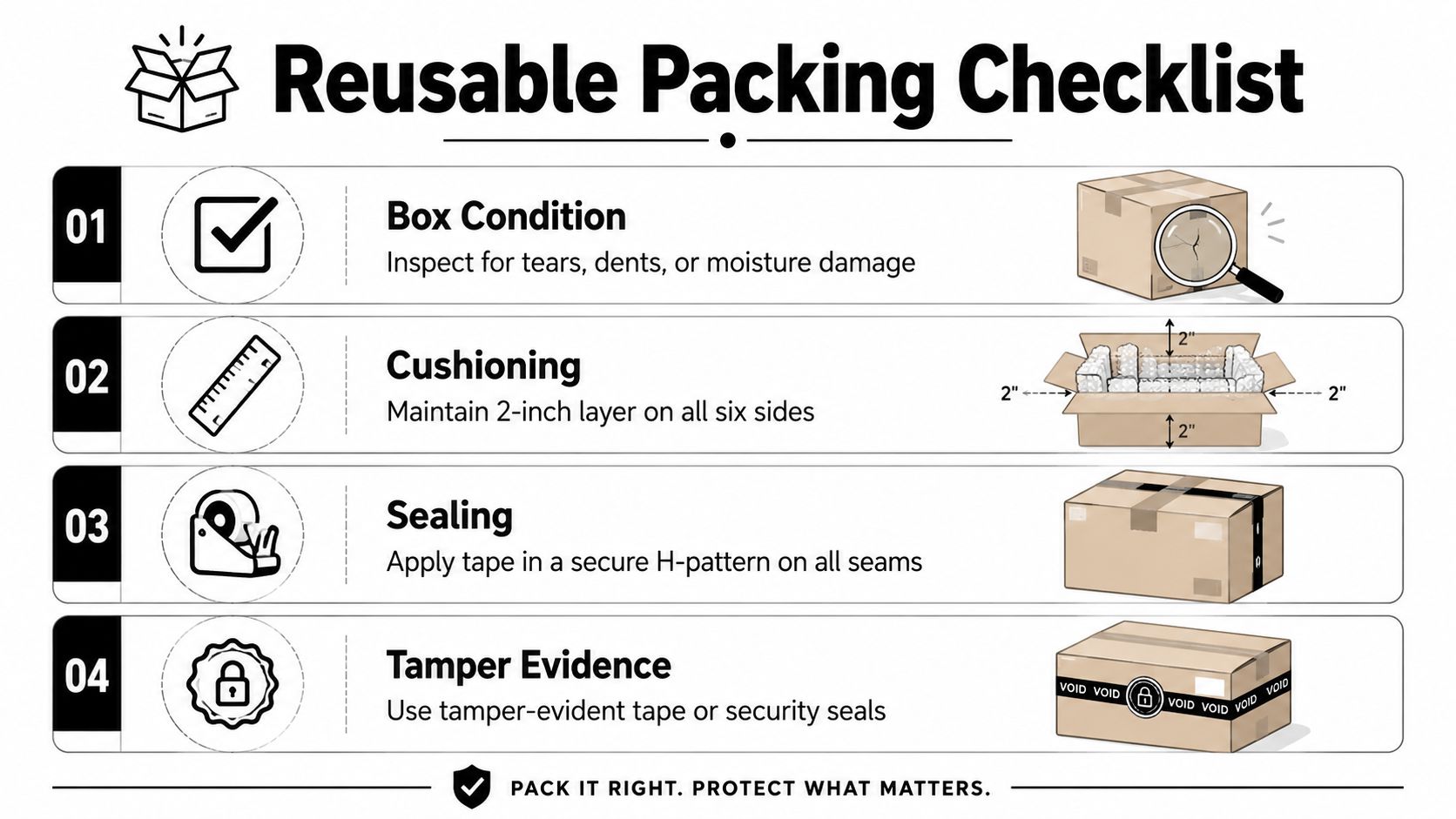
A pack-out gets a lot more reliable when staff follow the same checklist every time. The goal is consistency, not creativity. If you’re shipping products regularly, this is the sheet to hand to anyone who touches the box.
Basic packing checklist
- Box condition: Inspect for tears, dents, crushed corners, or moisture damage before use.
- Cushioning: Keep two inches of appropriate cushioning on all six sides.
- Sealing: Tape every seam in a secure H-pattern so the box doesn’t open under stress.
- Tamper evidence: Use tamper-evident tape or seals for high-value items.
- Orientation labels: Apply “this side up” or fragile labels only when they match the actual pack-out.
- Packing slip: Place the paperwork in a pouch so it doesn’t float loose inside the box.
That checklist works for outbound and return handling. For returns, resealable padded mailers make life easier because they reduce the need for extra tape and let customers reuse the same package. Tamper-evident closures also help protect against false damage or fraud claims, which can be a real problem in e-commerce.
For teams that want a deeper handling reference, a practical fragile-item packing guide is worth keeping on hand because fragile goods need consistency, not improvisation.
Returns are part of the pack design
If you know a product will come back sometimes, design for that from the start. Include return labels when appropriate, choose closures that survive a second trip, and avoid packaging that has to be destroyed to open. A box that’s easy to reopen and reseal saves time on both ends.
How a Local Pack-and-Ship Center Helps SMBs
Not every SMB should stock every protective material in-house. If you ship a lot of repeat SKUs, keep the everyday supplies on site. If you ship irregular, fragile, freight, or one-off items, hand them to a professional packing counter and move on. That hybrid setup is usually the smartest use of time and space.
A local pack-and-ship center brings a few things most small warehouses don’t have. You get people who pack all day, a wider range of materials than most SMBs keep on a shelf, and access to parcel and freight options through carriers like UPS, FedEx, and USPS. You also get cleaner handling for tracking, drop-offs, and returns processing without building the workflow yourself.
Business Mail Boutique LLC fits that model naturally for Sugar Land businesses that don’t want to overstock packaging supplies or train staff on every specialty pack-out. It’s a practical option for professional packing, shipment drop-off, and returns support when the product mix changes too often to standardize everything internally.
The main point of this guide is simple. Protective packaging materials work when they’re matched to the product, the box, and the lane. Void fill stops movement. Cushioning absorbs impact. Blocking and bracing keep the product fixed in place. Sustainability matters, but only after protection is right. Testing matters, because a good-looking box can still fail. Cost matters too, but only when you count damage and returns, not just unit price.
If you want a packing workflow that matches your actual products, stop guessing and get it scoped by a local team that handles this every day. Visit Business Mail Boutique LLC or call to set up a packing plan that fits your shipping volume, your product mix, and the way your orders really move.

Related posts

Custom Brass Plate Engraving in Sugar Land | Business Mail Boutique
Custom Brass Plate Engraving in Sugar Land: A Personal Tribute to Remember
A few carefully chosen words can turn a small brass plate i...

Silver Bracelet Engraving in Sugar Land | Business Mail Boutique
Personalize silver bracelets with names, dates, and hearts at Business Mail Boutique in Sugar Land. Call 281-875-0161 for a quote.
ers...

Graduation Gift Engraving Sugar Land | Business Mail Boutique
Graduation Gift Engraving Sugar Land | Business Mail Boutique.
A Personalized Texas A&M Graduation Gift: Custom Glass Engraving in...