
- Print Business Cards in Sugar Land – Same Day Service
- Copying Services
- Document Printing, Finishing & Lamination in Sugar Land
- Flyers
- Print Banner in Sugar Land | Same-Day Banner Printing Near Me
- Graphic Design
- Photo Printing
- Postcard Printing
- Document Printing
- EDDM Full Service Postcards
- FotoZoomer Large Format Printing


ATF Form 23 Fingerprinting.
Learn how to complete ATF Form 23 fingerprinting with FD-258 cards, find local providers, and avoid common mistakes in this step-by-step guide.
Businessmailboutique
11645 S. Hwy 6
Sugar land, Texas 77498 United States (US)
Email: info@businessmailboutique.com
Route
You’re standing at the counter with a Form 23 in one hand and a question the clerk hears all day. Do you need one fingerprint card or two, do they need to be ink cards, and does this still change if you’re filing as a trust instead of as an individual? The short answer is that ATF Form 23 fingerprinting is a real processing requirement, not a box-checking exercise, and the rules around it are in the middle of shifting right now.
Table of Contents
- What ATF Form 23 Fingerprinting Entails
- What Happens at Your Fingerprinting Appointment
- How Fingerprint Cards Travel With Form 23
- Where to Get Fingerprinted in Sugar Land
- Fees and Timing for Form 23 Fingerprinting
- Common Reasons ATF Rejects Fingerprint Submissions
- Wrapping Up Your Form 23 Fingerprinting Plan
What ATF Form 23 Fingerprinting Entails
A first-time filer in Texas often expects a quick print-and-go visit, then discovers that the paperwork does more than it looks like on the page. ATF Form 23, formally the NFA Responsible Person Questionnaire, is the document ATF uses to review each responsible person tied to an NFA application, and the fingerprint packet is part of that identity check. Under the framework that took effect after ATF’s 41F rule, each responsible person had to submit Form 23 with two FBI FD-258 fingerprint cards and a 2×2-inch passport photo taken within one year of filing, which standardized the fingerprinting burden across trusts and other legal entities ATF 41F guidance.
That matters because “responsible person” is broader than many applicants expect. If you file for a trust, a corporation, or another entity, the people who can control the NFA item usually need their own Form 23 submission, and each one has to be handled cleanly. The fingerprint cards are not entered into a field on the form. They travel as separate attachments with the packet, and ATF still requires fingerprints to be clear enough for accurate classification and taken by a properly trained individual, which is why bad prints slow the file down instead of getting waved through.
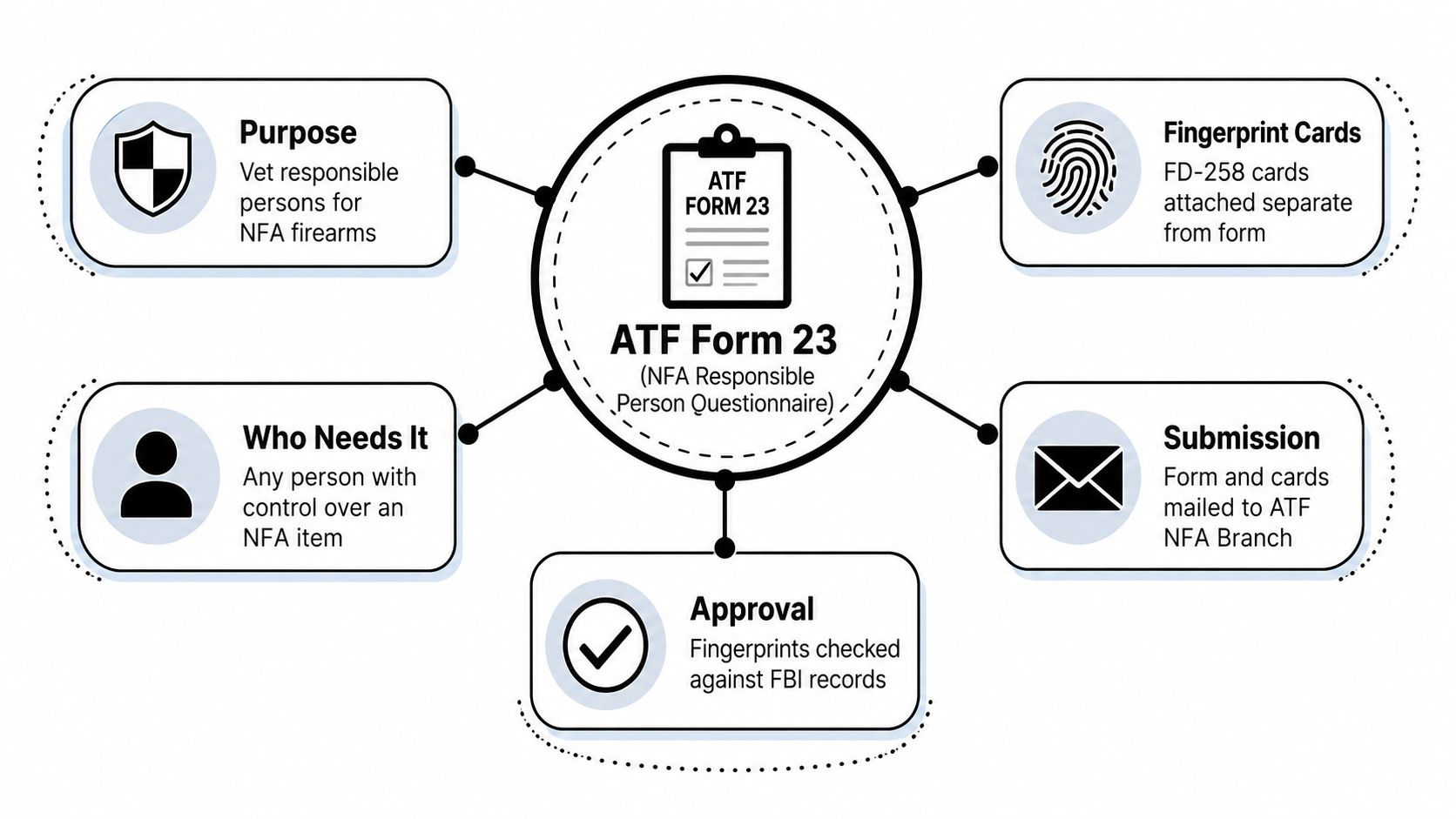
There are two practical formats filers deal with today. The traditional route is the FD-258 ink card, rolled by a trained technician and mailed with the application. That is still the most widely accepted option, especially when you are filing paper Form 4 or Form 5 packages. The other route is live scan electronic capture, where prints are captured digitally and transmitted in a format the receiving system can use, but ATF currently accepts electronic submissions only for certain Form 1 eFile filings, not for paper Form 4 or Form 5 packages.
Practical rule: pick the fingerprint format based on the filing type first, then on convenience. A provider can offer live scan and still not be the right fit if your packet needs paper FD-258 cards.
The decision usually comes down to four things. Your state rules, the form you are filing, how fast you need the packet ready, and whether you already have printed cards in hand. If you already know your filing is paper-based, there is no advantage in overthinking a live scan setup that will not feed that packet. If your filing is electronic and the provider can send usable prints into the ATF channel, that can simplify the workflow.
For people who want a broader fingerprinting reference, this fingerprinting FAQ guide explains how the appointment flow and card handling work in practice. The important shift ahead is the 2026 proposed ATF rule, which would move NFA fingerprinting toward an electronic one-card regime and change the current paper-versus-live-scan decision for filers who are still working through both systems ATF rule record.
What Happens at Your Fingerprinting Appointment
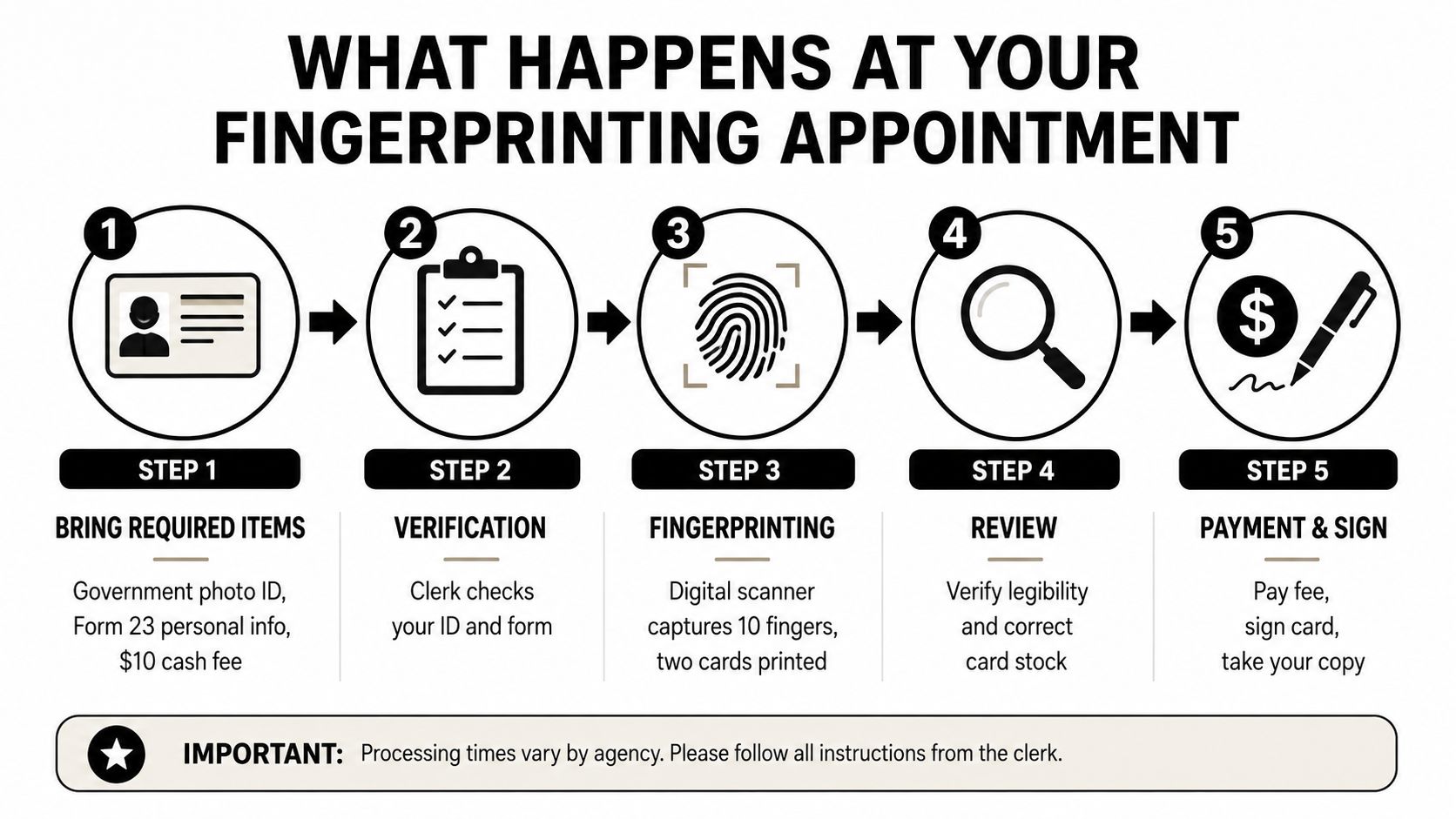
A good appointment starts before the technician ever touches the card. Bring a valid government photo ID, your completed Form 23 details, and the names of any co-responsible persons if you’re filing for a trust or entity. The technician should confirm which ATF filing you’re making, because the wrong card type or the wrong packet setup creates avoidable delays. If you’re missing basic identity details, the whole visit turns into a paperwork rescue.
The sequence that prevents bad cards
The technician usually starts by cleaning and drying your hands so lotion, sanitizer, ink residue, and oil don’t blur the ridges. Then each finger gets rolled nail-to-nail with even pressure so the full ridge detail lands on the card, followed by the flat impressions. That sequence matters because a half-rolled finger or a light, uneven roll can leave a usable-looking card that still fails when ATF tries to read it.
After the prints are down, a careful technician checks each block under magnification and re-rolls rejects immediately. That’s the difference between a good appointment and a mail-back. A card that looks “close enough” to the eye often isn’t close enough for the background-check workflow.
For a deeper look at how ink and live scan differ in a real shop setting, this guide on ink and live scan capture is helpful because it shows why some applicants choose one method over the other. The key tip is simple. Don’t rush the finger prep, and don’t leave until the technician has looked at legibility, card stock, and signature blocks.
Keep your hands dry, skip heavy lotion right before the visit, and ask for a quality check before the card gets sealed.
If you’ve got calluses, damaged fingertips, or hands that were just sanitized five times in the car, say so up front. A technician can usually work around that with a better roll, but only if you mention it before the card gets filled with weak impressions.
How Fingerprint Cards Travel With Form 23
A Form 23 packet can look organized and still cause delays if the fingerprint cards are not handled correctly. The questionnaire identifies the filer, while the cards give ATF the identity check it needs for the background review. Under the current paper workflow, applicants still submit two completed FD-258 cards with each Form 23 packet, so anyone who only hears “bring fingerprints” can show up short.
Packet order that keeps the file clean
The cleanest packets usually start with the Form 23 pages on top, followed by the sealed fingerprint envelope, then any supporting paperwork behind it. The technician should seal the cards, sign across the seal, and leave the envelope closed. Once that envelope is opened and handled again, the chain from print capture to submission is already weakened.
Loose cards create avoidable problems. Staples in the wrong place, bent corners, and open clips can make the packet harder to scan and harder to route with the rest of the file.
That paper sequence is changing. ATF’s proposed rule record for RIN 1140-AA63 points to a future where responsible persons would not attach fingerprint cards to Form 23 in the same way, and individual applicants on certain forms would move from the long-standing two-card standard to one card ATF proposed rule record. For now, the paper packet still follows the older structure.
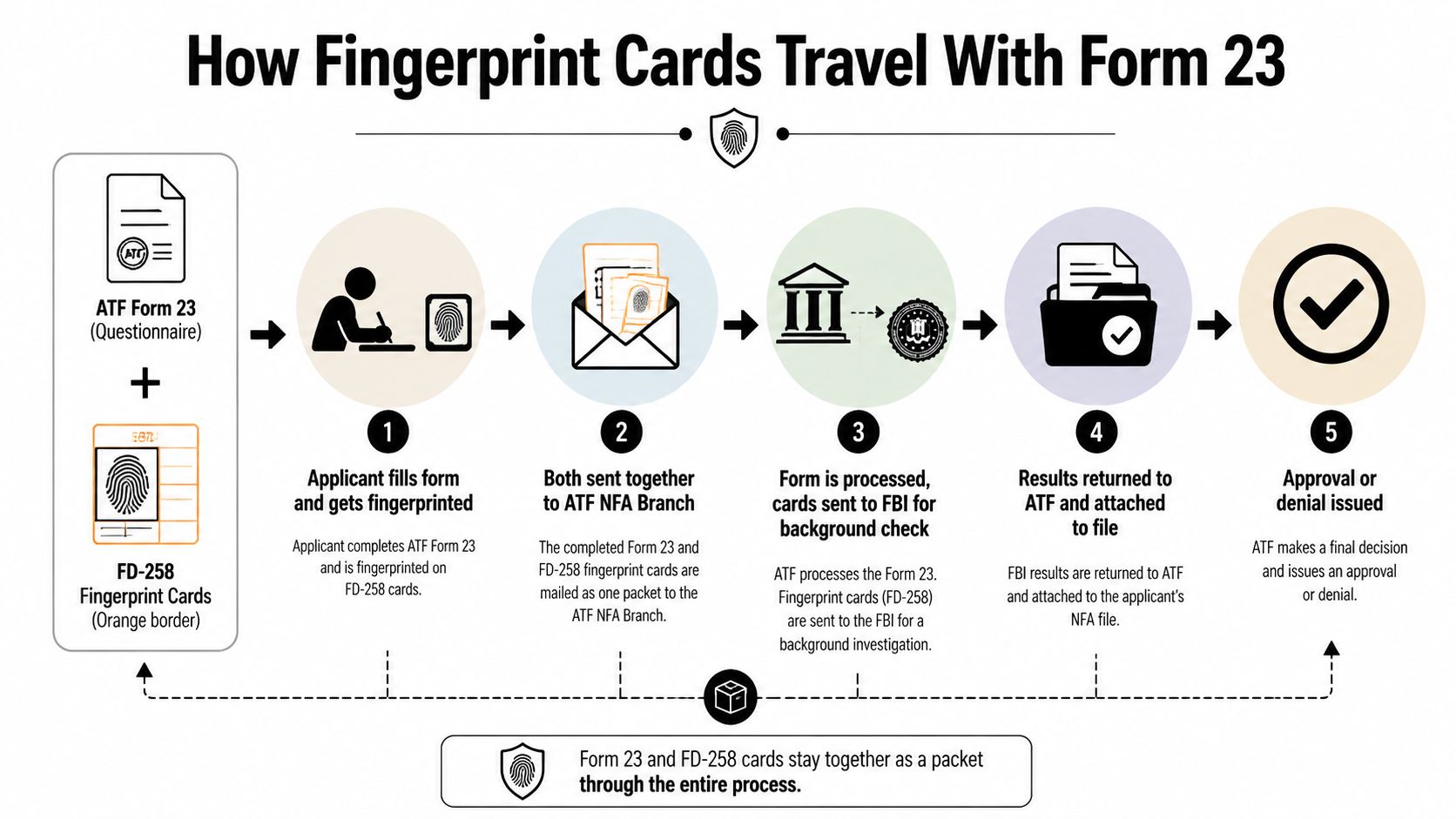
The Form 23 establishes who you are and what role you play. The fingerprint cards let the system verify that identity through the background-check process. If you are filing electronically and the system allows a digital workflow, the attachment step changes, but the identity check still has to happen. For a closer look at the live-scan side of that transition, this overview of live scan and FD-258 fingerprint cards is a useful reference.
Field rule: never mail an envelope you have not checked twice. The delays I see most often come from packets assembled in a hurry, then sealed before anyone confirmed the right cards were inside.
Where to Get Fingerprinted in Sugar Land
Three filers can walk into Business Mail Boutique LLC on the same Tuesday and need completely different handling. One just wants sealed FD-258 cards for a paper packet. Another is coordinating prints for several responsible persons. A third is trying to keep everything moving while the federal process shifts toward electronic fingerprinting.
In Sugar Land and Greater Houston, the practical options are the same: a local print shop with live scan or ink-trained staff, a law enforcement agency that fingerprints civilians by appointment, or a mobile fingerprinting service that comes to your home or office. Which one works depends on access, scheduling, and how much back-and-forth you want to avoid.
| Fingerprinting Options in Sugar Land | Typical Cost | Turnaround | Best For |
|---|---|---|---|
| Walk-in print shop | Varies by provider | Same visit | Individual filers who want sealed FD-258 cards fast |
| Law enforcement appointment | Varies by agency | Scheduled window | Applicants who can work around appointment-only access |
| Mobile fingerprinting service | Varies by provider | By appointment | Corporate filings with multiple responsible persons |
A walk-in shop is usually the simplest route because it keeps FD-258 cards on hand and lets you leave with sealed cards in one visit. Mobile service makes more sense when several responsible persons need prints at the same location, but the travel fee can be hard to justify for one filer. Law enforcement options can work well when they are open to civilians, but availability is often narrower than people expect.
Business Mail Boutique LLC is one local option in Sugar Land. It handles fingerprinting alongside shipping and document services, which can reduce the number of stops you make. That matters when you want the print, the technician signature, and the envelope handled in one place instead of split across vendors.
Before you book, ask three direct questions. Do they stock the right FBI card, do they sign the technician block themselves, and do they understand ATF packet handling? If any answer is vague, keep looking. For filers preparing to shift between paper packets and live scan workflows, this overview of live scan and FD-258 fingerprint cards is a useful reference.
Fees and Timing for Form 23 Fingerprinting
A filer usually faces two separate costs. One is the local fee for the fingerprint appointment. The other is the time the ATF review process adds after the packet leaves your hands. The local fee is the part you can compare right away. The federal timeline is the part that usually decides how much buffer you need.
| Form 23 Fingerprinting Cost and Timing | Current Paper Process | Proposed 2026 Electronic Process |
|---|---|---|
| Fingerprint format | Two FD-258 cards for the current paper process ATF guidance | One card for individual applicants on certain NFA forms, according to the proposal ATF rule record |
| Submission style | Mailed packet with paper cards | Conditional submission when fingerprints are required |
| Review posture | Routine paper handling | More targeted electronic handling |
| Practical planning | Build in a longer buffer | Expected to be shorter once implemented |
Current ATF guidance still shows two FD-258 cards with the ATF copy of Form 5320.23, so the paper workflow remains the standard today ATF guidance. The proposed rule would remove the Form 23 fingerprint-card requirement and move toward a more targeted system where fingerprints are requested only when the statute or the Director calls for them ATF rule record.
That matters for timing because fingerprint quality is often the first place a packet slows down. A clean local appointment may feel like the end of the task, but for ATF it is just the start of the review clock. In practice, the safest plan is still to build in a healthy buffer before you need the approval in hand.
If the proposed electronic workflow becomes final and fully implemented, the agency expects a tighter turnaround. That is a future-state projection, not a current filing promise. I would still plan around the paper process that exists today, then treat the electronic change as a real improvement once it is live.
Real-world planning: do not schedule a purchase, range day, or move date around the assumption that the fingerprint packet will move quickly. A one-person filing is simpler than a packet with several responsible persons, but both still depend on clean prints, correct assembly, and enough lead time.
Common Reasons ATF Rejects Fingerprint Submissions
Wrong card stock causes more trouble than most applicants expect. Only the FBI-standard FD-258 card belongs in the packet, and generic cards or local variations can get kicked back before the fingerprint quality even becomes an issue. If the card isn’t the right format, the rest of the work doesn’t matter.
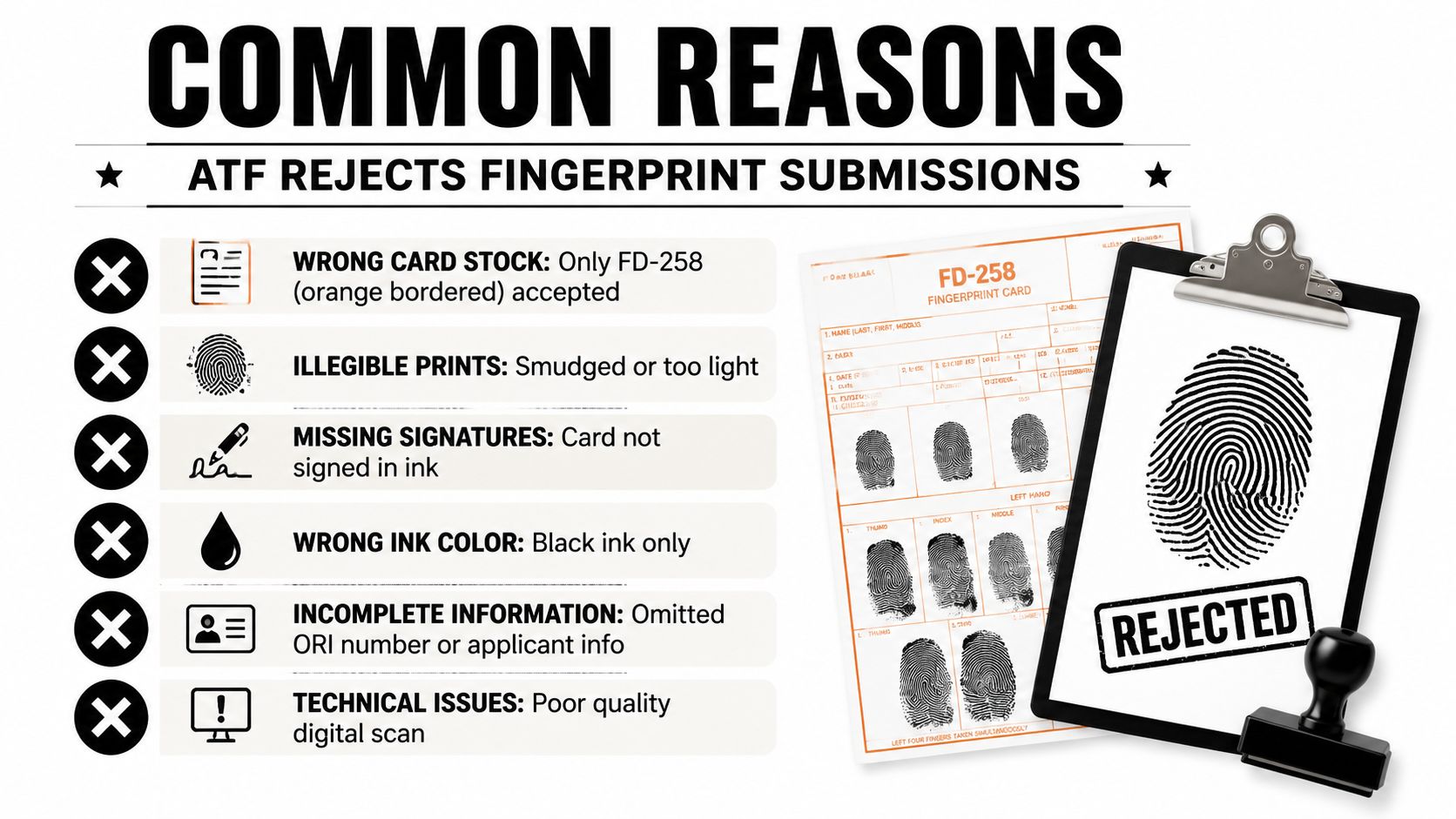
The mistakes that usually send packets backward
A good card can still fail if the ink is wrong. Over-inked prints smear, under-inked prints disappear into the card, and a finger rolled flat instead of nail-to-nail leaves gaps in the impression. Smudges and light impressions are the sort of problems that look small in person and big on review.
The form itself can also sink the packet if it’s incomplete. Missing signatures, missing dates, or skipped applicant information create a problem before the prints are even evaluated. The technician and applicant both need to do their part, and the card shouldn’t leave the shop until those blocks are checked.
Other delays are mechanical. A photo placed where it shouldn’t be, a folded card that creases the rolled impressions, or loose paper clips that catch the wrong edge can all slow handling. The goal is not just to submit prints, it’s to submit a packet that can be read and filed without anyone having to guess what went where.
Here’s the simple pre-mail checklist I’d use every time:
- Card type: Confirm it’s the FBI FD-258 card, not a state-specific substitute.
- Print quality: Check for clear ridge detail, no smearing, and no faint blocks.
- Signatures: Make sure the applicant and technician signed where required.
- Attachments: Keep the photo and paperwork where the packet order expects them.
- Envelope: Seal the fingerprint cards correctly and don’t reopen the envelope after printing.
If you catch one of these problems before mailing, you save yourself the wait. Once the packet is out the door, you’re relying on a correction cycle that always takes longer than getting it right the first time.
Wrapping Up Your Form 23 Fingerprinting Plan
A smooth ATF Form 23 fingerprinting submission starts with order, not guesswork. Confirm who counts as a responsible person, use the correct FD-258 cards, and make sure the Form 23 is complete before anyone heads to the printer or the mailbox. A technician who knows ATF packet handling can help keep the cards readable and the paperwork in the right sequence.
The fingerprinting skill itself stays the same across Form 1, Form 4, and Form 5 filings. The main difference is how the packet is assembled and sent. Once the prints are clean and the form is finished correctly, repeat filings usually go more smoothly because you already know where delays tend to start.
The proposed 2026 electronic shift points toward a one-card workflow and less paper handling later ATF rule record. Until that change becomes standard, the current paper process still controls most filings, so it makes sense to follow today’s requirements and prepare for the transition at the same time.
If you’re in the Houston, Sugar Land, or Greater Houston area, Business Mail Boutique LLC handles fingerprinting, document finishing, and mailing support in one place. Visit Business Mail Boutique LLC to get your Form 23 packet prepared with the cards handled, the prints sealed, and the submission ready to mail.

Related posts
Find Fingerprint Near Me
Find Fingerprint Near Me: Your 2026 Guide
You got the email, the hiring portal update, or the licensing checklist. It says you nee...

PrintScan Sugar Land Location of Business Mail Boutique
PrintScan Sugar Land Location of Business Mail Boutique
If you need the printscan sugar land location of business mail boutique, the l...
Get Fingerprinting for the board of Nursing in Sugar Land
Are you seeking fingerprinting services for the Board of Nursing in the Sugar Land area? Look no further than Business Mail Boutique, s...