
- Print Business Cards in Sugar Land – Same Day Service
- Copying Services
- Document Printing, Finishing & Lamination in Sugar Land
- Flyers
- Print Banner in Sugar Land | Same-Day Banner Printing Near Me
- Graphic Design
- Photo Printing
- Postcard Printing
- Document Printing
- EDDM Full Service Postcards
- FotoZoomer Large Format Printing


Name Change Fingerprinting.
Name change fingerprinting.. Navigate name change fingerprinting with confidence. Learn where to go, what to bring, ink vs Live Scan options, fees, and how.
Businessmailboutique
11645 S. Hwy 6
Sugar land, Texas 77498 United States (US)
Email: info@businessmailboutique.com
Route
You’re at the counter, you’ve got your petition drafted, and then the clerk or attorney says you need fingerprints before the court will move your name change forward. That’s the moment you realize name change fingerprinting isn’t just a checkbox, it’s a logistics problem. The key work is figuring out where to go, what format your jurisdiction accepts, and how to time everything so the report is still valid when the judge sees it.
Courts use fingerprints because a new legal name can hide older records if the search relies on names alone. In Manitoba, for example, the province tied civil name-change administration to fingerprint submission so the RCMP could check for criminal-record matches and preserve record integrity, a clear sign that biometrics are used to connect identities across name changes rather than treat each application as a clean slate Manitoba’s 2011 name-change fingerprint announcement. If you’re collecting consent documents or background-check paperwork for a client, the privacy checklist at Digital Footprint Check consent guidance is a useful companion reference because the same basic issue keeps showing up, identity has to be tied to the right person before anyone relies on the result.
Table of Contents
Why Courts Require Fingerprints for Legal Name Changes
A woman walks into my counter with a stack of forms and a new marriage certificate, sure that the court will only want the paper trail. Then she learns the background check is part of the process, because the court is not just approving a new label, it’s asking whether the person behind that label matches the records already on file. That’s the core reason name change fingerprinting exists, it connects the new legal name to prior identity records with a biometric marker that doesn’t shift when names do.
The identity problem behind the rule
Name changes are legal, but names themselves are fragile identifiers. People use maiden names, married names, hyphenated names, aliases, nicknames, and sometimes inconsistent birth data, which means a name-only search can miss records or pull the wrong ones. Fingerprints solve a different problem than forms do, they give the court and reviewing agencies a stable identifier that can follow the person across time and across different names.
Manitoba’s 2011 policy makes that logic visible in plain language, applicants for a legal change of name had to submit fingerprints through designated law enforcement agencies, the fingerprints and name-change information went to the RCMP, and a match to a criminal record meant the new name would be added to that record while a non-match led to destruction of the prints Manitoba’s 2011 name-change fingerprint announcement. That’s not a clerical formality. It’s identity governance, and it shows why a court wants biometrics when the applicant is changing the name under which records will later be searched.
What gets matched behind the scenes
The FBI’s fingerprint infrastructure shows how large this identity layer has become. In 2023, the FBI’s Criminal Justice Information Services division received and processed 74 million fingerprints, and by February 2026 the Next Generation Identification system was described as averaging more than 165,000 daily searches across more than 194 million computerized criminal and civil fingerprint records FBI fingerprint history and records overview. That scale matters because courts and agencies aren’t dealing with a niche verification tool, they’re relying on a mature records system.
Practical rule: if a name change can affect how a record is found later, the fingerprint becomes the anchor that keeps the file tied to the same person.
For readers who want to separate identity checking from other screening steps, the clearest explanation I’ve found is the comparison in Fingerprinting vs Background Check. Fingerprinting and background checks often travel together, but they’re not the same thing, and courts care about that distinction.
Ink Cards Versus Live Scan Digital Fingerprinting
The first question I ask clients is simple: what does your jurisdiction accept? A lot of delays start because someone assumes digital is always faster or paper is always old-fashioned, when the answer is jurisdiction-specific. Texas, for example, requires paper fingerprint cards that cannot be transmitted electronically, while other places steer applicants toward electronic providers or approved alternatives.
When paper cards win
Ink cards, often on FD-258 forms, are still the right answer in places that want physical submission or do not accept an electronic workflow for a particular filing. That format gives you something tangible to mail, keep a copy of, and attach to a process that still runs on paper. It’s also the safer choice when the jurisdiction’s rules are explicit about mailed cards, because using the wrong format can force a complete do-over.
When Live Scan is the better fit
Live Scan digital fingerprinting works well when the receiving agency accepts electronic transmission. The quality control is often cleaner at the point of capture, and you don’t have to worry about a card getting bent, smudged, or unreadable in transit. The catch is that not every court, state agency, or civil name-change workflow accepts digital submission, so speed only helps if the format matches the rule.
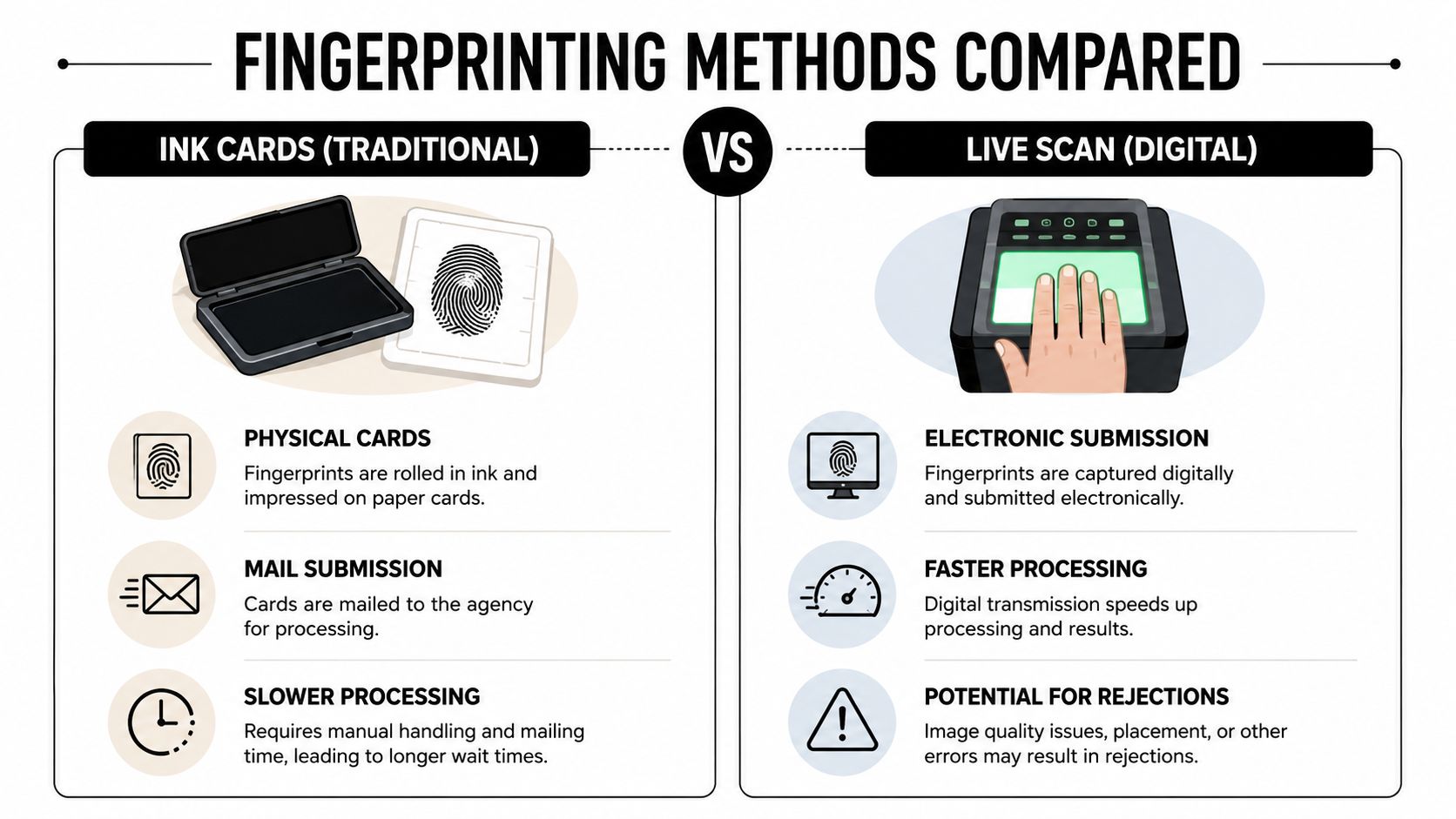
| Feature | Ink Cards (FD-258) | Live Scan Digital |
|---|---|---|
| Submission style | Physical card | Electronic transmission |
| Best fit | Jurisdictions that require mailed cards | Jurisdictions that accept digital intake |
| Common risk | Smudges, handling issues, mailing delays | Rejection if the court or agency wants paper |
| Counter reality | More manual, but often more universally accepted | Cleaner capture, but rule-sensitive |
The one thing I tell people to verify before booking is whether the court, clerk, or background-check agency names a specific format. That decision saves more time than any marketing promise about faster processing. If you’re comparing formats for a civil filing, the practical overview in Live Scan and FBI FD-258 cards is worth checking alongside the local instructions.
The wrong format is worse than no appointment at all, because it creates the false feeling that the task is already done.
What to Bring and How to Prepare
A fingerprint appointment fails for boring reasons more often than dramatic ones. Someone brings the wrong ID, leaves the court form at home, or shows up with a name mismatch between the petition and the identification card. The technician can’t fix that at the counter, so the visit turns into another trip, another fee, and another delay.
Bring the documents that actually prove who you are
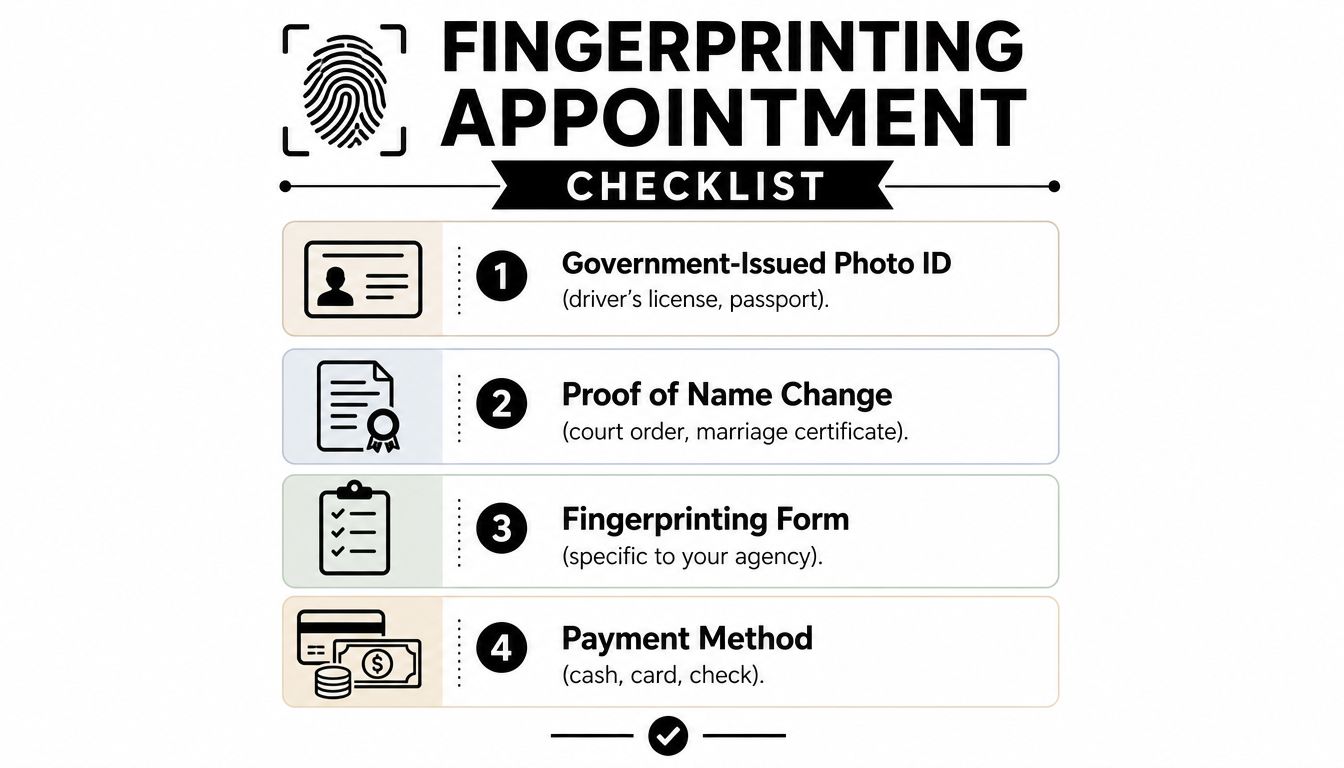
At minimum, bring a government-issued photo ID that the provider will accept, plus the specific fingerprinting form tied to your court or agency. If your current ID still shows your old name, carry the document that explains the difference, such as the court order or marriage certificate that supports the change. If your paperwork is even slightly inconsistent, organize it before you arrive rather than trying to persuade the front desk to improvise a solution.
Check the paperwork against the appointment type
Civil name-change fingerprinting is a paperwork match game. The form, the ID, and the court instructions all need to line up, and the provider usually can’t guess which version your jurisdiction wants. I’ve seen applicants arrive with a perfectly valid ID and the wrong card format, which is a frustrating way to learn the appointment was never the bottleneck.
A short checklist helps more than a long explanation:
- Photo ID: Bring the exact ID you expect the provider to accept, not a backup you hope they’ll take.
- Name-change proof: Bring the petition, court order, or marriage certificate that explains the new legal name.
- Fingerprint form: Use the form named by your court, agency, or fingerprint vendor.
- Payment method: Confirm accepted payment before you leave home, because some locations are stricter than they advertise.
If you want a broader intake checklist and common document questions in one place, the complete fingerprinting FAQ guide is a practical reference to review before you book. It’s easier to correct a document pile at your kitchen table than at a service counter with a line behind you.
Finding a Fingerprinting Provider and Understanding Costs
The hardest part for many applicants isn’t the prints themselves, it’s finding a place that still does civil fingerprinting the way your jurisdiction wants it done. Some law-enforcement agencies have stepped back from civil cases, some states use approved vendors, and some locations only handle certain formats. That’s why a name change can become a routing problem instead of a legal one.
Where people actually go
The provider usually falls into one of three buckets. A law-enforcement agency may still offer civil fingerprinting, a private vendor may handle both paper and digital captures, or an authorized business center may offer the service as part of a broader document workflow. In Sugar Land, Texas, Business Mail Boutique LLC is one place that offers fingerprinting alongside related document services, which can help when you need more than just the print itself.
What to ask before you schedule
Don’t ask only whether they do fingerprints. Ask whether they do civil name-change fingerprinting, whether they use ink cards or digital capture, whether they can complete the exact form your court wants, and whether you need an appointment. That four-question screen saves more time than trying to diagnose the mismatch after you’ve already arrived.
A useful counter-checklist looks like this:
- Format accepted: Confirm paper cards, digital submission, or both.
- Provider type: Ask whether they serve civil applicants or only criminal matters.
- Access method: Find out if they take walk-ins, appointments, or both.
- Service scope: Confirm they can handle the specific card or agency form you need.

Provider selection also affects how quickly you move from print capture to submission. Some locations mail the card for you, some hand it back, and some send the data electronically as part of a separate workflow. Texas is a good example of why this matters, because the state’s fingerprint-card process still requires paper handling rather than a simple digital handoff Texas DPS fingerprint card instructions.
If a provider can’t explain how your jurisdiction wants the prints submitted, that’s a warning sign, not a convenience issue.
Submitting Results and Managing Processing Timelines
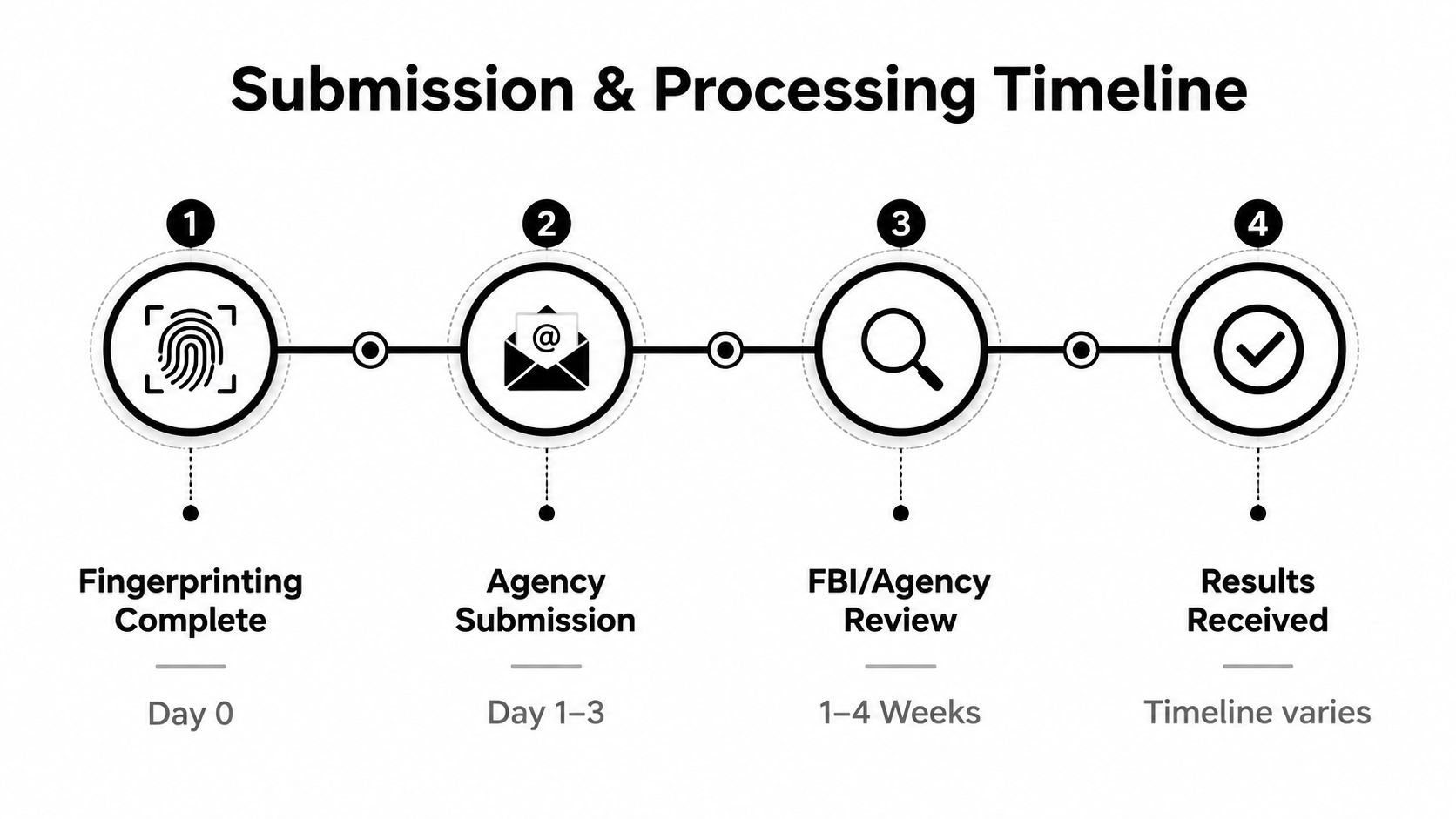
Fingerprinting appointments feel like the finish line, but they’re really the middle of the process. The submission method determines who receives the prints, how they’re routed, and whether the court will still accept the result when your filing date comes around. If you miss the timing window, you can end up doing the whole thing twice.
Why deadlines matter more than most people expect
Some jurisdictions require the report to be recent when the petition is filed, and North Carolina guidance treats the report as time-sensitive enough that it must be dated within 90 days of the petition, which means a delayed filing can make a fresh report stale before the court sees it. Texas and North Carolina guidance both reflect the same practical reality, background paperwork has a shelf life, and the clock doesn’t pause because your hearing date moved.
In Canada, RCMP-based name-change fingerprinting can take 2 to 3 weeks for applicants with no criminal record and 1 to 3 months for those with records, and the application can’t be filed until the report arrives. That timing difference is operationally huge. A clean record and a record-hit do not travel through the system at the same speed, so applicants need to plan around the slower scenario, not the best one.
Submission paths change the timeline
Electronic submission usually shortens the handoff between capture and agency review, while mailed paper cards add physical transit and handling. Neither path guarantees a faster result if the form or format is wrong, because the agency can only process what matches its intake rules. The practical move is to schedule the fingerprint appointment backward from your court deadline, not forward from the day you feel ready.
If your filing window is tight, aim to get the prints done early enough that a delayed report still leaves time for correction or resubmission. That buffer is what keeps a normal administrative step from turning into a court reset.
Common Mistakes and How to Avoid Them
The biggest mistake is assuming fingerprinting is the same everywhere. It isn’t. Florida exempts petitions restoring a former name from the fingerprint requirement, while other adult and minor name-change processes still require prints and background checks, so copying advice from a different state can set you up for rejection before the clerk even reviews the file Florida name-change statute.
Another common failure is waiting too long after the prints come back. A report that was valid when issued can go stale if the court filing slips, and a jurisdiction that wants a report dated within a defined window will not care that the delay was unintentional. I’ve also seen applicants pick up the wrong provider because they searched by convenience instead of acceptance rules, then discover the court wanted a paper card, not a digital capture.
The mistakes that cost people the most time
- Wrong jurisdictional rule: Using advice from another state when your court has its own fingerprint requirement.
- Expired report window: Filing after the report is no longer current.
- Mismatch in name documents: The ID, petition, and supporting order don’t line up.
- Unreadable prints: Smudged or incomplete cards force a redo.
The cleanest prevention strategy is to verify the court’s instructions first, then book the provider second, then do the appointment only after the paperwork is assembled. That order sounds simple, but it prevents most of the counter-level problems I see. If you’re a business owner, freelancer, or local resident trying to handle this without bouncing between offices, Business Mail Boutique LLC offers fingerprinting alongside other document services in Sugar Land, which makes it easier to keep the prints, photos, and paperwork moving in one place.
If you need help with fingerprinting for a legal name change, visit Business Mail Boutique LLC to arrange a local appointment and confirm the format your paperwork requires. The team can handle fingerprinting alongside related services, which helps cut down the back-and-forth that usually causes avoidable delays.

Related posts

Custom Memorial Glasses Engraved in Three Hours in Sugar Land
When a customer needed eight personalized glasses for a memorial, Business Mail Boutique completed the engraving or...

Custom Martini Glass Engraving in Sugar Land, TX
Custom Logo Engraving on Martini Glasses in Sugar Land, Texas.
Business Mail Boutique recently completed a beautiful custom engravin...

Custom Engraved Wine Glasses for a Golf Club Event in Sugar Land, TX
Custom Engraved Wine Glasses for a Golf Club Event in Sugar Land.
Custom wine glass engraving in Sugar Land, TX at Business Mail Bouti...