
- Print Business Cards in Sugar Land – Same Day Service
- Copying Services
- Document Printing, Finishing & Lamination in Sugar Land
- Flyers
- Print Banner in Sugar Land | Same-Day Banner Printing Near Me
- Graphic Design
- Photo Printing
- Postcard Printing
- Document Printing
- EDDM Full Service Postcards
- FotoZoomer Large Format Printing


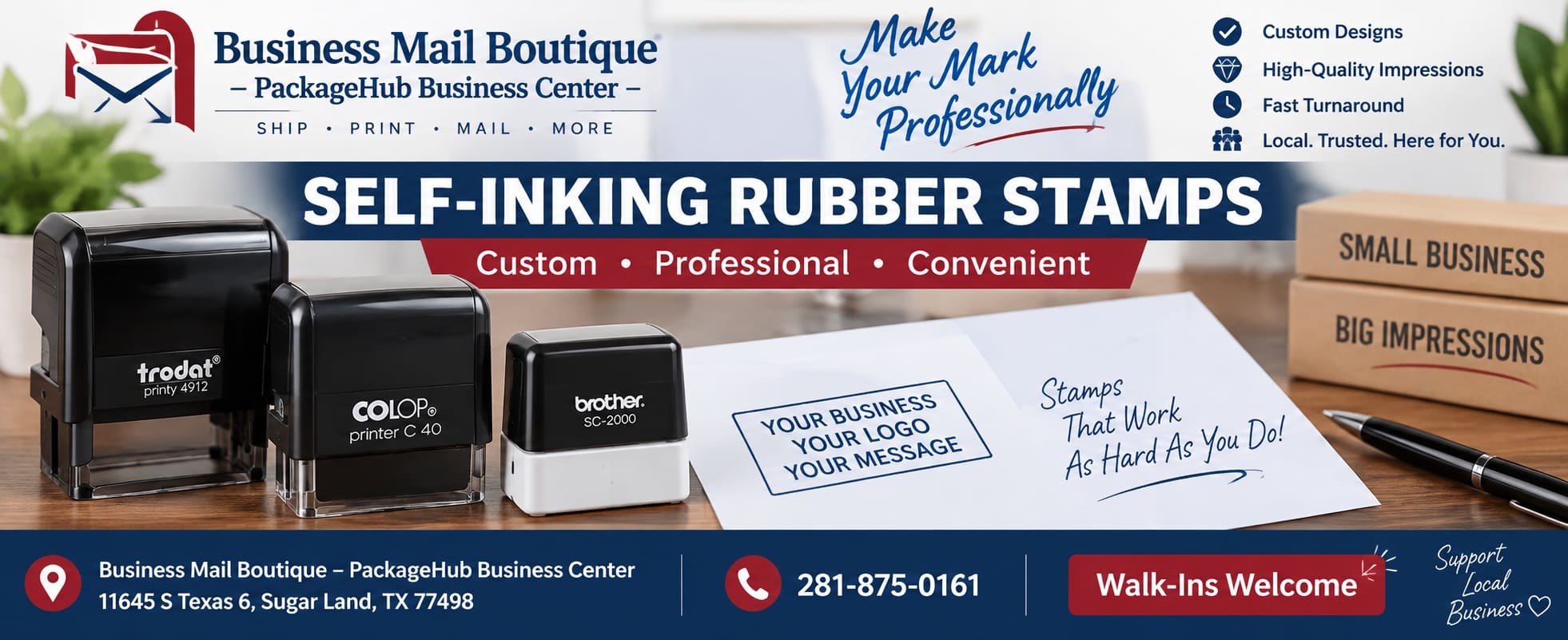
Self Ink Rubber Stamps.
Discover everything about self ink rubber stamps. Learn how they work, compare types, customize your stamp, maintain it properly, and order locally.
Businessmailboutique
11645 S. Hwy 6
Sugar land, Texas 77498 United States (US)
Email: info@businessmailboutique.com
Route
You know the moment. A stack of invoices is waiting, the approval box is already lined up, and the separate ink pad has either dried out or vanished into the back of a drawer. You press once, get a faint mark, press again, and now the document looks rushed. That is the day a self ink rubber stamp stops being a convenience and starts being a workflow tool.
For businesses that stamp all day, the difference is bigger than speed. It’s about cleaner impressions, fewer desk-side failures, and less time spent chasing accessories that should’ve been within reach in the first place. If you’ve ever had to clean up a messy mark before sending a document, you already understand why this format keeps showing up in offices, mailrooms, and front desks. For broader office workflow ideas, the practical note in real estate fax tips is a useful complement, especially when paper handling is still part of your daily routine. And if you’re building out a broader branded counter setup, the approach used in promotional items to give away shows how small office tools can support a cleaner, more professional handoff.
Table of Contents
- Why Self-Inking Rubber Stamps Matter for Your Business
- What Self-Inking Rubber Stamps Are and How They Work
- Different Types and Real-World Use Cases
- Comparing Self-Inking to Traditional and Pre-Inked Stamps
- Choosing the Right Size and Customization Options
- Maintenance and Re-Inking Your Self-Inking Stamp
- Pricing Expectations and Local Ordering in Sugar Land
- Wrapping Up Your Self-Inking Stamp Journey
Why Self-Inking Rubber Stamps Matter for Your Business
The value of a self-inking rubber stamp shows up on busy days, not quiet ones. A receptionist stamping incoming mail, a warehouse clerk marking receipts, or a controller approving batches of paperwork doesn’t have time to hunt for a separate pad and reset the stamp every time. That extra step sounds minor until it repeats dozens or hundreds of times in a day.
A self-inking unit folds the ink supply into the tool itself, so the rhythm stays consistent. You press, the die inks itself, the impression lands, and the mechanism resets for the next mark. That simple change removes a lot of friction, especially in departments where one person handles the same action over and over.
Practical rule: if the task is repetitive and the mark needs to look the same every time, self-inking usually beats a loose pad and handle.
The business case is also about presentation. A clean, even impression looks deliberate, while a half-inked mark reads as sloppy, even if the paperwork behind it is fine. That matters in document control, mail handling, school administration, and any office where a stamp is part of the record, not decoration.
There’s also a practical reason these tools still make sense in a digital world. Paper doesn’t disappear just because the process behind it got more modern. Shipping desks, accounting teams, and service counters still need fast, repeatable marking, and a self-inking format keeps that work moving without extra desk clutter.
What Self-Inking Rubber Stamps Are and How They Work
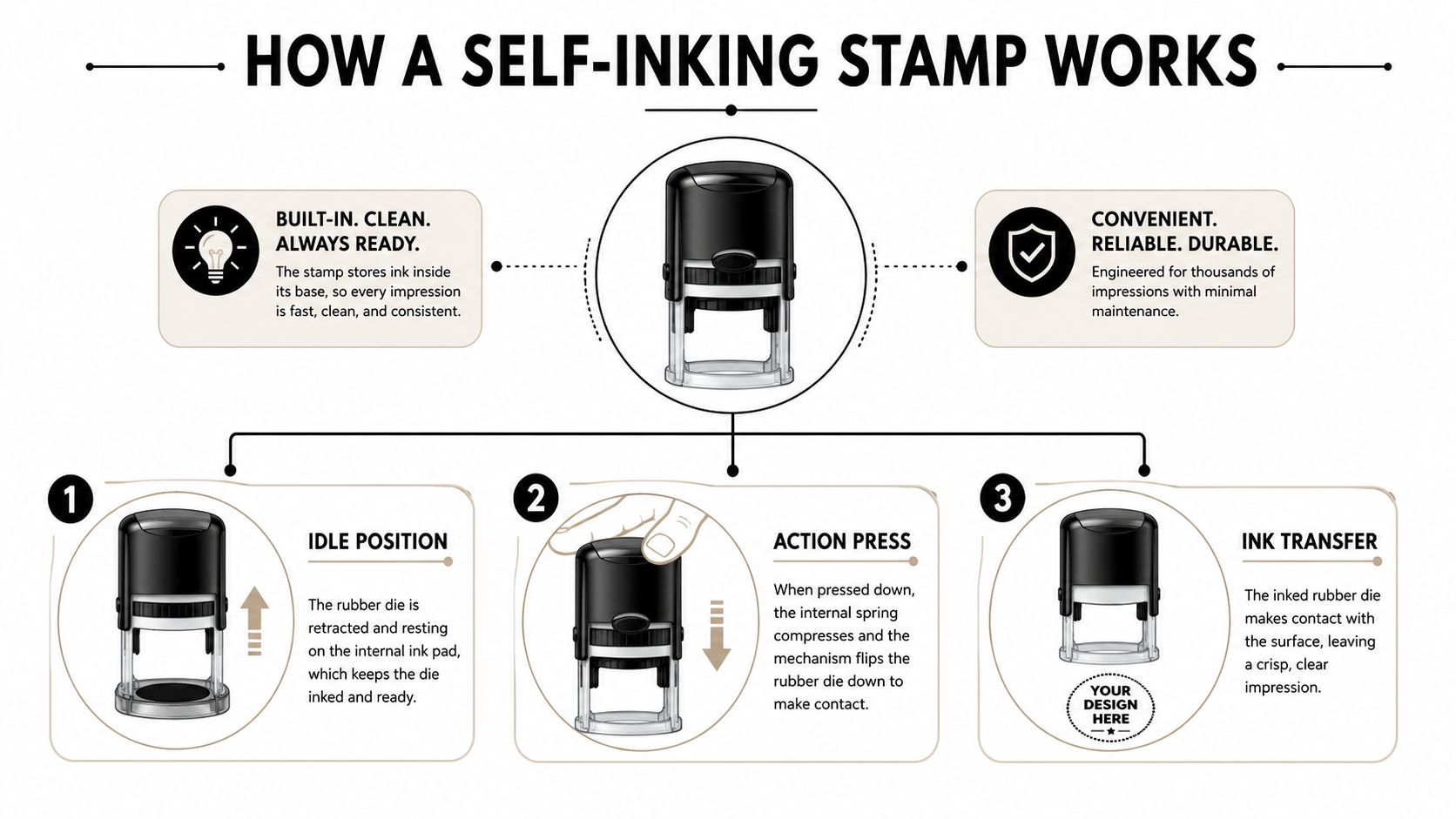
A self-inking stamp uses a two-part housing. One side holds the die, the other side holds the internal ink pad, often made from cellular rubber or felt. Press the stamp down, the die swings into the pad, picks up ink, and transfers that ink to the surface in one motion. The mechanism then returns to its resting position so the next impression is ready.
The practical value came from speed and consistency. Self-inking rubber stamps emerged as a distinct office tool by the late 19th and early 20th century, building on vulcanized rubber from 1839 and the patenting of vulcanization in 1844. Historical summaries place the first rubber stamp companies in the 1880s, and one reference notes that B.B. Hill patented a self-inking stamp in 1886, a milestone in office automation rubber stamp history. Separate pads slowed repetitive work and made impressions less even.
Where It Sits in the Stamp Family
Self-inking sits between the old-school pad-and-die stamp and the pre-inked stamp. The pad-and-die style uses a separate ink pad every time. The pre-inked style stores ink in the die itself. Self-inking keeps a built-in pad and resets automatically between impressions stamping history overview.
That design fits offices that need fast, repeatable marking without adding clutter to a crowded desk. It also gives you a more predictable impression than a loose pad that gets set down, moved, and sometimes skipped in the middle of a rush. If the job is signing off forms, labeling folders, or marking routine approvals, that consistency matters.
The trade-off is simple. The die, pad, and spring all have to stay in sync. When one part drifts, the impression fades or shifts. A new self-inking stamp usually feels automatic right away, then gets lighter as the pad dries or the mechanism wears. On many jobs, the cheapest fix is replacing the pad. If the body or spring is worn, a full stamp replacement makes more sense. For Sugar Land buyers, same-day local ordering can turn a long wait into an afternoon errand, which matters when a department cannot stop for a missing stamp.
Different Types and Real-World Use Cases
A mailroom doesn’t use a stamp the same way a small accounting office does. One is built for constant repetition, the other usually wants compact storage and neat desk use. The shape and size of the stamp matter, but so do die material, ink capacity, and how much abuse the body can take over time.
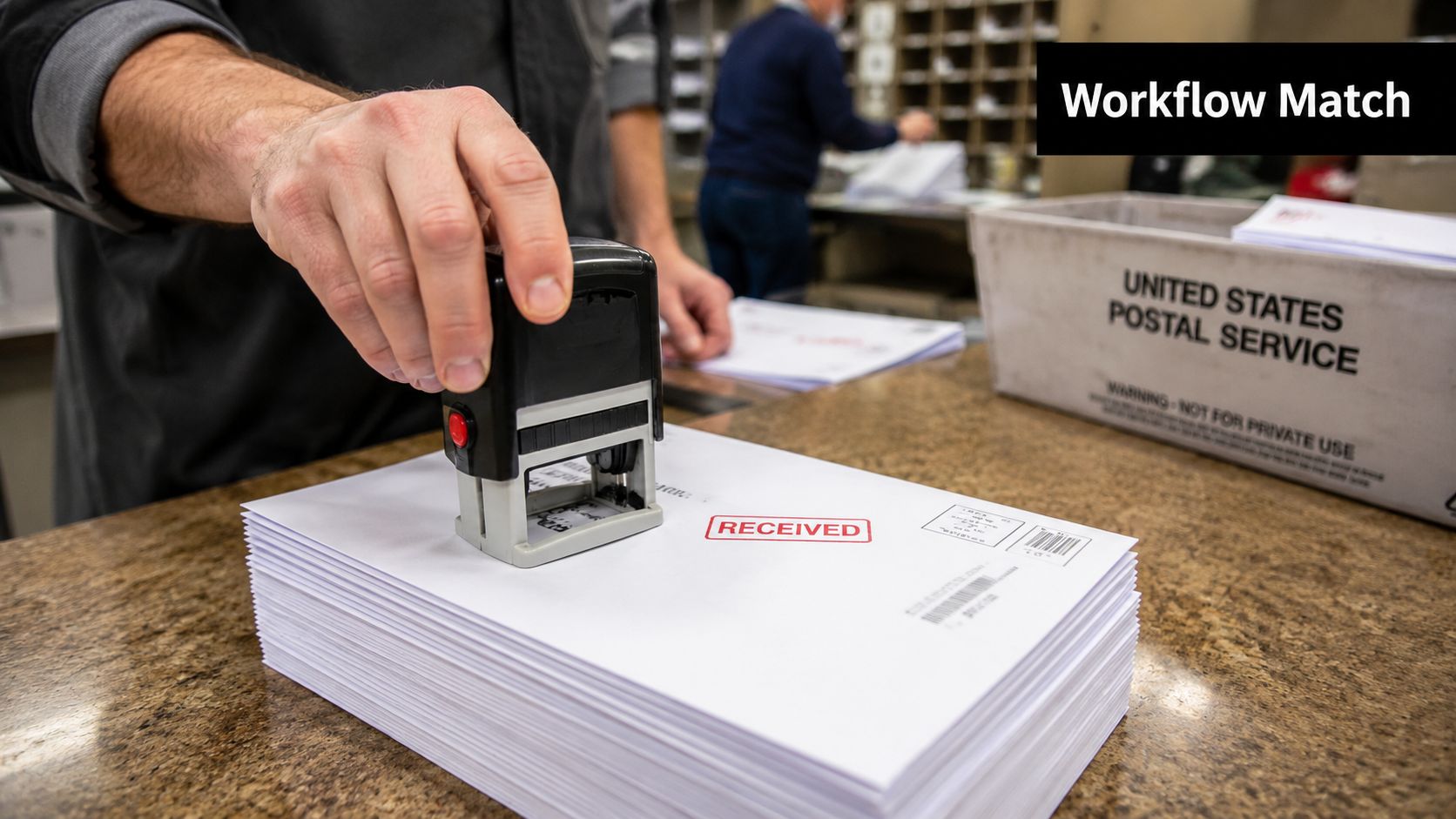
A receiving counter is one of the best fits for a self-inking model. Every package needs a fast acknowledgment, and nobody wants to reach for a separate pad while a delivery line builds up. Document control offices are another strong fit because they need the same mark, in the same place, all day long. The tool isn’t glamorous, but it keeps records readable and consistent.
Matching the Stamp to the Workflow
There isn’t one “best” size for every business. Bigger stamps give you more room for logos, multi-line text, or department labels, while smaller ones stay nimble for cramped desk spaces and simple approval marks. A front desk that stamps visitor logs needs different handling from a shipping team that stamps labels all day.
If your operation is high volume, the larger body and stronger reservoir usually make life easier. If the stamp lives in a drawer and comes out for occasional approvals, a compact model is less annoying to store and handle. The business decision is not just what fits on paper, but what fits the day-to-day rhythm of the office.
Recent market coverage suggests the category is still growing, with one report projecting the custom self-inking stamps market at USD 1.12 billion and 7.8% CAGR, and another estimating a separate address self-inking segment growing from USD 210.2 million in 2026 to USD 356.7 million by 2034 at 6.8% CAGR market coverage summary. Those projections don’t tell you which stamp to buy, but they do show the format is still being refined for business use.
A local print and office shop can be useful here too. If you need a stamp configured for a specific counter workflow, a place that already handles labels, print jobs, and office supply requests can usually match the stamp to the job faster than an online cart with guesswork.
Comparing Self-Inking to Traditional and Pre-Inked Stamps
An office that stamps packing slips all morning has different needs from a front desk that marks a form once in a while. That is why stamp choice usually comes down to how often you stamp, what surface you stamp, and how much maintenance you want to handle.
Traditional pad-and-die stamps use a separate ink pad. Self-inking stamps keep an internal pad that re-inks the die after each press. Pre-inked stamps store ink in the die material itself, which is why they often produce very sharp impressions, especially on clean paper. For a quick reference on how stamp families differ, see this stamp family overview.
The trade-offs show up in daily work. Traditional stamps are useful when you want more freedom to swap pad colors or use a classic handle style. Pre-inked units are a good fit for detailed marks, but they are less forgiving if you expect frequent refills or a lot of changeover. Self-inking sits between those two, and that middle ground is what keeps it practical for busy offices.
What Changes in Daily Use
| Factor | Self-Inking | Traditional Pad-and-Die | Pre-Inked |
|---|---|---|---|
| Ink mechanism | Internal pad | Separate ink pad | Solid cartridge or die ink |
| Ease of use | One-step press | Two-step process | One-step press |
| Best fit | Repetitive office work | Occasional, flexible use | High-detail impressions |
That table matters more than the marketing copy. If your team stamps all day, self-inking saves time because the pad is built in. If the job is occasional and the imprint varies often, traditional still makes sense. If you want a crisp image and can live with the feel of a pre-inked unit, that format has its place.
Self-inking also holds up well in offices that care about routine and turnaround. It is faster than manual re-inking, easier to keep at a workstation, and simpler to hand between users. For a shop that also handles custom stickers and label printing in Sugar Land, that mix of speed and control can make day-to-day document work easier to manage.
Choosing the Right Size and Customization Options
Stamp size should follow the space you have to mark. A receipt box, a shipping label, and a signature block all have different boundaries, and the stamp needs to fit the boundary cleanly. If the impression overlaps printed text, the whole point of the stamp gets lost.
Text layout matters just as much as size. A business name with a phone number needs different spacing than a simple “PAID” mark or a department approval. Logos can work well, but only when the lines are thick enough to reproduce clearly and the artwork is simplified for the die.
The Surface Dictates the Ink
The biggest mistake buyers make is thinking size is the only spec that matters. Self-inking systems are usually engineered around a built-in pad and a solid-rubber die, and the pad chemistry has to match the surface. Water-based dye inks are the default on paper because they stay wet in the pad and dry quickly on absorbent stock, while solvent-based inks are for non-porous or mixed surfaces like plastic, metal, glass, and laminated paper ink and surface compatibility.
That trade-off is worth respecting. Water-based ink usually means less odor and less bleed-through on paper. Solvent-based ink gives you more adhesion on hard or slick surfaces, but it demands the right pad and cartridge setup. If the chemistry is wrong, you’ll see smearing, weak bonding, or a mark that never really settles.
Here’s the quick decision filter I’d use in an office:
- Paper forms and invoices: use water-based dye ink.
- Plastic, glass, metal, or laminated stock: match the stamp to solvent-compatible ink.
- Logo-heavy marks: keep the design simple enough to stay crisp.
- Small approval boxes: choose the smallest size that still reads cleanly.
Getting that match right saves money later because you don’t have to replace a stamp that was built for the wrong surface. It also keeps the impression readable, which is the whole reason the stamp exists.
Maintenance and Re-Inking Your Self-Inking Stamp
A self-inking stamp usually fails in stages. The first sign is a lighter impression. After that, edges soften, then the whole mark looks tired. When that starts happening, more pressing won’t fix it, because the pad has already begun to dry out.
The practical guidance is simple. Self-inking stamps are commonly capable of thousands of impressions before pad replacement or re-inking, and one major retail help source says pads can last up to 10,000 impressions before replacement pad life guidance. That’s a useful benchmark for office planning, especially in mailrooms and receiving counters where you can feel the output fade before the pad fully gives out.
Re-Inking Without Ruining the Pad
The mistake I see most often is overfilling. More ink does not mean better output. Too much ink causes smudging and can damage the pad or the mechanism, which is why light top-ups usually beat aggressive saturation.
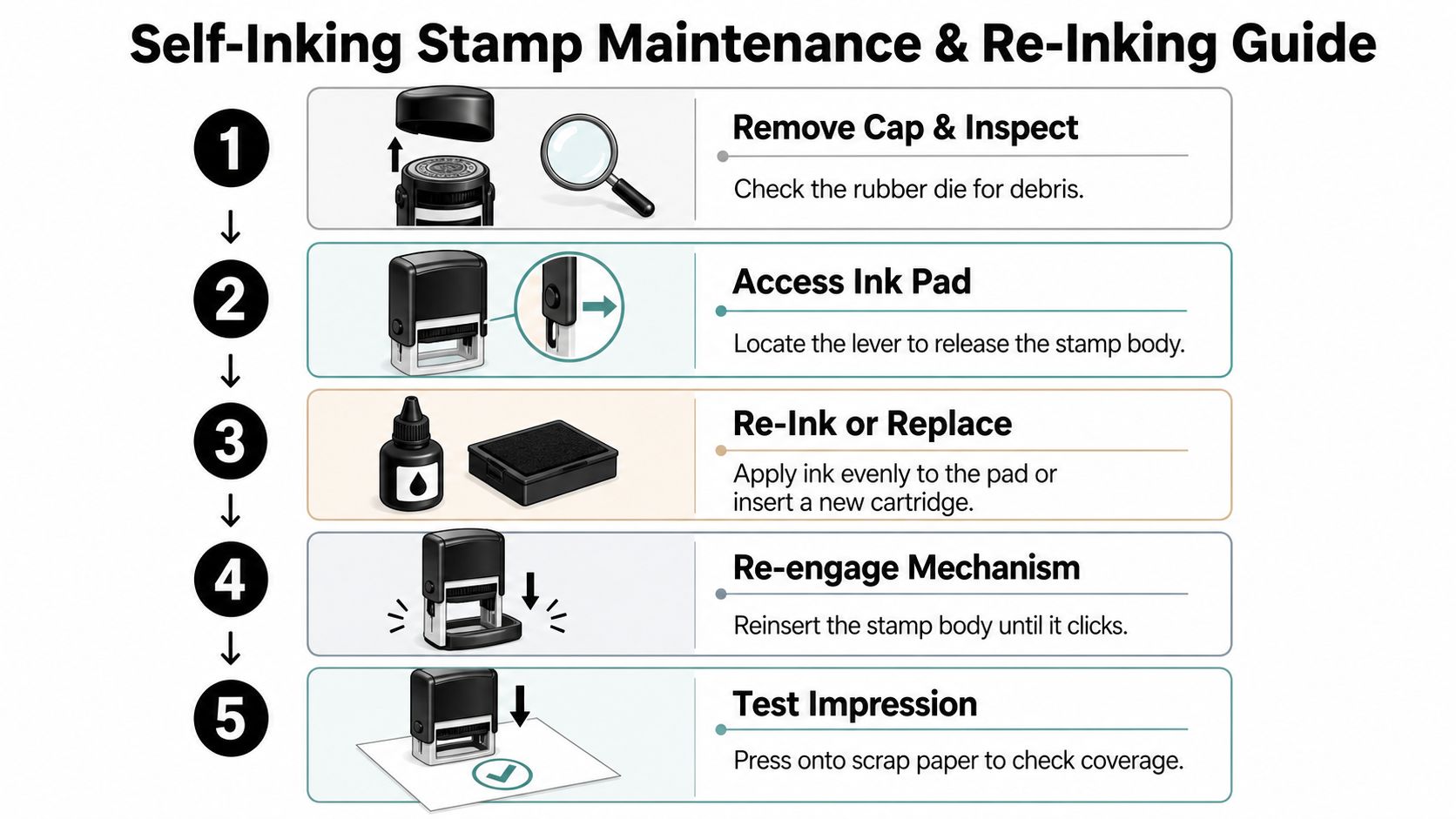
A sane maintenance routine looks like this:
- Inspect the impression first. Check whether the fade is even or patchy.
- Use approved ink only. Avoid harsh solvents and incompatible inks.
- Apply ink sparingly. Let the pad absorb it before testing.
- Test on scrap paper. Don’t go straight back to live forms.
- Replace worn pads when needed. Don’t force an exhausted pad to keep working.
Don’t chase a darker mark by flooding the pad. A clean, legible impression is the goal, not a soaked one.
The other thing that matters is what not to use. Maintenance guides warn against solvent cleaners and incompatible inks such as stencil, marking, numbering, or whiteboard inks because they can ruin the die or handle. Replacing the pad assembly at the right time is usually cheaper than trying to rescue a worn-out one.
The embedded video below shows a practical maintenance approach in motion.
For day-to-day business use, the rule is straightforward. Re-ink lightly, test often, and replace worn parts before they start making bad impressions that waste paperwork and time.
Pricing Expectations and Local Ordering in Sugar Land
Sticker shock usually comes from customization, not from the stamp body itself. Basic ready-made models stay on the lower end because they need little setup, while custom stamps with logos, multiple lines of text, or specialty layouts cost more because someone has to prepare the die and check the final proof. The more specific the imprint, the more work the build requires.
Turnaround matters just as much as price. Online orders can be fine when the job is flexible, but they’re a poor fit when a contract, event, or new employee setup needs a stamp now. That is where local service becomes more than a convenience.
Business Mail Boutique’s rubber stamp service in Sugar Land gives local buyers a faster path when the schedule is tight rubber stamp service. The advantage is simple, you can talk through the layout, surface type, and intended use in person instead of hoping the online proof matches the actual workflow. For a business that needs the tool today, that can turn a week of waiting into an afternoon errand.
What to Budget For
- Simple office marks: lowest setup cost, fastest to produce.
- Multi-line or logo stamps: higher because of design and die preparation.
- Specialty ink needs: add complexity if the stamp must work on non-paper surfaces.
- Same-day local pickup: worth it when delay costs more than the purchase difference.
The local angle matters most for small businesses, event teams, and office managers who can’t afford a shipping delay. If the stamp is part of a launch, a filing update, or a front-desk reset, getting it locally can remove a lot of unnecessary back-and-forth.
There’s also a broader pattern here. Just as people use how to print downloadable wall art when they want fast, practical output without waiting on a slow production cycle, a same-day stamp order solves the same problem for office paperwork. The value is not just the product, it’s the time you don’t lose.
Wrapping Up Your Self-Inking Stamp Journey
The smart decision starts with the surface, not the sales page. If you know what you’re stamping most often, the rest becomes clearer, size, ink chemistry, and maintenance all follow from that one choice. Get the match wrong and you’ll fight smears, weak impressions, or a stamp that wears out too soon.
The integrated design is what makes self-inking useful in the first place. It keeps the ink and die working together, which is why it stays popular in offices that need consistent, repetitive marking. Add in routine maintenance, and you’ve got a tool that can stay reliable for a long time without becoming a desk headache.
For businesses that need a fast answer, a local option can shorten the whole process. For offices that want to compare layout, surface use, and timing before ordering, that conversation is worth having before the first impression lands on an important document.
Business Mail Boutique LLC can help with custom rubber stamps as part of its Sugar Land print and office services, which makes it a practical stop when you need a stamp matched to your real workflow. If you’re ready to order or want to talk through the right size, ink, and layout for your office, visit Business Mail Boutique LLC and get the process moving today.

Related posts

Custom Memorial Glasses Engraved in Three Hours in Sugar Land
When a customer needed eight personalized glasses for a memorial, Business Mail Boutique completed the engraving or...

Custom Martini Glass Engraving in Sugar Land, TX
Custom Logo Engraving on Martini Glasses in Sugar Land, Texas.
Business Mail Boutique recently completed a beautiful custom engravin...

Custom Engraved Wine Glasses for a Golf Club Event in Sugar Land, TX
Custom Engraved Wine Glasses for a Golf Club Event in Sugar Land.
Custom wine glass engraving in Sugar Land, TX at Business Mail Bouti...