
- Print Business Cards in Sugar Land – Same Day Service
- Copying Services
- Document Printing, Finishing & Lamination in Sugar Land
- Flyers
- Print Banner in Sugar Land | Same-Day Banner Printing Near Me
- Graphic Design
- Photo Printing
- Postcard Printing
- Document Printing
- EDDM Full Service Postcards
- FotoZoomer Large Format Printing


Small Business Packaging Orders That Actually Save You Money.
Practical steps for small business packaging orders — measure right, pick the right box, order in bulk, and use local drop-off services without overpaying.
Businessmailboutique
11645 S. Hwy 6
Sugar land, Texas 77498 United States (US)
Email: info@businessmailboutique.com
Route
You’re standing in a warehouse aisle with five box sizes around you, a tape measure in one hand, and supplier tabs open on your phone. None of the boxes fits the product quite right. One leaves too much empty space, another costs more than expected, and the custom mailer you liked online requires a quantity your current sales don’t justify.
That’s how small business packaging orders become a margin problem. Packaging affects every shipment through material cost, dimensional weight, damage exposure, storage, labor, and reordering decisions. The global e-commerce packaging market was valued at USD 106.46 billion in 2025 and is projected to reach USD 392.85 billion by 2033, with a projected CAGR of 17.9% from 2026 to 2033, according to Grand View Research’s e-commerce packaging market report. For a small seller, that growth means packaging is no longer a minor back-office purchase. It’s an operating decision tied to shipping reliability, customer experience, and cash flow.
Table of Contents
- Why Most Small Business Packaging Orders Drain Margin
- Measuring Your Products Before You Order Anything
- Matching Packaging Type to What You Actually Ship
- Right-Sizing to Cut Your Packaging Cost Per Order
- Bulk Ordering Without Overcommitting Cash to Inventory
- Using a Local Pack and Ship Store for Drop-Offs and Overflow
- Your 30-Day Packaging Order Action Plan
Why Most Small Business Packaging Orders Drain Margin
A carton can look economical on a supplier’s website and still raise the cost of every shipment. If its internal dimensions leave excess space, the carrier may calculate charges using dimensional weight. You then pay for air, while extra void fill adds material, labor, and instability inside the parcel. Fragile products that shift during transit also create a damage cost that a box-price comparison will miss.
Branding creates a different cash-flow risk. A custom mailer may improve presentation, but low-volume sellers can tie money to slow-moving inventory, artwork changes, and minimum order quantities. Digital printing has made short runs as low as 50 to 100 units possible, compared with 500 to 1,000 units often associated with flexographic or lithographic printing, as described in this packaging cost analysis. That access helps, but it does not make every custom order sensible. A product change, promotion, or seasonal shift can leave usable packaging stranded.
Practical rule: Judge each packaging choice by its cost per shipped order, not its purchase price alone.
Track the leaks that your packing process can control:
- Box size: Base internal dimensions on the packed product and its protection, not retail dimensions alone.
- Void fill: Add enough material to prevent movement, then stop before the parcel becomes larger than necessary.
- Order timing: Reorder before a stockout, while waiting to validate a format before committing cash to a long supply.
- Carrier handoff: Pack and label routine orders internally. Use a shipping counter for irregular, fragile, or overflow work when the time and damage risk justify it.
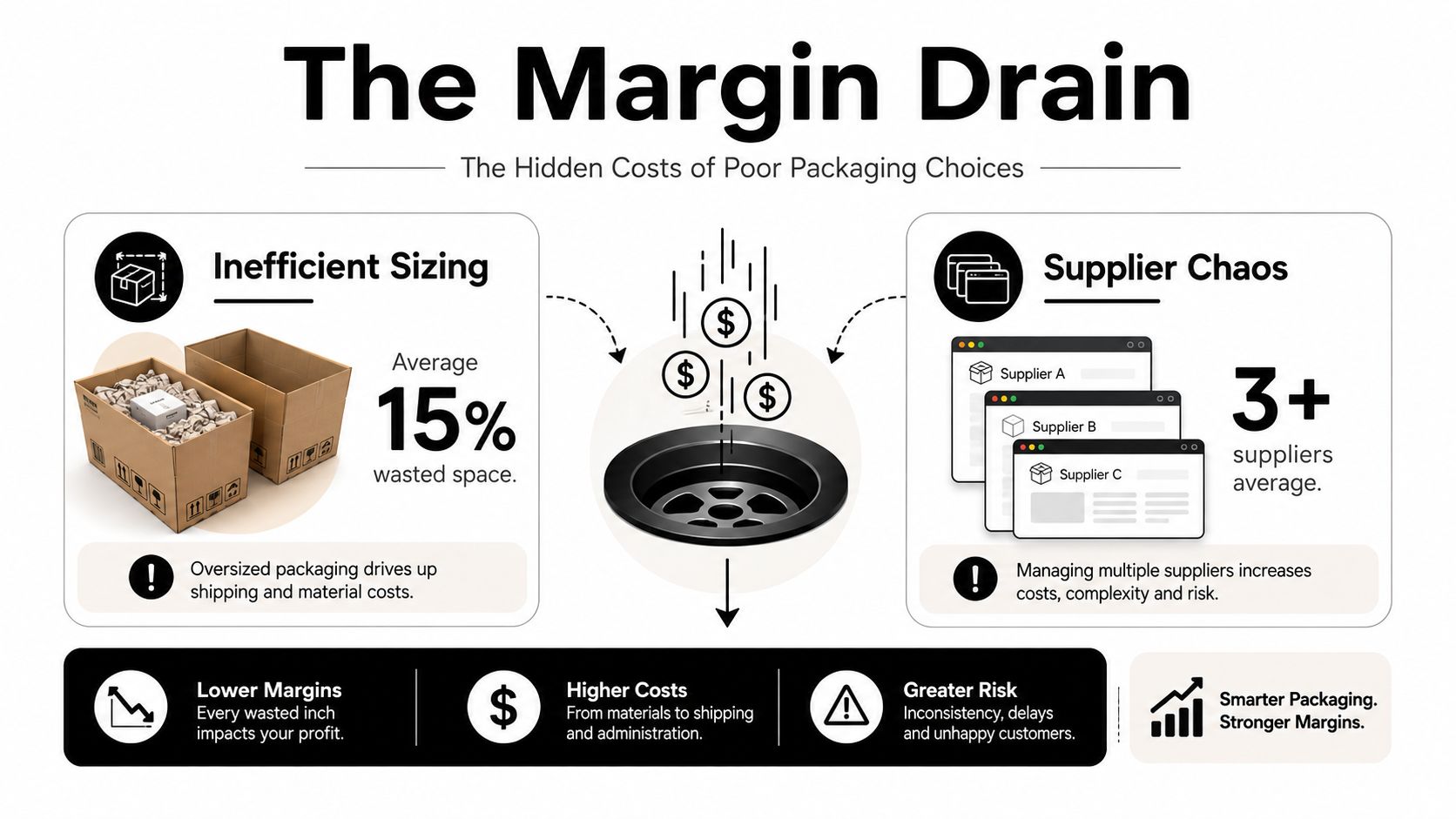
Packaging materials typically account for 10% to 20% of average e-commerce fulfillment cost, while packaging alone commonly ranges from USD 0.50 to USD 2.00 per order, with a reported median of USD 1.80, according to the OpenSend packaging cost summary. Use your own numbers to test the decision. Multiply the difference between two packaging options by your monthly shipment count, then compare that result with added packing time, damage exposure, storage, and cash tied in inventory. That calculation shows whether better-looking packaging earns its place.
Measuring Your Products Before You Order Anything
Start with the products that move best. Pull your shipment history and select the three most-shipped SKUs, rather than measuring every product in your catalog at once. Your first objective is to create packaging that works repeatedly for the items responsible for most of your daily packing work.
Measure the packed shape, not the ideal shape
Measure length, width, and height at the widest points. Include protruding parts such as spouts, lids, handles, tags, protective sleeves, and retail inserts. A tumbler may fit by its body dimensions but fail once the lid and vertical clearance are included.
Use an inch-and-a-half buffer as a starting point for products that need protective material. The product still needs room for its cushion, and the buffer should reflect the actual protection method, not a guessed gap around the item. Candles may need headspace for protective material, while jars often need corner protection because their vulnerable points aren’t limited to the center of the glass.
Record each result in a simple mapping sheet:
| SKU | Product Dimensions (L x W x H) | Box Internal Size | Cushion Type | Packed Weight |
|---|---|---|---|---|
| SKU-001 | ||||
| SKU-002 | ||||
| SKU-003 |
Validate the finished parcel
Pack the product exactly as it will ship. Don’t weigh the item by itself and assume the result will guide the carrier decision accurately. Add the box or mailer, protective material, tape, inserts, and any branded component, then weigh the finished unit on a shipping scale.
Keep both actual weight and package dimensions in the record. That information gives you a usable basis for comparing carrier rates and identifying products that need a different package format.
Common measurement traps include:
- Tumblers: Allow for lid height and vertical protection.
- Candles: Leave enough headspace for cushioning and prevent pressure on the vessel.
- Jars: Protect corners and control movement inside the box.
- Products with tags or spouts: Measure the farthest protruding point, not the flat body.
A supplier’s listed outer dimensions won’t tell you whether the product will survive transit. Test the packed unit, close the package, shake it gently, and inspect whether the contents move before ordering a large quantity.
Matching Packaging Type to What You Actually Ship
Packaging format should follow the product, the weight, and the likelihood that the parcel will come back. A premium-looking package isn’t automatically a better package if it adds size, storage requirements, or replacement cost.
Poly mailers work well for soft, flat goods such as apparel, printed paper products, and some cosmetic items. They store efficiently and can be a sensible choice when the contents don’t need structural protection. They’re a poor fit for rigid products, glass, or anything that can puncture the film.
Single-wall corrugated boxes are the default starting point for most hard goods. They ship flat, stack well, and offer a practical balance of protection and cost for items such as candles, stainless tumblers, and small electronics accessories. A properly fitted single-wall box usually makes more sense than jumping straight to heavier construction.
Double-wall corrugation earns its place when the product is heavy, fragile, or repeatedly damaged in a lighter carton. Buying it for every parcel adds material cost and can increase package weight without solving the actual failure point.
Rigid setup boxes create a strong presentation, but their premium construction can work against low-volume economics. They often take more storage space and can contribute to a larger parcel, so reserve them for products where presentation supports a clear commercial purpose.
| Packaging Type | Best For | Weight Range | Return Risk Fit | Cost Band Per Unit |
|---|---|---|---|---|
| Poly mailer | Soft, flat, flexible products | Light shipments | Lower return and damage exposure | Lower |
| Single-wall corrugated | Most hard goods and standard parcels | Light to moderate shipments | Moderate return exposure | Moderate |
| Double-wall corrugated | Heavy or fragile products | Heavy shipments | Higher damage or return exposure | Higher |
| Rigid setup box | Premium presentation and gift-style orders | Product-dependent | Higher presentation expectations | Highest |
For cushioning choices and product-specific protection, review these protective packaging materials for small business shipments.
A useful decision rule is simple: soft and flat starts in a mailer, everything else starts with single-wall corrugated. Move up a tier when the product’s damage history, return exposure, or presentation requirements justify it.
Right-Sizing to Cut Your Packaging Cost Per Order
Right-sizing begins with the internal dimensions recorded during product testing. Sellers often focus on the unit price of a box while ignoring the carrier charge created by the outside dimensions. That reverses the order of operations.
The cost of a package includes the container, protective material, tape, and any dimensional penalty. For reference, the verified industry data in this brief reports packaging-only costs commonly ranging from USD 0.50 to USD 2.00 per order, with a median of USD 1.80, and basic boxes around USD 0.25 in some small-business purchasing situations. Use your own invoices to replace assumptions with actual figures.
The dimensional weight calculation guide can help you compare actual weight with the space your parcel occupies in a carrier network.
| Box Size | Box Cost | Void Fill Cost | Dimensional Weight | Added Carrier Surcharge |
|---|---|---|---|---|
| Tight-fit test carton | Use supplier quote | Use measured usage | Compare with actual weight | Confirm with carrier |
| Standard carton | Use supplier quote | Use measured usage | Compare with actual weight | Confirm with carrier |
| Oversized carton | Use supplier quote | Use measured usage | More likely to exceed actual weight basis | Confirm before ordering |
A candle illustrates the issue. An 8 x 8 x 10 inch carton may provide enough room for the candle, corner protection, and controlled cushioning after testing. A 12 x 12 x 12 inch carton creates substantially more empty volume, even before adding fill. The correct comparison isn’t “which box costs less.” It’s “what is the total packed cost after the carrier rates the parcel?”
Void fill deserves the same scrutiny. Air pillows can be useful when they prevent movement without adding much weight, but they can be wasteful when a small amount of crumpled kraft paper holds the item securely. Oversized mailers, double-wall cartons for light products, and decorative inserts that force a larger box are common silent margin killers.
Track this formula for each core SKU:
(box cost + fill cost + tape cost + dimensional penalty) ÷ units shipped per month
That result shows whether the waste comes from the packaging material itself or from the space the package occupies.
Bulk Ordering Without Overcommitting Cash to Inventory
A supplier’s lower unit price can look attractive while tying up cash in packaging that sits unused. Bulk purchasing works when the order matches proven consumption, available storage, and the time your products will remain unchanged. Start with a short test order for products you already ship consistently, then reorder from actual usage.
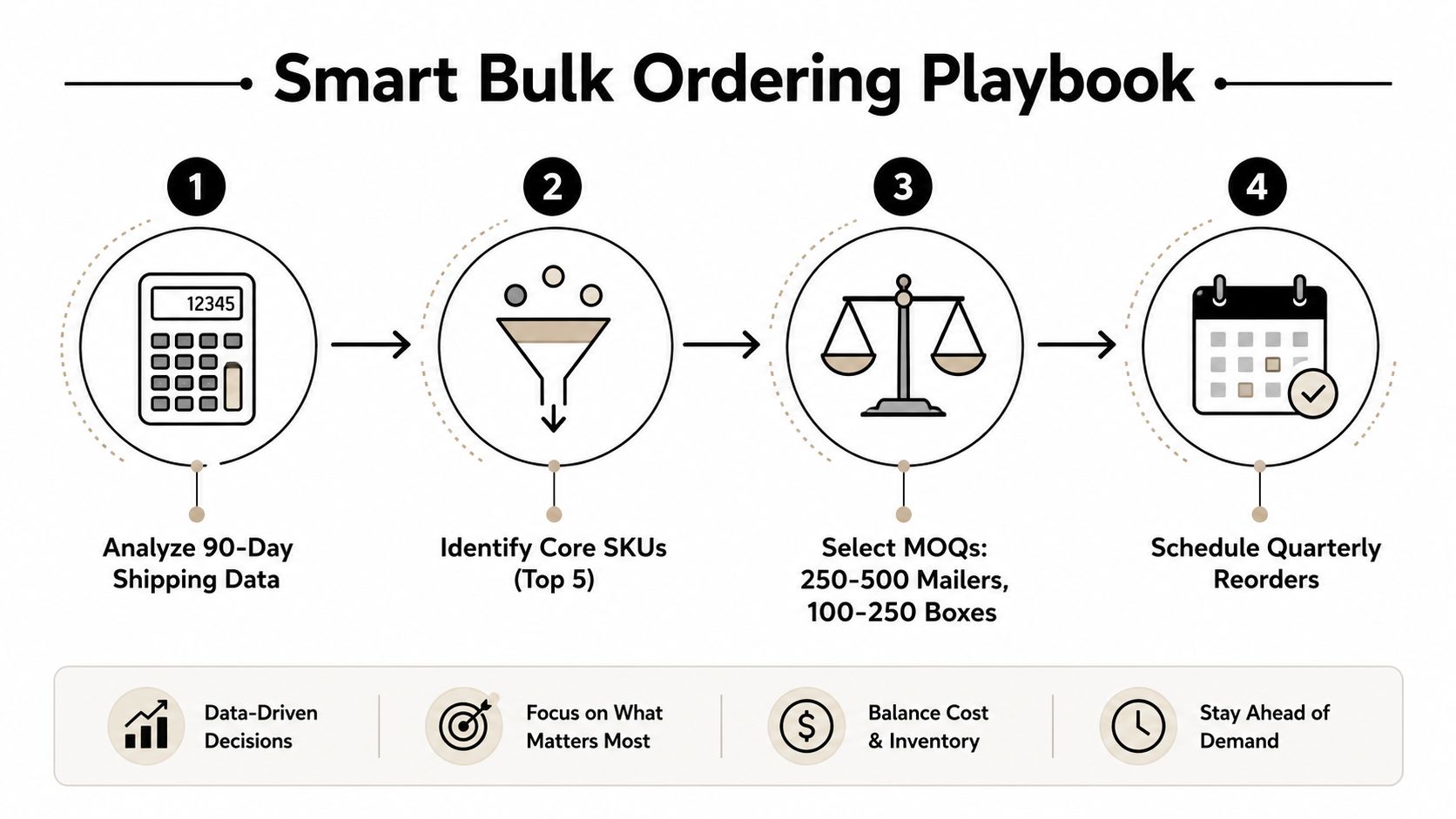
For many small businesses, 250 to 500 mailers or 100 to 250 boxes per size can be a practical starting range when those quantities fit the burn rate. Custom-printed runs may require 1,000 or more units, so verify the artwork, dimensions, and product fit before paying for a large batch. Digital printing may support minimums as low as 50 to 100 units, according to the verified packaging cost data. That option lets a smaller brand test branded packaging without committing to a full production run.
Choose the print method after validating demand
Digital printing suits short runs, multiple SKUs, and artwork that changes regularly. Flexographic printing can fit a stable design with consistently high volume. Avoid setup fees for artwork you expect to revise, and do not add several printed SKUs to reach a supplier’s lower unit price. A cheaper carton that becomes obsolete is still an expensive carton.
Set the reorder point with a formula:
Average weekly usage × lead time in weeks + two weeks of safety stock
Use actual consumption rather than projected sales alone. A rolling 13-week forecast can reveal seasonal movement and help schedule peak packaging purchases 60 to 90 days ahead, provided those intervals match supplier lead times and available cash.
Before placing a purchase order, verify four operating constraints:
- Usage: How many units did each SKU consume during the recent baseline period?
- Storage: Can the cartons stay dry, accessible, and undamaged?
- Lead time: How long will the supplier take to produce and deliver the order?
- Backup: What will you use if the primary supplier misses delivery?
A local pack-and-ship store may hold overflow inventory when warehouse space is tight, but confirm storage terms before depending on that arrangement. If a purchase order strains working capital, review these 2026 purchase order finance tips from Business Loan Warrior before treating a packaging discount as a cash-flow win. Finance only the quantity you can put into orders on a predictable schedule.
Using a Local Pack and Ship Store for Drop-Offs and Overflow
A local pack-and-ship store can fit into the workflow without replacing your entire operation. Use it as a scheduled drop-off point for pre-labeled parcels, a packing resource for irregular products, or an overflow station during busy periods.
The basic process is straightforward. Schedule a pickup or drop-off window, bring parcels with labels already attached, and ask the store to process labels through UPS, FedEx, or USPS when you need carrier guidance. If you’re short on tape, cartons, mailers, or kraft paper, you can also purchase packaging materials during the same visit instead of opening a new supplier account for a small urgent order.
Know when outsourcing packing makes sense
In-house packing usually wins for repeatable products with validated carton sizes. Outsourcing becomes more practical when the order has unusual dimensions, fragile contents, gift-style presentation, or a one-off product that doesn’t justify stocking a dedicated box.
Holiday overflow is another clear use case. Your team can keep packing standard SKUs while the store handles irregular parcels, returns, or last-minute shipments. Professional packing is especially useful when damage replacement would be expensive. One industry source reports that replacing a damaged product can cost an e-commerce business up to 17 times the original shipping cost, according to Amcor’s damaged-pack cost analysis.
Carrier selection should follow the parcel rather than habit. A store operator may compare USPS Ground Advantage for lighter shipments, UPS Ground for many moderate-weight regional parcels, and FedEx when a speed commitment matters. The actual choice still depends on destination, dimensions, service availability, and the current quote.
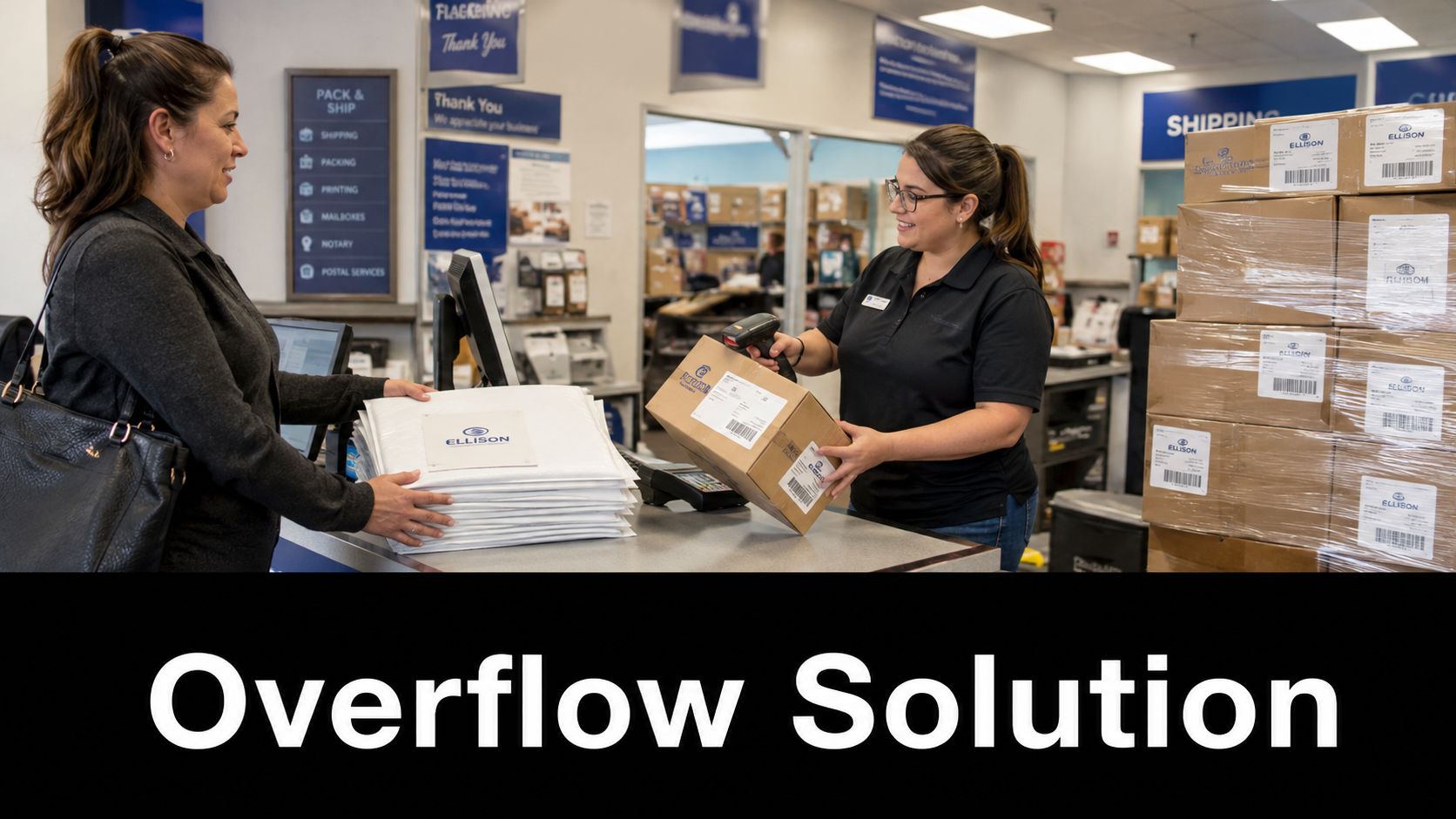
Business Mail Boutique LLC is one local option for packaging supplies, professional packing, carrier drop-offs, tracking, returns processing, and related shipping support. To make the first visit efficient, bring the packed product or a representative sample, your current box dimensions, average packed weight, destination information, label preferences, and a clear description of the overflow problem. You can also use this guide to find a shipping store near Sugar Land.
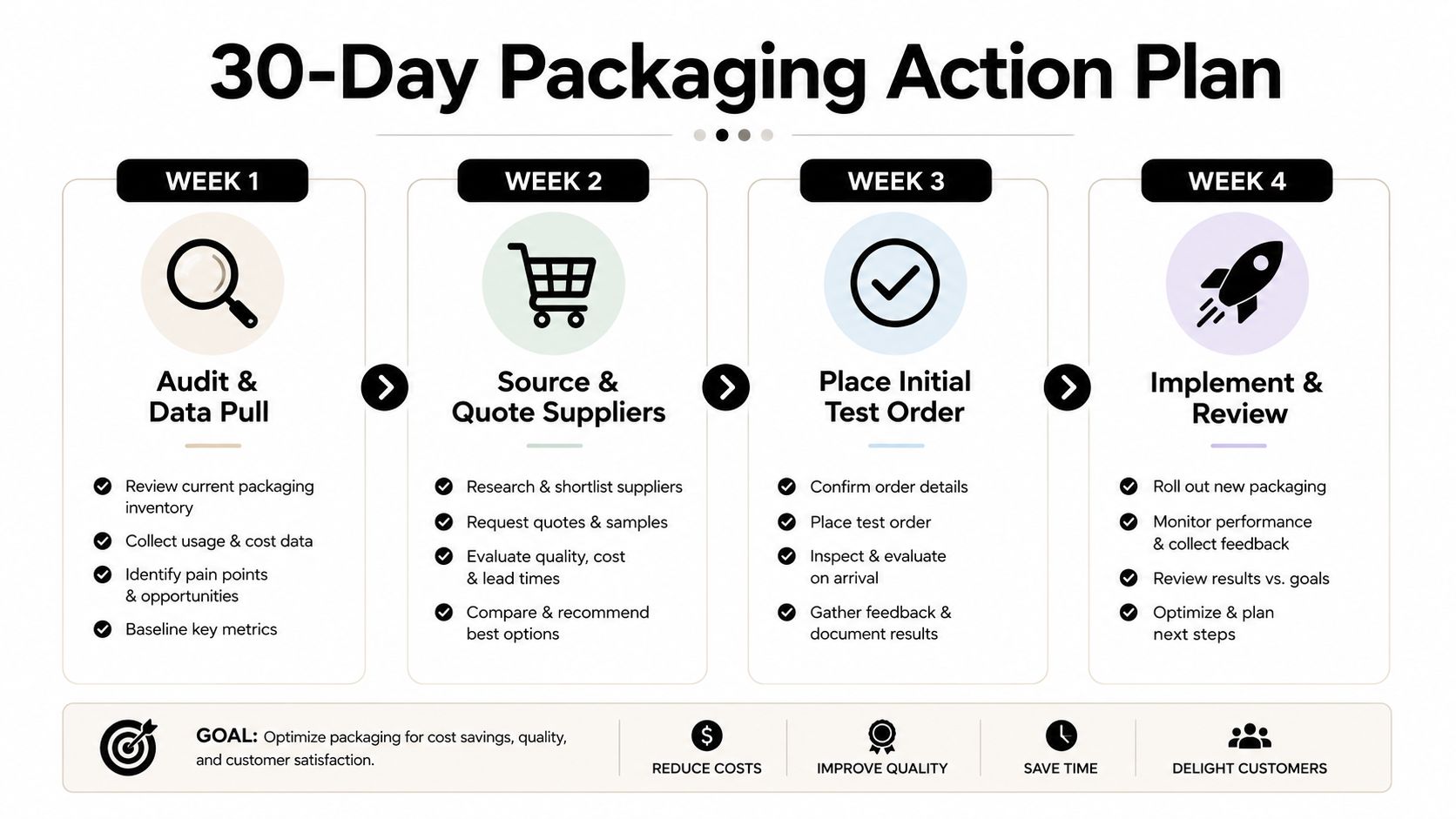
Your 30-Day Packaging Order Action Plan
A packaging reset works better as a short operating project than as an open-ended search for the perfect box. Assign one owner, record the baseline, and make each purchase decision from the same set of measurements.
Week one focuses on evidence
Pull the last 90 days of shipment records and list the five most-shipped SKUs. Record each parcel’s actual weight, dimensions, packaging format, carrier, damage or return notes, and current packaging cost per order. If the data is incomplete, start with invoices, shipping platform records, and a sample of recent parcels rather than guessing.
Week two turns products into package specifications
Measure the top SKUs at their widest points, including lids, tags, spouts, sleeves, and inserts. Build the SKU-to-box mapping sheet, pack test units, weigh finished parcels, and calculate where dimensional weight may affect carrier selection.
Week three compares suppliers and workflows
Request quotes from two bulk suppliers and one local pack-and-ship store. Compare more than unit price. Include minimum order quantity, artwork or setup costs, freight, lead time, storage requirements, replacement policy, and whether the supplier can support a backup order when demand changes.
Week four places a controlled order
Start with a supply sized for roughly 60 days, assuming the quantity matches your measured burn rate and available storage. Set reorder points using the weekly usage formula, then schedule a monthly review of packaging cost per order, damage incidents, dimensional charges, and stock remaining.
End the month with four decisions in writing:
- Custom mailers: Which three SKUs have enough repeat volume and brand value to justify them?
- Plain corrugated: Which products need reliable protection more than printed presentation?
- Overflow support: At what order volume, product type, or seasonal condition will you use the local store?
- Weekly metric: Will you track packaging cost per order, dimensional penalties, damage rate, or a combination that reflects your actual leak?
A useful baseline includes the damage rate and packaging cost per order over 90 days, then segments results by SKU category and carrier. The right-sizing methodology described in this packaging best-practices playbook recommends using 3 to 5 package sizes to cover about 85% of orders, with potential dimensional-weight surcharge reductions of 15% to 30% when implemented correctly. Treat those figures as cited methodology, not a guarantee, and validate the result against your own shipment history.
Business Mail Boutique LLC provides packaging supplies, professional packing, UPS, FedEx, and USPS shipping support, package drop-offs, tracking, and returns processing for small businesses. Visit Business Mail Boutique LLC with your product samples and current package measurements to compare an in-house workflow with local packing and overflow support.

Related posts

Custom Memorial Glasses Engraved in Three Hours in Sugar Land
When a customer needed eight personalized glasses for a memorial, Business Mail Boutique completed the engraving or...

Custom Martini Glass Engraving in Sugar Land, TX
Custom Logo Engraving on Martini Glasses in Sugar Land, Texas.
Business Mail Boutique recently completed a beautiful custom engravin...

Custom Engraved Wine Glasses for a Golf Club Event in Sugar Land, TX
Custom Engraved Wine Glasses for a Golf Club Event in Sugar Land.
Custom wine glass engraving in Sugar Land, TX at Business Mail Bouti...